

The national government took a decisive step in its reform agenda by sending the electoral reform bill to Congress, a wide-ranging initiative aimed at fundamentally modifying the functioning of the Argentine political system. The proposal, which has already entered the Senate, seeks to eliminate PASOs, introduce the Clean Record figure and redefine the funding of political parties, among other structural changes. The political momentum of the initiative was confirmed by President Javier Milei himself, who announced from Israel the sending of the project with a strong message on social networks: “WE ARE ELIMINATING THE STEPS: stop forcing Argentines to pay caste inmates. WE CHANGE FUNDING: Politics ends living out of your pocket. CLEAN SHEET: the corrupt OUT for good. IMPUNITY HAS ENDED. THE FUCK IS OVER. LONG LIVE FREEDOM FUCK...!!”
.The text, consisting of 79 articles, formally entered the Upper House this Wednesday afternoon. There, amendments are proposed to multiple key regulations, including the Organic Law on Political Parties, the Law on the Democratization of Political Representation, Transparency and Electoral Equity, the National Electoral Code and the Law on the Financing of Political Parties. The government's strategy of starting the debate in the Senate responds to the need to build agreements with provincial governors, who are central actors in defining the future of the reform.
In this context, negotiations will be decisive, since many leaders seek their own political guarantees before following the changes proposed by the Casa Rosada.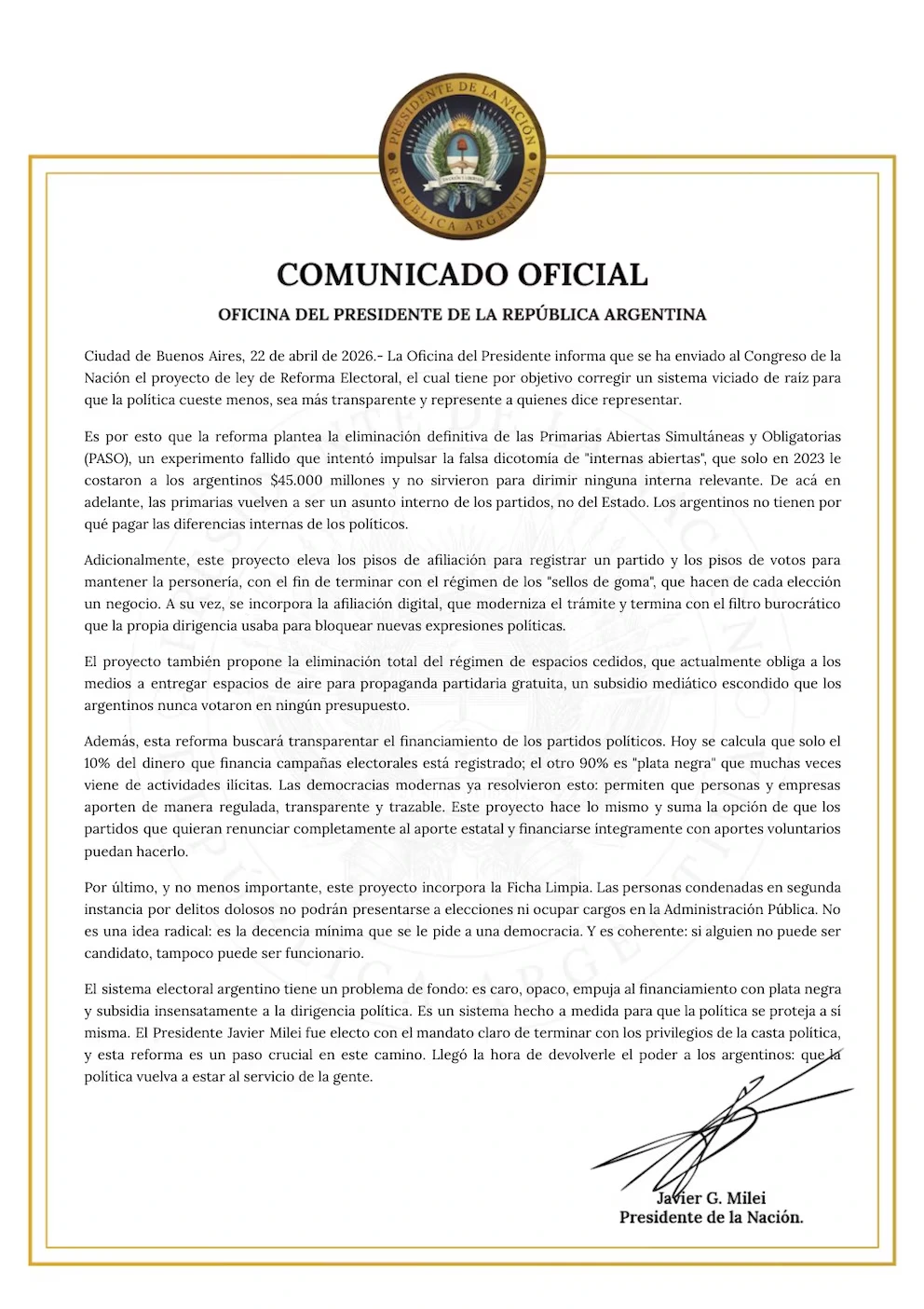
End of STEPS One of the
central axes of the project is the elimination of PASOs at the national level. The initiative argues that internal party women should be organized and financed exclusively by the political forces themselves, without state intervention or the use of public resources. With this measure, the Government aims to reduce spending and strengthen party autonomy.
If this amendment advances, each party or alliance must define its candidates through internal mechanisms, without the mandatory participation of the electorate in that instance.
According to the text, the objective is to prevent taxpayers from continuing to finance internal processes of political groups, consolidating a principle of self-sustainability.New rules for political parties
The reform also redefines the requirements for the constitution and functioning of political parties. To obtain legal-political status, it will be necessary to have at least 50 founding voters per district, in addition to submitting a founding act, declaration of principles, charter, designated authorities, party address and official website. In addition, applicants must declare that they are not part of or founded another force in formation
.After the provisional recognition, groups will have 180 days to accredit members equivalent to 0.5% of the district register, with a limit of 2,000,000 registered, and must call internal elections within a maximum period of 90 days.

To achieve national recognition, it will be mandatory to have a presence in at least ten districts and to gather members equivalent to 0.1% of the national register. The control will remain in the hands of the Public Prosecutor's Office, which may request the expiry in the event of
non-compliance.The causes of loss of personality include: not carrying out interns for four years, not participating in two consecutive national elections, not reaching 3% of the register in successive elections, or violating gender parity in governing bodies.
Clean Record: a limit to impunity The
project incorporates the concept of Clean Record, which will prevent those convicted in the second instance of intentional crimes, serious human rights violations or war crimes from being a candidate or party authority. The registration will be carried out by the National Electoral Chamber and will remain in force until the conviction is revoked or the sentence is