

The Central Bank has already reached 65% of its 2026 goal and today it bought USD 105 million

The Central Bank has already reached 65% of its 2026 goal and today it bought USD 105 million
porEditorial Team
Argentina

With peaks of up to USD 400 million per day, the BCRA has already exceeded USD 6.491 million in the year and is on track to meet, and even exceed, the goal of USD 10 billion, with projections of up to USD 17 billion

Compartir:

In a context of reconfiguration of the monetary and exchange rate scheme, the Central Bank of the Argentine Republic has already reached 65% of its reserve accumulation target for 2026, driven by a sustained pace of purchases that had daily peaks of more than USD 400 million. This performance positions it on a trajectory that not only aims to meet the base objective of $10 billion, but even to approach the projected ceiling of USD 17

billion.

The monetary authority registered a new positive day with the acquisition of USD 105 million, maintaining an average of purchases above the limit of 5% of the daily volume of the Single and Exchange Free Market (MULC), a parameter that had been set as an operational reference. In mid-April, this pace allowed us to exceed 60% of the annual goal, strengthening the optimistic projections of the team led by Santiago Bausili

.
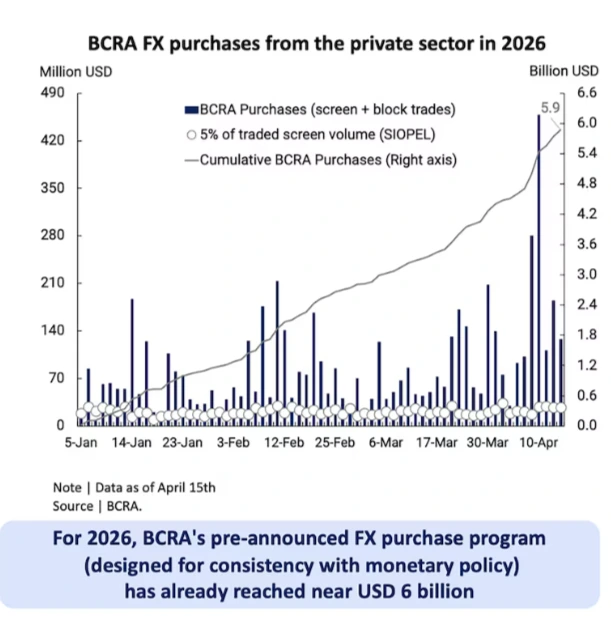
Generally, BCRA purchases exceeded 5% of the volume traded in the MULC.

In parallel, the BCRA accumulates 72 consecutive days with a buyer balance, combining direct interventions and block transactions with companies. On the last day alone, it totaled USD 235 million, while the cumulative total for the year already exceeds USD 6,491 million, consolidating more than half of the objective set within the new monetary regime.

Private estimates also support this trend. The consultancy firm Analytica estimated purchases of USD 6.02 billion since the start of the program, which represents 171.5% above the 5% limit of the MULC and is equivalent to 60% of the base goal of USD 10 billion. The volume purchased even exceeded the prudential metric of $5,161 million, driven by a sustained pace since the

second week of February.

The good performance was highlighted by the vice-president of the BCRA, Vladimir Werning, during meetings with investors in Washington D.C., where he presented evidence that on most days purchases exceeded the 5% threshold of the MULC. In April alone, the bank already accumulated close to USD 2 billion, evidencing an acceleration compared

to previous months.

Milei, Caputo and Bausili

During the presentation of “Phase 4” of the economic program, Santiago Bausili explained that the accumulation of reserves responds to the dynamics of demand for money and the liquidity of the exchange market. The base scenario envisages an expansion of the monetary base from 4.2% to 4.8% of GDP by December 2026, with purchases of USD 10 billion. However, with an additional increase in demand for money equivalent to 1% of GDP, acquisitions could scale to USD 17 billion without the need for

prolonged sterilization.

The intervention scheme, which alternates between direct purchases and block transactions, made it possible to consolidate reserves even in a context of liquidity fluctuations. The days with purchases exceeding USD 400 million reflect the intensity of the process

.

In this regard, Javier Milei himself and Economy Minister Luis Caputo emphasized the importance of this strategy, pointing out that “if the BCRA were not buying reserves, the dollar would be at $1,100 instead of $1,375 as it closed on Tuesday”, highlighting the stabilizing role of exchange policy.

Currently, gross international reserves are around USD 45 billion, while net reserves continue to grow gradually. The key going forward will be to sustain the pace of accumulation and prevent expansion from being diluted

.
Central Bank of the Argentine Republic

During his exhibition in the United States, Vladimir Werning identified three central factors that support the continuity of the accumulation process:

First, the fall in retail demand for dollars. The monthly average went from USD 2.5 billion before the elections to USD 800 million later, which, according to the official report, implies that these operations are now channeled into the local system. “After the elections, household demand for foreign exchange plummeted and these purchases are now being made in the country, supporting deposits and loans in US dollars,” the presentation highlighted

.

Second, the return of corporate funding. From October 2025 to April 2026, companies issued negotiable bonds for $9.9 billion, of which only $6.8 billion were liquidated in the market. This leaves a remnant of $3.2 billion as a potential foreign exchange supply in the coming months, reinforcing the

prospect of accumulation.

Finally, the impact of the Large Investment Incentive Regime (RIGI). Projects under this scheme generated net revenues of USD 762 million as of March 2026, with a gross flow of USD 1,205 million and expenditures of USD 452 million. According to the presentation, “foreign exchange inflows from foreign direct investment related to long-term RIGI approved projects are already being used

.”

Noticias relacionadas

An organization linked to Turkish Islam builds the largest mosque on the European continent in France

An organization linked to Turkish Islam builds the largest mosque on the European continent in France

Javier Milei sent the electoral reform: end of the PASO, elimination of funding and a clean record for candidates

Javier Milei sent the electoral reform: end of the PASO, elimination of funding and a clean record for candidates

Thanks to Milei, child poverty fell again and reached its lowest level since 2018

Thanks to Milei, child poverty fell again and reached its lowest level since 2018

Democrats imposed a new electoral map in Virginia and eliminated Republican representation in the state

Democrats imposed a new electoral map in Virginia and eliminated Republican representation in the state

The Rule of Law in Uruguay is in CTI: Judge Iris Vega Ottonello must resign today or be dismissed

The Rule of Law in Uruguay is in CTI: Judge Iris Vega Ottonello must resign today or be dismissed

Kirchnerism rejects a pro-market reform of Zdero in Chaco to generate economic growth

Kirchnerism rejects a pro-market reform of Zdero in Chaco to generate economic growth

La Derecha Diario logo
ESX logoInstagram logoYouTube logoTikTok logo
ARGENTINABOLIVIAECUADORISRAELMEXICOURUGUAYDERECHA DIARIO TV
  • ESXInstagramYouTubeTikTok
  • DERECHA DIARIO TV
  • Secciones
  • ARGENTINA
  • BOLIVIA
  • ECUADOR
  • ISRAEL
  • MEXICO
  • URUGUAY
  • Países
  • La Derecha Diario logoLA DERECHA DIARIO
  • La Derecha Diario México logoLA DERECHA DIARIO MÉXICO
  • La Derecha Diario Uruguay logoLA DERECHA DIARIO URUGUAY
  • La Derecha Diario Ecuador logoLA DERECHA DIARIO ECUADOR
  • La Derecha Diario Bolívia logoLA DERECHA DIARIO BOLÍVIA
  • La Derechadiario República Dominicana logoLA DERECHADIARIO REPÚBLICA DOMINICANA
  • La Derecha Diario Israel logoLA DERECHA DIARIO ISRAEL
  • La Derecha Diario Estados Unidos logoLA DERECHA DIARIO ESTADOS UNIDOS
  • Temas
  • GUERRA EN IRÁN
  • JUICIO POR YPF
  • El Diario
  • QUIENES SOMOS
  • AUTORES
  • PUBLICIDAD
  • DONAR
La Derecha Diario logo
TwitterInstagramYouTubeTikTok
Derecha Diario TV

Nosotros

  • Quienes Somos
  • Autores
  • Donar

Privacidad

  • Protección de datos
  • Canales
  • Sitemap

Contacto

  • info@derechadiario.com.ar
PUBLICIDAD






