The left is trying to present this discussion as a battle between business owners and workers. It is a deliberate falsification. The real division is between those who manage scarcity and those who bet on value creation, between those who live off conflict and those who believe in the prosperity that arises from private initiative, between those who need an impoverished country to sustain their narrative and those who seek a productive Argentina, integrated into the world and capable of generating real opportunities.
It is no coincidence that more than 70% of those surveyed support the labor reform. Society perceives that the previous model failed. It perceives that the promise of protection ended up being exclusion. It perceives that, for the first time in a long time, there is a political decision to confront the mafias that became rich from paralysis.
For more than half a century, the left turned labor law into an ideological totem, a moral banner with which it justified suffocating regulations, expropriatory rulings, and unions turned into corporations. In the name of "protection", they built a system that pushed millions out of the formal market and consolidated a caste that lives off permanent conflict. Today, when that building is starting to creak, they shout "loss of rights". But what is really cracking is not the "rights": it is the scaffolding of privileges that guarantees them power, money, and control over millions of workers.
The truth that makes those who turned statism into an unquestionable faith uncomfortable is simple and brutal: employment is not imposed by decree, it is caused when there are incentives to invest, produce, and hire. It is created when the rules allow hiring to be more profitable than not doing so. No business owner —large, medium, or small— can sustain a job if the total cost exceeds the productivity that this worker generates. It is not an ideological issue. It is basic mathematics. However, for decades legislation was passed as if economic reality could be bent by political will.
The result is plain to see. Argentina has fewer companies per inhabitant than most countries in the region. Where there are fewer companies, there is less competition, less investment, and fewer opportunities. The left talks about "acquired rights", but it avoids taking responsibility for the balance sheet of its own model: millions of people trapped in informality or depending on a welfare plan.
El Gobierno denunciará por terrorismo a los responsables de la violencia en el Congreso
The Argentine labor market was transformed into a system of perverse incentives. Litigating became more profitable than producing. The lawsuit industry grew while the real industry shrank. The unions stopped representing workers and started representing their own structures, with multimillion-dollar coffers and the capacity for street pressure. Every reform was blocked under the argument of "social justice". Every blockade consolidated stagnation.
In the face of this scenario, the labor modernization driven by Javier Milei's government is not a concession or a symbolic gesture: it is a regime break. It doesn't target the worker, but the regulatory maze that turned the worker into the adjustment variable of a system that manages scarcity to justify its own existence. For decades, unemployment was functional to the narrative; it allowed subsidies, coffers, and power structures to be sustained. Breaking that logic implies restoring centrality to those who produce and those who take risks. Because dignity doesn't arise from a welfare plan but from work. Work only flourishes where there are clear rules, predictability, and freedom to hire.
For years, the idea was established that the subsidy was a right and effort was a cruel imposition of the market. That narrative produced generations trapped in dependency. The current proposal reverses that logic: training instead of clientelism and freedom to hire without fear of a lawsuit that destroys what has been built. It is not about abandoning anyone; it is about no longer condemning millions to permanent marginalization.
El Gobierno denunciará por terrorismo a los responsables de la violencia en el Congreso
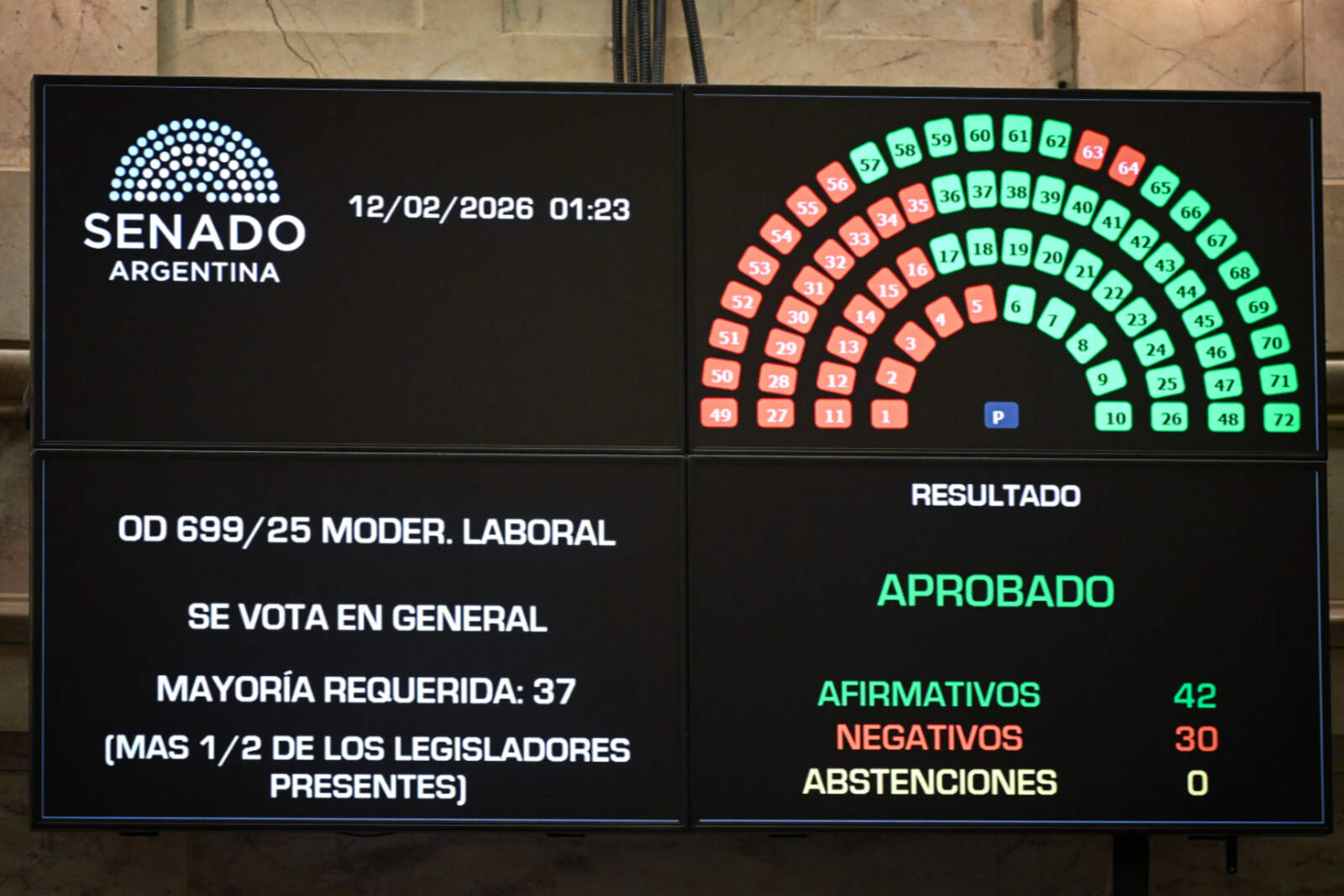
The preliminary approval of the labor modernization bill was not just another vote. It was a sign that the country is beginning to abandon the immobility that condemned it for decades. The debate in the Chamber of Deputies is still pending, as are the pressures and attempts at sabotage. But the axis has already changed. The discussion is about how to generate employment, not how to manage its absence.
The future of work is at stake because what is at stake is something deeper: the very idea of economic freedom. Persisting in a scheme that destroys companies and multiplies subsidies is not compassion; it is suicide. Modernizing is not taking away rights; it is restoring possibilities.
Argentina faces a historic decision. It either remains anchored in a past of rigidity, litigation, and decline, or it opens the door to a dynamic, competitive labor market oriented toward value creation. What is being voted on is not just a law. What is being voted on is whether work will once again be the engine of social mobility or whether it will remain a hostage of a system designed to fail.