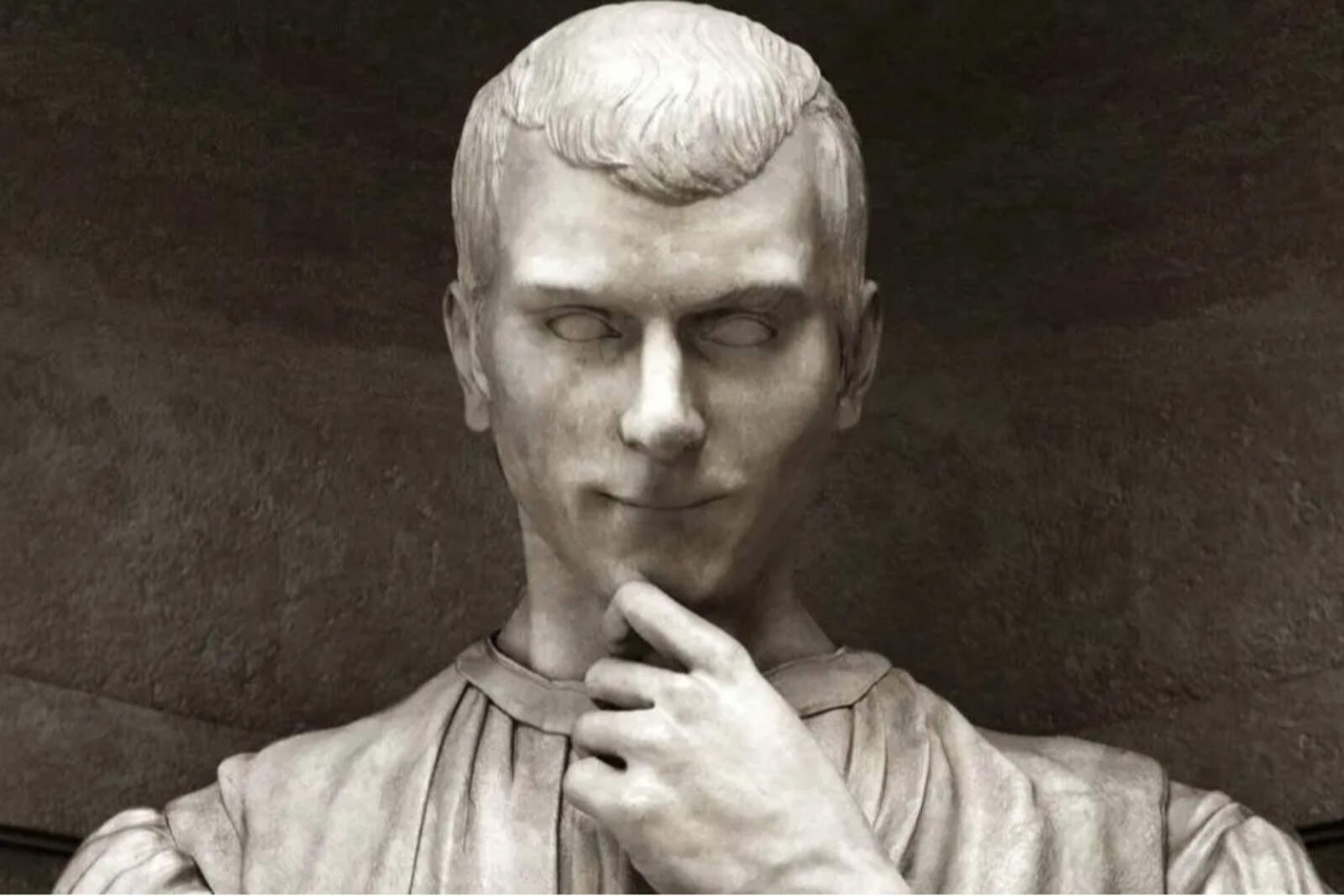
"Machiavelli is dead." This is how Javier Milei opened his speech in Davos, in the very heart of globalism. It was not a rhetorical phrase. It was a frontal challenge to the idea that sustained centuries of political domination: that power can violate moral principles if it promises good results.
For far too long, politics justified itself under a premise as simple as it was lethal: the end justifies the means. Under that logic, power claimed the right to expropriate, regulate, censor, indebt, and impoverish, always in the name of a higher cause. The problem is not that this logic has been poorly applied. The problem is that it is false from its root.
The error doesn't lie in the fact that politics sometimes goes too far, but in believing that it can be morally legitimate. Political power is not a neutral referee that occasionally becomes corrupt: it is an institution structurally based on coercion. To claim to moralize it is to attempt to humanize a mechanism designed to impose decisions by force.
When people say that politics must submit to ethics, the inevitable conclusion is even more uncomfortable: if ethics forbids aggression, then politics, as we know it, is incompatible with ethics. It is not because it fails, but because its basic functioning rests on the threat and use of violence.
This point becomes crucial in the current context, where agendas proliferate that present themselves as "humanist," "inclusive," or "solidary," but that deep down still demand more political power, more central planning, and more control over people's lives. People no longer speak of socialism in classic terms. It is disguised with morally seductive language.
The problem is not aesthetic. It is ontological. Behind these "elegant" agendas, the same socialist core as always persists: the denial of private property, the dissolution of individual responsibility, and the belief that an elite can decide for others what is just. The words change, not the logic. That logic remains deeply unethical.
Here it becomes inevitable to recall Thomas Sowell, who warned that socialism always appeals to good intentions but ends up producing catastrophic results. It is not because of an implementation error, but because it starts from an unsustainable premise: that it is possible to violate essential principles without paying a devastating human cost.
The case of Venezuela is not an anomaly. It is the logical consequence of having accepted that the State can decide everything. The economic collapse, the social destruction, and the consolidation of a narco-dictatorship were not accidental excesses, but the foreseeable outcome of a system that eliminated any real limit on political power.
None of that happened overnight. It happened gradually, always justified by a "higher end": equality, social justice, popular sovereignty. That is the real danger of Machiavellianism: it doesn't present itself as open tyranny, but as a moral necessity. When that logic is accepted, there is no longer any possible institutional or ethical brake.
This is why saying that Machiavelli is dead doesn't mean that politics must "recover." It means something deeper: that we must stop thinking of politics as the central instrument of social organization. The alternative is not more ethical power, but less power. Not a moralized State, but voluntary relationships, free contracts, and cooperation without coercion.
The West is not in crisis because of a lack of good rulers. It is in crisis because it has accepted for far too long the idea that someone has the right to rule the lives of others. The real way out doesn't involve humanizing power, but desacralizing it.
In that sense, the phrase "Machiavelli is dead" doesn't announce the rebirth of politics. It announces something more radical: the beginning of the definitive questioning of political power as a legitimate institution. Meanwhile, that questioning today is beginning to make itself heard from an unexpected place: Argentina. It had been more than one hundred years since Argentina had a President who, from a moral perspective, could stand before the world to defend Western civilization. History is being written before our eyes.