The U.S. Secretary of State stated that Washington has a concrete proposal to reopen the Strait of Hormuz and continue nuclear negotiations with Tehran without lifting economic pressure.
The partial closure initiated by Iran after the start of the regional war caused significant global energy tensions and disrupted international maritime trade.
The possibility of a détente quickly impacted the markets: on Monday, international oil prices recorded declines of over 5% for both Brent and WTI.
Washington maintains pressure on the Iranian nuclear program
Despite diplomatic advances, Rubio insisted that the nuclear chapter remains the most delicate point of the negotiation.
“Nuclear negotiations are very technical matters. You cannot resolve a nuclear issue in 72 hours on the back of a napkin,” he declared to the New York Times.
The United States asserted on Monday that it is close to reaching a “fairly solid” agreement with Iran to move towards the reopening of the Strait of Hormuz and continue diplomatic negotiations with Tehran, although President Donald Trump avoided raising expectations for an immediate announcement and reaffirmed that he will not sign a “bad deal.”
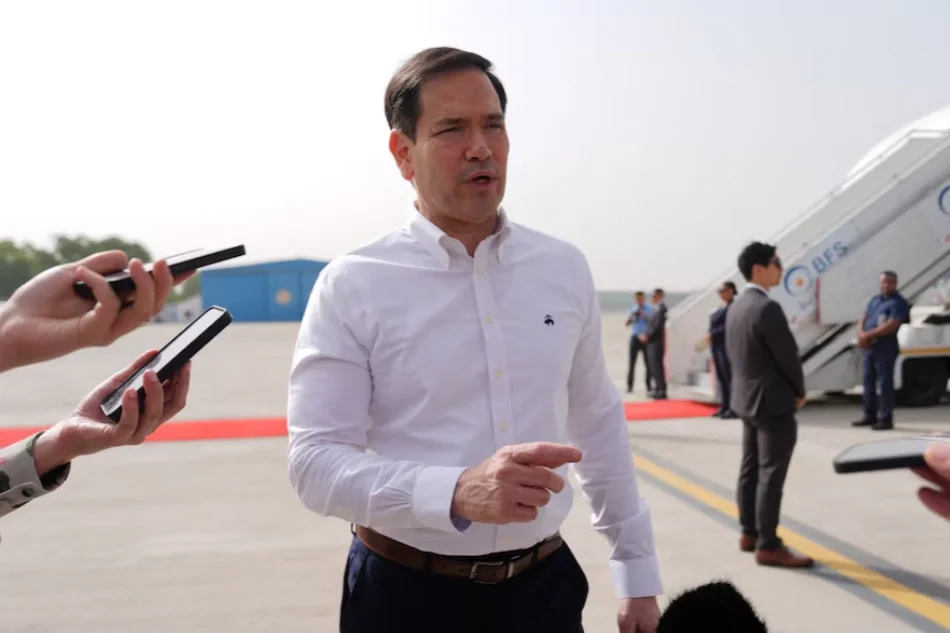
U.S. Secretary of State Marco Rubio stated from New Delhi that Washington has already presented a concrete proposal that would help alleviate part of the regional crisis and reactivate maritime traffic through one of the planet's most important energy routes.
Marco Rubio confirmed progress with Iran
“We have something on the table that, in my opinion, is quite solid in terms of its ability to open the Strait of Hormuz, but also to engage in negotiations about the Iranian nuclear program,” Rubio declared during his official visit to India.
The head of U.S. diplomacy clarified, however, that there are still political and technical issues pending before a definitive understanding.
“We thought we might have news last night or maybe today, but I wouldn’t put too much importance on it,” he added.
Trump tempered expectations for an immediate agreement
Rubio's statements came after Donald Trump lowered the tone regarding the possibility of an imminent announcement with Tehran.
“I have instructed my representatives not to rush (...) because time is on our side,” the U.S. president wrote on Truth Social.
Trump also made it clear that the United States will maintain economic pressure on the Iranian regime as long as there is no definitive agreement.
“The blockade on Iranian ports will remain in full force,” he asserted.
Marco Rubio stated that the US has a "solid" proposal to open the Strait of Hormuz.
Rubio fully supported that strategy and assured that the Republican administration will not accept rushed concessions.
“The president is not in a hurry. He is not going to make a bad deal and he is not going to sign a bad agreement,” he stated.
The Strait of Hormuz remains the central axis of the conflict
The eventual agreement would allow for the partial or total reopening of the Strait of Hormuz, a strategic maritime route through which approximately one-fifth of the oil and gas consumed in the world passed before the conflict.
The United States and Israel maintain that Iran seeks to develop nuclear weapons under civilian cover, while Tehran insists that its program is solely for energy and scientific purposes.
Marco Rubio stated that the US has a "solid" proposal to open the Strait of Hormuz.
Netanyahu demands the elimination of the “nuclear threat”
Israeli Prime Minister Benjamin Netanyahu asserted on Sunday that he fully agrees with Trump regarding the conditions that a potential definitive agreement with Iran should meet.
“This involves dismantling Iran's uranium enrichment facilities and removing enriched nuclear material from its territory,” Netanyahu stated after a phone conversation with the U.S. president.
Israel believes that any agreement that does not completely eliminate Iran's nuclear capability represents a direct threat to its security.
The regional conflict remains open
As diplomatic talks progress, military tension in the Middle East remains active.
The Lebanese Ministry of Health reported on Monday that two people died from new Israeli attacks in the south of the country, despite the ceasefire in effect since April.
For its part, the Israeli army confirmed the death of one of its soldiers during recent operations in Lebanese territory.
Rubio reiterated from India Washington's full support for Israel.
“Israel always has the right to defend itself. Every country in the world has that right,” the Secretary of State asserted.