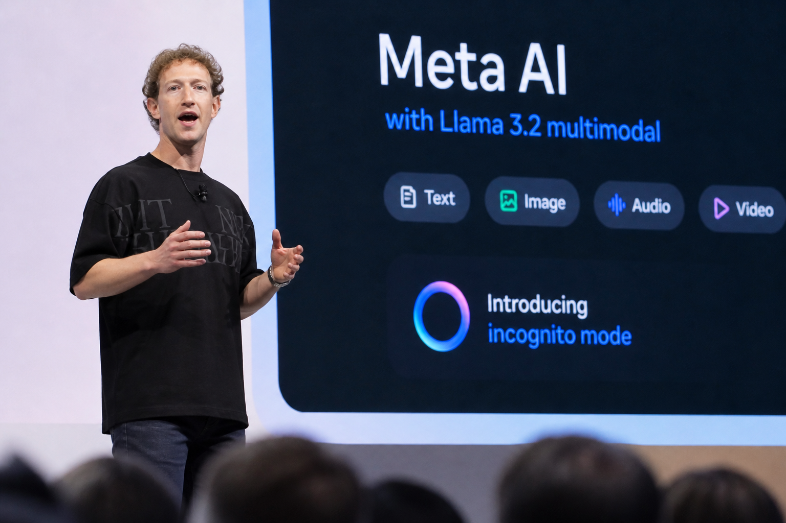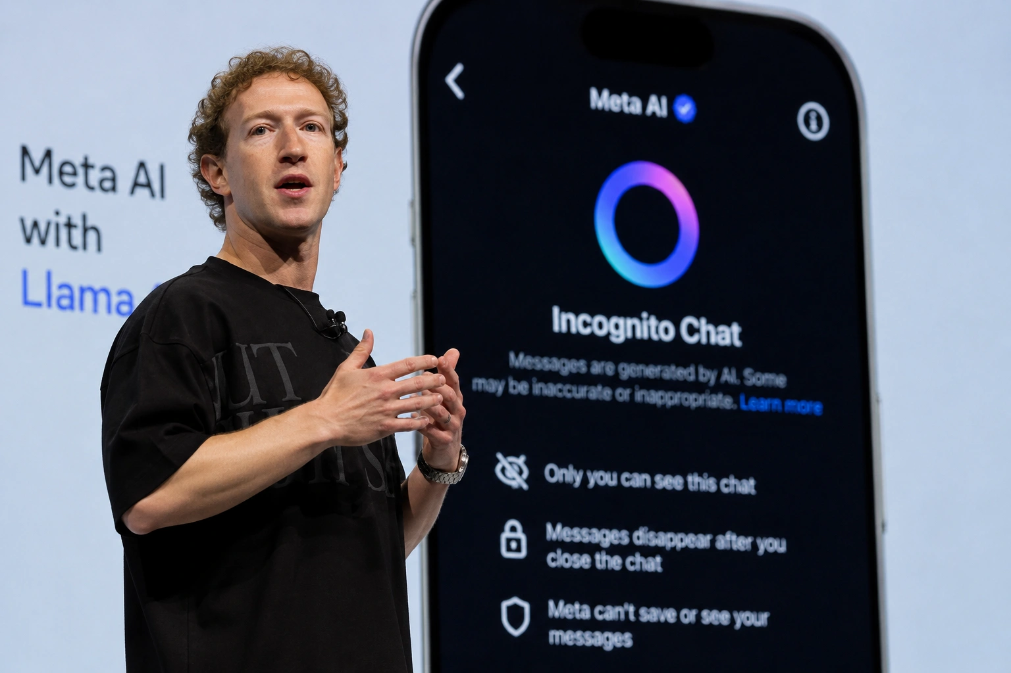

The new Incognito Chat feature does not store records on servers and uses end-to-end encryption, setting it apart from other AI chatbots that retain data for days or months.
Mark Zuckerberg introduced Incognito Chat, a new feature for Meta AI that promises to be the first major artificial intelligence product with total privacy. According to the CEO of Meta, in these chats, no records are stored on the company's servers.
The messages disappear once the user ends the chat session, similar to the incognito modes of other AI assistants. However, Meta emphasizes that its version goes further because it incorporates end-to-end encryption, meaning that no one, not even the company itself, can read the conversations.
“Other apps have launched incognito modes, but they can still see the questions that come in and the answers that go out. Incognito Chat with Meta AI is truly private,” Zuckerberg noted. This feature clearly differentiates it from competitors like Google's Gemini or ChatGPT.
For example, Google retains temporary chat data for up to 72 hours, while in ChatGPT, temporary chats can be stored for up to 30 days. In Claude, incognito chats are kept for at least 30 days.
Privacy at the Center of the Discussion
The announcement comes at a time when the privacy of interactions with AI is under scrutiny. Recent lawsuits in the United States and Canada have highlighted how records of conversations with tools like ChatGPT were used in mass shooting cases. Even The New York Times obtained a court order to have conversations stored indefinitely.

Meta, for its part, builds this feature on the Private Processing technology it launched last year to process data in WhatsApp. The new Incognito Chat option will be implemented in the coming months in both WhatsApp and the Meta AI app.
It is striking that this push for privacy in AI comes shortly after Meta removed end-to-end encryption in direct messages on Instagram, a decision that drew criticism from users concerned about security.
Zuckerberg's move aims to position Meta as a more privacy-respecting alternative in a market dominated by chatbots that store data for extended periods. This could attract those looking to converse with AI without leaving a digital footprint.
Experts point out that while the approach is positive, the real challenge will be in how it is implemented and whether the promise of not storing any information is truly fulfilled. For now, Meta promises that messages are automatically deleted at the end of the session.
The feature adds to other initiatives by the company regarding privacy, although it still raises doubts among those closely following changes in data policies of major tech companies. With the planned gradual rollout, WhatsApp and Meta AI users will soon be able to try this more secure and ephemeral chat option.
In a context where AI is increasingly part of everyday life, initiatives like Incognito Chat respond to the growing demand for tools that respect users' personal information without compromising functionality.