At the same time, the Buenos Aires administration moved forward with the suspension of the MESA plan, which means cutting funding for canteens and food assistance throughout the territory. The decision makes it clear that defunding is not limited to security forces, but even reaches the role of social containment.
In the midst of an increasingly evident security crisis in the Buenos Aires suburbs, different mayors began to promote the creation of municipal police as a response to the deterioration of the provincial scheme. The case of San Isidro, led by Mayor Ramón Lanús, became one of the clearest examples of
this trend.
Lanús confirmed that he seeks to move forward with his own local force, although for this he needs a law that must be approved today by the Buenos Aires Legislature. It is not the only one: several municipalities are already beginning to distance themselves from a provincial scheme that they consider incapable of dealing with insecurity
.
A province without direction and confronted with its own police
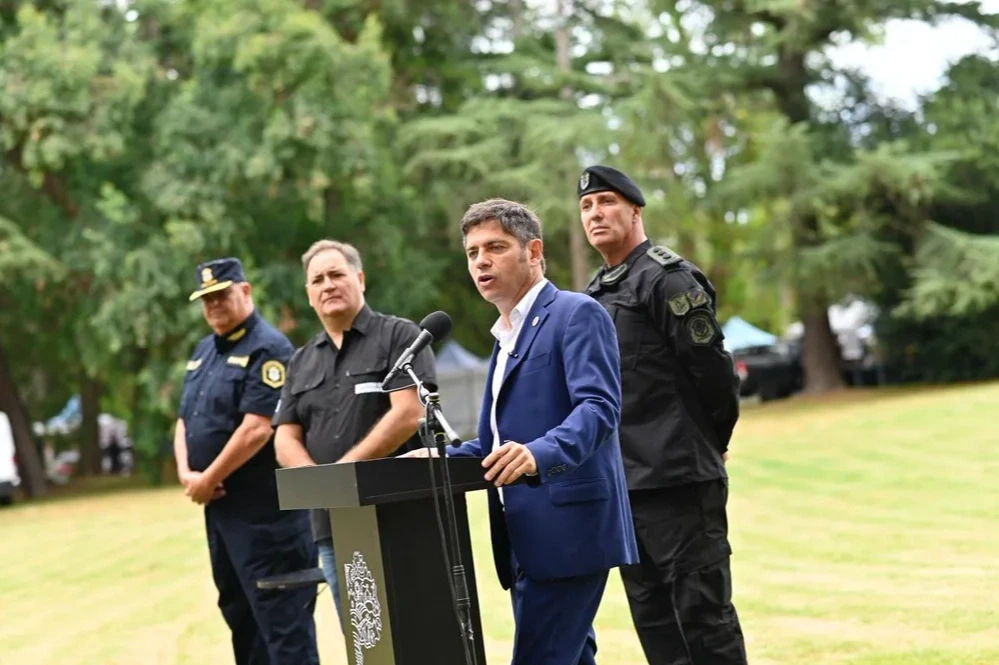
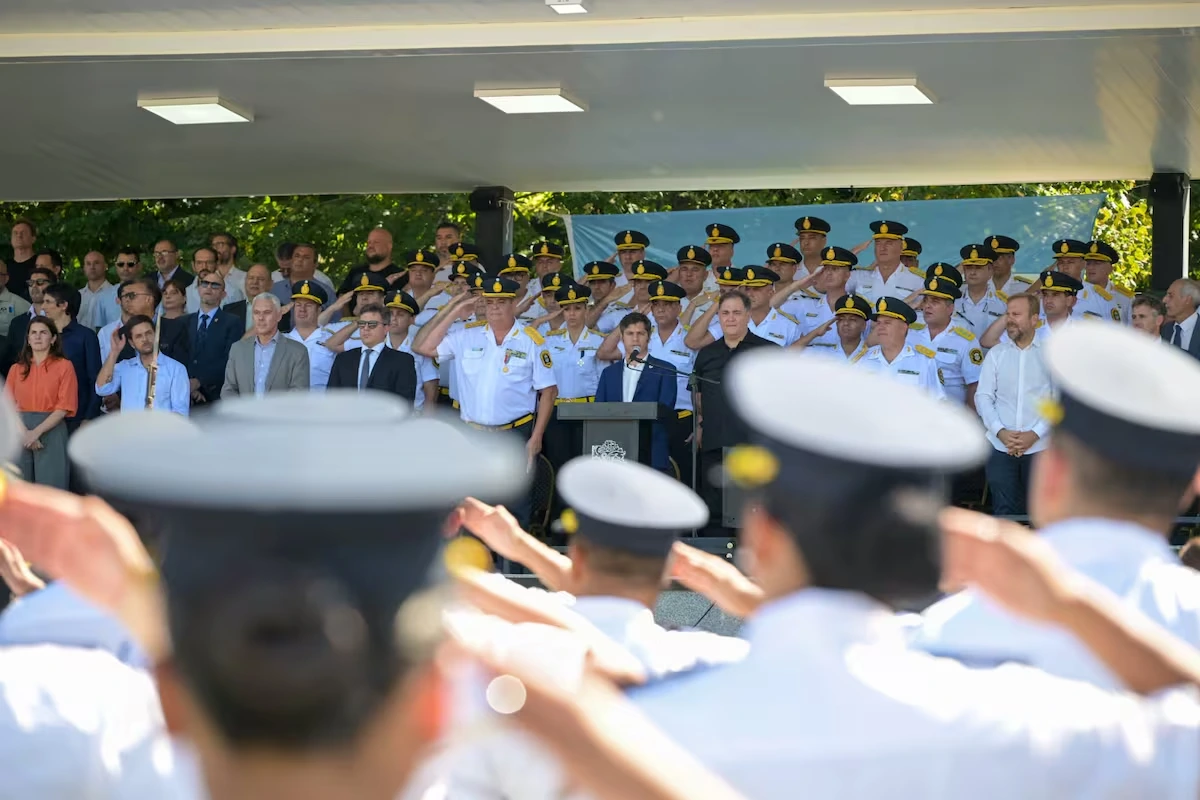
Kicillof was insulted at the events of the Buenos Aires Police School.
The background of this municipal advance is not only explained by a question of autonomy, but also by the deterioration of provincial security management. In recent weeks, Governor Axel Kicillof himself was exposed at the Buenos Aires Police School, where he wasbooedduring an official ceremony
by officers demanding wage improvements.
The episode revealed a growing malaise within the force, marked by structural problems in salaries, equipment and working conditions. With authority already eroded, the provincial government chose to minimize what happened and push, making as little noise as possible, the idea of “municipal autonomy” out
Kicillof defined his priorities together with Kirchner mayors.
In this scenario, security appears as another area affected by the same logic. With a conflicted police force and increasingly tight resources, the Province is facing increasing difficulties in maintaining minimum levels of prevention
and control.
While security resources are being cut and funding for food assistance is eliminated, the Executive keeps political spending and an oversized state structure intact, leaving basic functions such as security and social containment in the background.
The escape from responsibility
Kicillof with Buenos Aires police. While the provincial government is trying to set up the “debate” about local police, the logic behind it is to transfer responsibilities to municipalities instead of solving the underlying problem. Enabling mayors to take charge of security appears as a way to get rid of a basic function that corresponds to the provincial State
.
In this context, opposition mayors stress that their priority is to take care of their neighbors, even though security is formally a competence of the Province. They seek that municipalities have their own operational capacity to intervene where the Province should act, but it does not