
In a decisive turn for recent economic history, Argentina has begun to break the back of the inflationary scourge under the firm leadership of President Javier Milei. The Consumer Price Index (CPI) recorded a figure of 2.6% in April, marking the first real deceleration after ten exhausting months of an upward trend inherited from Kirchnerism.
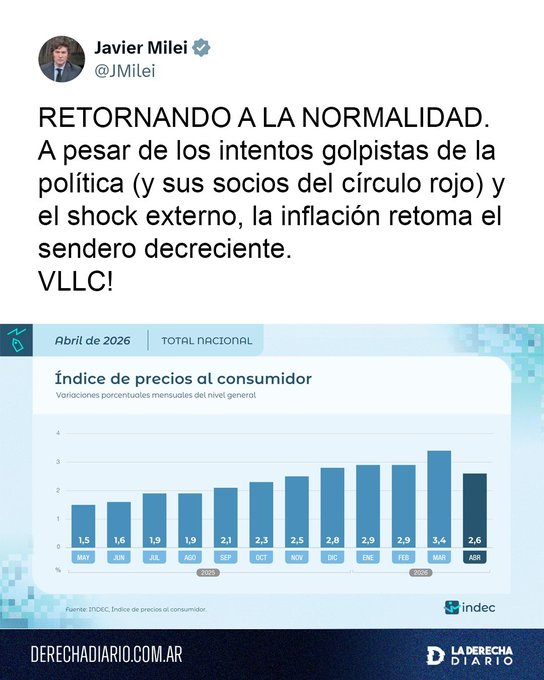
This triumph of economic freedom was celebrated by the president, who declared: “Returning to normal. Despite the coup attempts by politics (and their partners in the red circle) and the external shock, inflation is back on a declining path.”
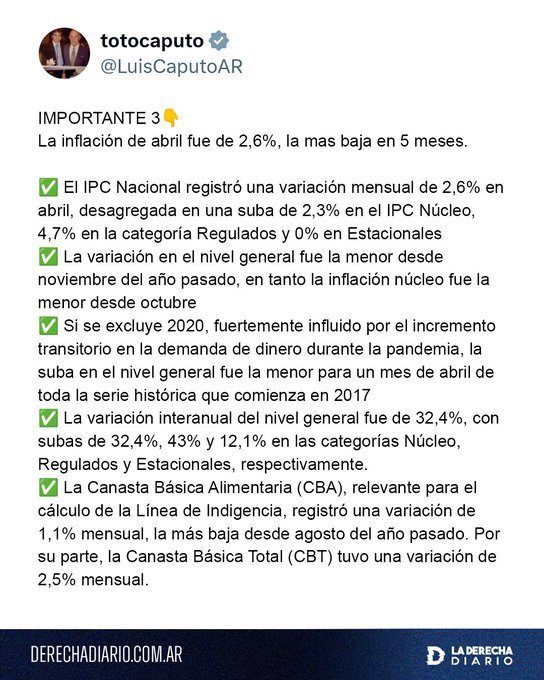
The management of Economy Minister Luis Caputo has achieved what many considered impossible: placing the price variation at the lowest level in five months. According to the head of the Treasury, if we exclude the year 2020 due to the pandemic distortion, the overall price increase in this April has been the lowest in the entire historical series that began in 2017.
This data is not isolated, as core inflation stood at a hopeful 2.3%, the lowest record since October of last year.
Diving into the technical details that certify this success, Indec confirmed that the slowdown from the 3.4% in March is a compelling fact. In year-on-year terms, the figure stands at 32.4%, with a cumulative of 12.3% so far this year, figures that are strictly within the ranges forecasted by the official economic team.
A fundamental aspect for social well-being is the evolution of the Basic Food Basket (CBA), essential for measuring indigence, which recorded a variation of just 1.1% monthly, its lowest mark since August of last year. Meanwhile, the Total Basic Basket (CBT) showed an increase of 2.5% monthly, consolidating real protection over purchasing power against the escalation the country had been suffering.