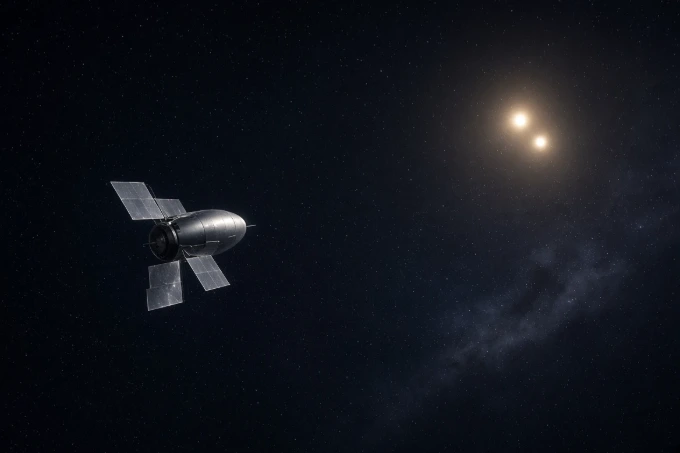
A nonprofit organization called Fermi Explorer Mission announced its intention to launch a spacecraft to Alpha Centauri, the closest star system to Earth, before the end of 2029. This is a project of enormous scope: if everything goes as planned, the journey could take up to 80,000 years to cover the 4.4 light years that separate us from that destination.
The trajectory that the probe will follow is unconventional. It was discovered by an artificial intelligence system developed by Physical Superintelligence (PSI), an AI-driven physics research lab backed by $58 million in funding, led by Breakthrough Energy, the climate investment group founded by Bill Gates.
This is not the first attempt of its kind. In 2016, investor Yuri Milner introduced Breakthrough Starshot, an initiative proposing to propel tiny probes with powerful lasers to reach one-fifth the speed of light and arrive at Alpha Centauri in about 20 years. He promised $100 million for a proof of concept, but a decade later, nothing has been launched.
“We didn’t want to do another Breakthrough Starshot,” says Philip Johnston, co-founder and president of the Fermi Explorer mission. “We are firmly committed to actually launching something.”
A limited budget and a symbolic payload
The new mission, funded by private donors, aims for a cost of just $15 million. To stay within that framework, the team decided not to limit itself to a journey that could be completed in a human lifetime. “Let’s just find a way to get to another star,” summarizes Johnston.
The spacecraft will carry a payload of at least one kilogram. It will include artistic and scientific elements, messages, and a copy of the Golden Record, the gold-plated disc with sounds and images of Earth that NASA placed on the Voyager probes in 1977 as a message to potential civilizations.
Reaching Alpha Centauri is an extreme challenge. It is about 25 trillion miles away. Voyager 1, one of the fastest objects humanity has sent into space, has been traveling since 1977 and has yet to complete 1% of that journey. At that pace, the trip would exceed 70,000 years.
For a year, the Fermi team unsuccessfully searched for a way for a small, low-cost solar-powered spacecraft to complete the journey. The main obstacle was how to provide enough energy without significantly increasing its weight and, therefore, its fuel consumption.
The solution found by artificial intelligence
Johnston mentioned the problem on a podcast hosted by Alex Wissner-Gross, a physicist and co-founder of PSI. The researcher offered to process it with Get Physics Done, an open-source software that breaks down a physics question into smaller tasks and decides which simulations to run, using models like Claude or GPT.
A week later, the system found a novel trajectory that combined known orbital maneuvers in a way that the human team had not contemplated. The proposal suggested that the spacecraft first decelerate to bring its orbit closer to the Sun, even closer than Mercury. On each close pass, it would activate the engine while the solar panels receive four times more light. A thrust boost delivered at high speed would provide more energy than the same thrust at any other point.
Since the engine would only operate near the Sun, the panels could be small and the spacecraft would remain lightweight. The system largely worked on its own for three days, processing a billion tokens. An astrophysicist from PSI guided the process to meet the mission requirements, requested cost analyses and clearer graphics, and reviewed the results for errors.
“The fact that it proposed a completely different mission profile, one creative and that the Fermi team had not considered, was the most surprising aspect,” notes Matt Pines, co-founder and CEO of PSI. Still, he clarifies that the model lacks the judgment of a human researcher and often gets stuck in dead ends.
Beyond engineering: the Fermi paradox
Even if the probe is launched, Johnston admits that it probably won’t be the first to arrive. He hopes that propulsion technology will improve and that a spacecraft sent within a thousand years, just 20% faster, will surpass it by more than 10,000 years in arrival.
The project is not just an engineering bet. It also seeks to answer one of the oldest open questions in physics. In 1950, Enrico Fermi posed his famous paradox: the galaxy has hundreds of billions of stars, most much older than the Sun. A civilization traveling slowly between stars could spread throughout the Milky Way in just a few million years. If intelligent life exists, why haven’t we seen any signals?
Once the Fermi probe is launched, humanity will become a civilization that can and wants to reach another star. This rules out two possible explanations and opens up more unsettling ones. Perhaps life like ours is almost unimaginably rare. Or perhaps intelligent life is common but tends to go extinct before expanding. “One of those reasons could be that, once superintelligence is reached, it is for some reason self-destructive,” says Johnston. “Maybe in the next 50 years there will be some great filter that we fail to overcome.”