
After being successful in 2014, 2018 and 2022, the Panmure Liberum mathematical report, which combines economic and sports data, once again anticipates the country that will win the World Cup
The work was prepared by the firm Panmure Liberum and signed by economist Joachim Klement, who clarifies from the start that this is an analysis with a satirical tone and that it should not be taken as an absolute truth. However, it supports its projection in its own model that combines economic and sports variables. “The model is the model,” he summarized
.
The system uses indicators such as GDP per capita, population, average temperature, host advantage and the FIFA ranking to estimate the performance of the national teams. According to the author, these variables explain about 55% of the success in a World Cup, while the remaining 45% is subject to chance, a factor that becomes even more important in the elimination stages
.
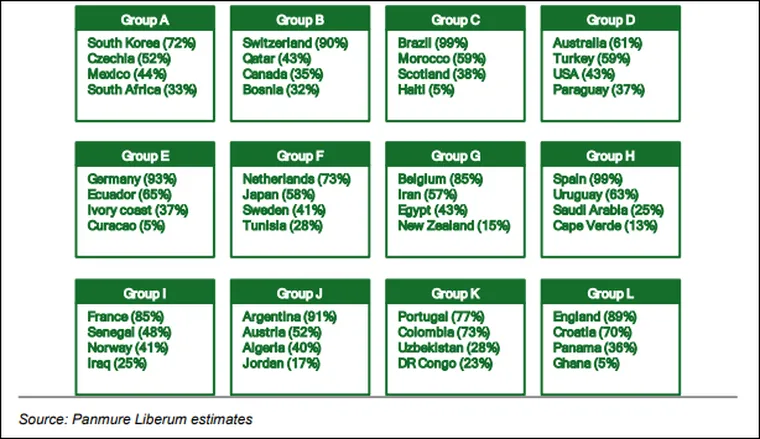
In the group stage, the projection places the Argentine National Team with a favorable picture, with a 91% chance of advancing the round ahead of Austria, Algeria and Jordan. They also appear to be well-positioned compared to the rest of the European powers, which anticipates a strong presence of the Old Continent in the decisive instances
. The group stage percentages
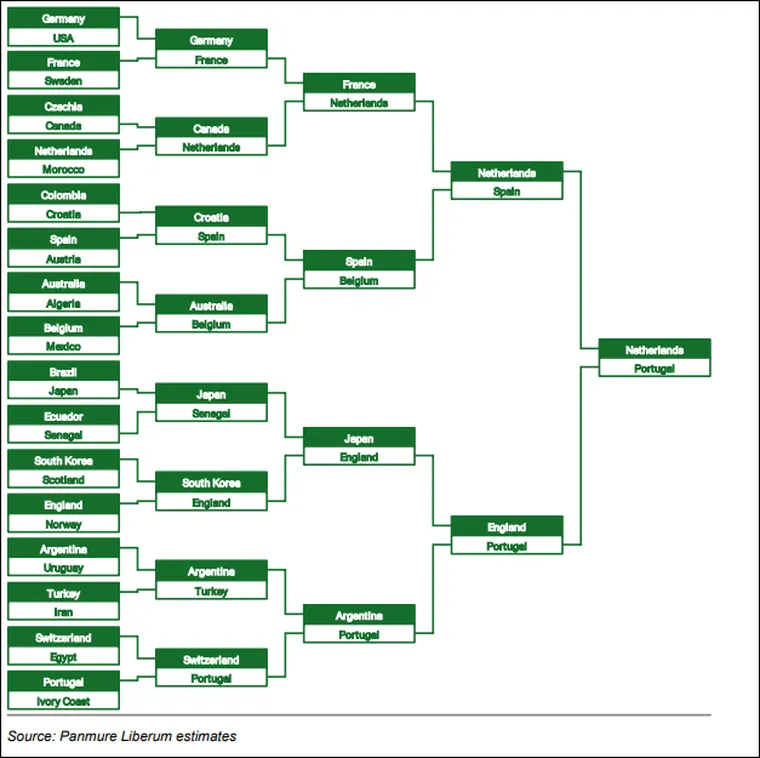
As the picture progresses, the model eliminates several of the great candidates. Brazil would be left out in the 16th after falling to Japan, in one of the main expected hits. France would also go far, but would be eliminated by the Netherlands in the quarterfinals, while Spain and England would fail to reach
the final.
For her part, the reigning champion Argentina, after eliminating Uruguay in the 16th and Turkeyin the eighth, would be eliminated in thequarterfinals against Portugal. “The quarter-final match between Argentina and Portugal pits the defending champion and the last remaining South American team in the race, still heavily supported by an already veteran figure, against a team that never won the World Cup and that also depends to a large extent on an elderly figure. Butunlike Argentina, Portugal has much more breadth and depth in its roster and, whenever Ronaldo steps aside, it should win this game in overtime,” the report notes
.
The analysis focuses on the depth of the squads as a decisive factor in hand-to-hand instances, even above the weight of the great figures. Under that logic, the Argentine team would have tools to advance, but not enough to prevail in the most demanding crossings

.
The screening leads to an unprecedented final between Portugal and the Netherlands, two teams with history but without world titles. The report highlights that both teams would arrive after demanding courses, with tight victories against weighty rivals (Morocco in the 16th, France in the quarterfinals and Spain in the semis for the Netherlands and Argentina inthe quarterfinals and England in the semis for Portugal), in a tournament that would not be characterized by a
high level of play. The direct elimination key
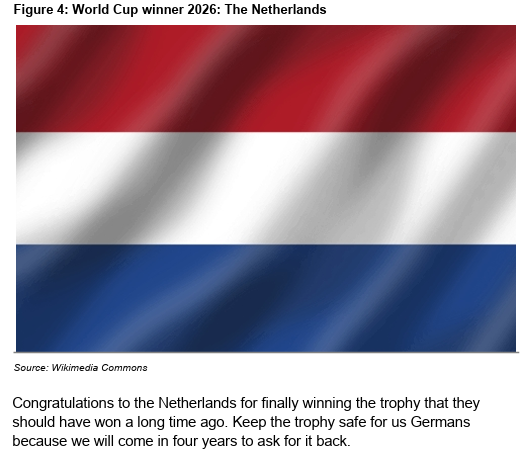
In this context, the model favors the Netherlands as champion, paying off a historic debt after losing three finals. The final, according to the projection, would be close and with few goals, in line with other recent results, with the exception of Qatar 2022, ending in a tight 1-0 in favor of The Clockwork Orange
. The world champion would be the Netherlands
Beyond the forecast, Klement himself warns about the limitations of the model, especially given the new 48-team format that the 2026 World Cup will have, which will increase unpredictability and the burden of luck. In addition, the report incorporates an economic approach, noting that during these tournaments, financial markets tend to show variations linked to the performance of the national teams, driven by changes in social mood and investor attention
.
With a striking track record but a deliberately ironic approach, the prediction reinstates the debate: whether this time the model will be right again or if the 2026 World Cup will break the trend.