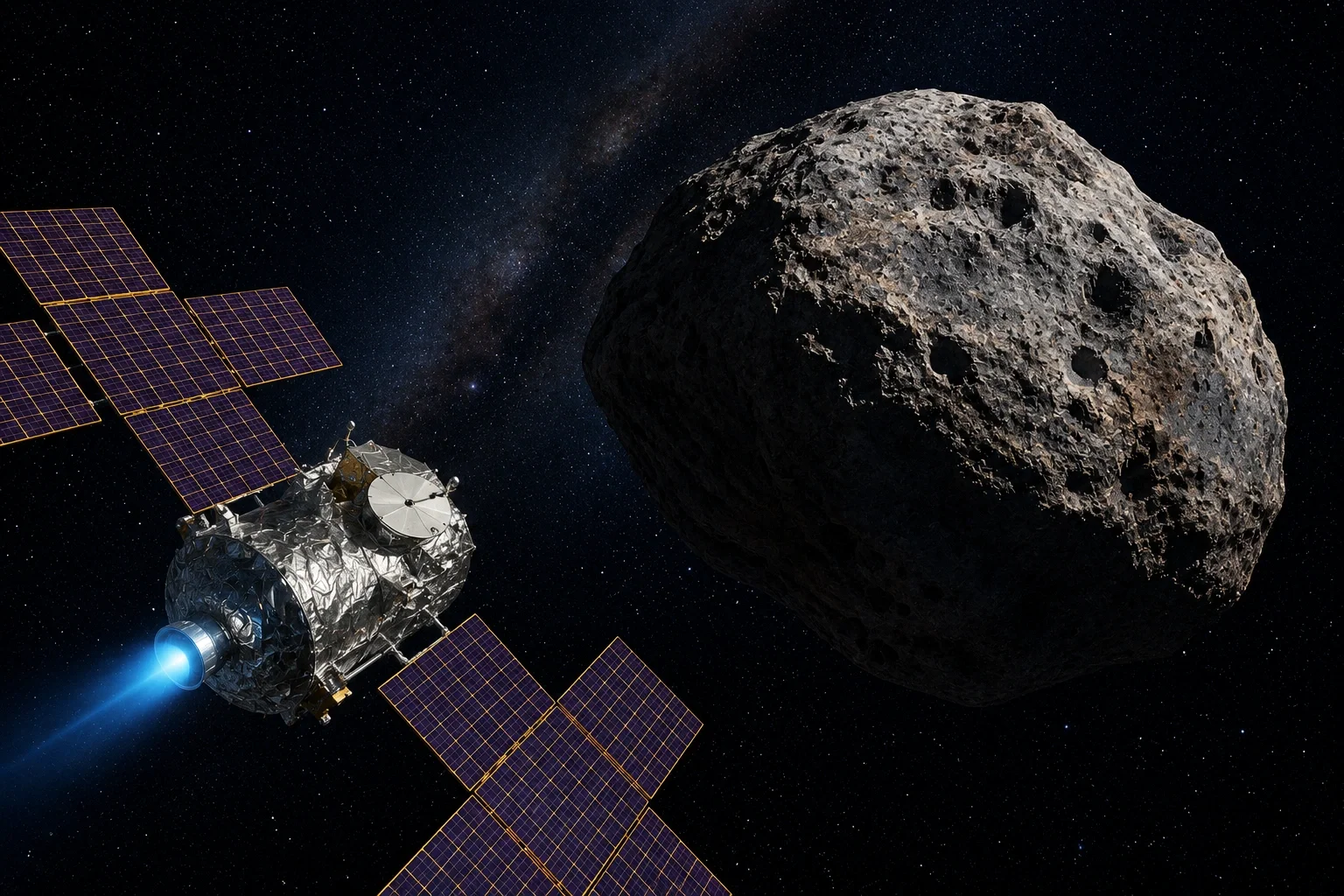
NASA took a key step in its ambitious mission to asteroid 16 Psyche. The namesake spacecraft successfully performed a gravitational assist maneuver around Mars on May 15, passing just 4,609 kilometers from the red planet.
This operation allowed for trajectory adjustments without consuming large amounts of fuel. This Tuesday, the space agency confirmed that everything went as planned and the probe continues its journey toward the asteroid belt.
The interest in Psyche lies in its possible composition. Scientists estimate that it is the exposed metallic core of an ancient planet that never fully formed. It is thought to be composed mainly of iron, nickel, and other metals.
Some hypothetical estimates suggest that the value of its metals could be equivalent to 300 times the current global economy, although experts clarify that these are theoretical calculations and not a practically exploitable wealth.

What is known about asteroid Psyche
The asteroid is located between the orbits of Mars and Jupiter. It has an irregular shape, a surface area of approximately 165,800 square kilometers, and at its widest point measures about 280 kilometers. According to available data, its metallic content would range between 30% and 60%.
This characteristic sets it apart from most known asteroids and makes it a unique target. Researchers believe that studying it will allow for a better understanding of the interiors of rocky planets like Earth.
The mission aims to answer fundamental questions about planet formation: how metallic cores were created and what processes occurred in the early stages of the Solar System. Psyche represents an exceptional opportunity to observe material that is normally hidden in the centers of planetary bodies.
If no issues arise, the probe will reach the asteroid in August 2029. Once there, it will orbit the celestial body to generate detailed maps of its surface and collect data on its composition and internal structure.
The scientific value of the mission
Beyond speculations about its “economic value,” the true objective is scientific. The spacecraft will gather information that could rewrite part of what we know about the history of the Solar System. The data it sends back will help validate or correct current models of planetary formation.
This is not the first time humanity has sent a mission to an asteroid, but it is one of the most relevant due to the type of body being studied. Psyche is not just a common pile of rocks and ice, but a possible exposed core that holds secrets from billions of years ago.
The maneuver near Mars once again demonstrated NASA's engineering precision. Utilizing the gravity of planets is a key technique for reaching distant destinations with less resource expenditure. The success of this gravitational assist ensures that the probe arrives with the necessary fuel for its operations around the asteroid.
In the coming years, the scientific community will closely monitor the mission's progress. Every piece of data received on Earth about Psyche will contribute to expanding knowledge about our cosmic neighborhood and the origins of planets like ours.