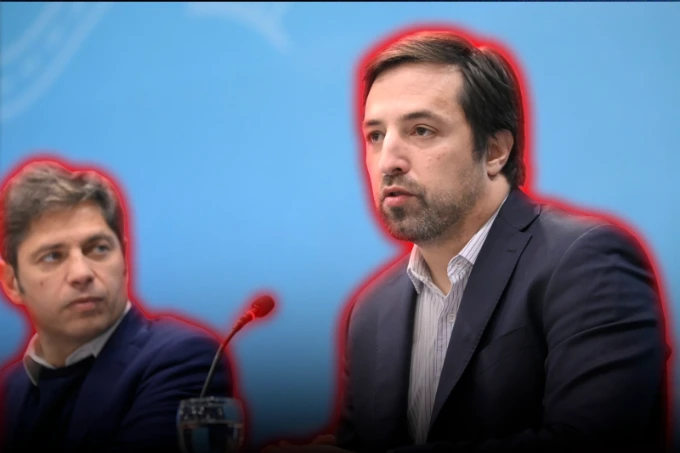
The Minister of Health of Buenos Aires, Nicolás Kreplak, defended free healthcare for non-resident foreigners and criticized the Government's decision by Javier Milei to start charging for non-urgent services in national hospitals as "discriminatory".
The official of Axel Kicillof stated that the measure is “unconstitutional” and used Article 36 of the Buenos Aires Constitution as an argument, which establishes that the Province guarantees its inhabitants access to health. Kreplak even claimed that this criterion should prevail over national establishments located in Buenos Aires territory.
Nicolás Kreplak was Kicillof's health minister during the eternal quarantine
The stance of the architect of the Buenos Aires quarantine involves rejecting the mechanism established by the Nation to recover costs generated by foreigners who do not have permanent residency, thus maintaining the defense of a scheme where these services are financed exclusively by Argentine taxpayers.
The Government had officially established through Resolution 1066/2026 a procedure for non-resident foreigners to present valid health insurance or pay in advance for the usual services provided in hospitals managed by the National State. Permanent residents maintain the same conditions as Argentine citizens.
The modification does not apply to emergencies. In cases that pose a certain and imminent risk to life or vital functions, care must be provided regardless of immigration status and cannot be delayed by administrative procedures.
Kreplak argues that paying for health care is discriminatory
Despite these exceptions, Kreplak described the policy as “discriminatory” and later stated that it was a “smokescreen” intended, according to his interpretation, to divert the discussion from the problems facing the healthcare system. He also accused the Government of causing “pain and suffering” through austerity measures.
To justify his rejection, accustomed to the wastefulness of the provincial administration, the Kirchnerist minister argued that non-resident foreigners have a "minimal impact" on the Buenos Aires system.
The Milei government regulated mandatory health insurance for foreigners
The new national regime, however, does not prohibit or restrict healthcare for foreigners, but rather establishes who must bear the cost of non-urgent services. If the patient has coverage, the hospital must notify the insurer and issue an electronic invoice; if they do not have it, a budget must be prepared and payment collected before providing the service.
In this way, the controversy once again exposed the differences between the national Government and the Buenos Aires Kirchnerism. While Milei moved forward to require non-resident foreigners to pay for their usual care or have insurance that covers the expenses, Kreplak opposed the change and defended a scheme where the cost of these services is fully absorbed by Argentine taxpayers.