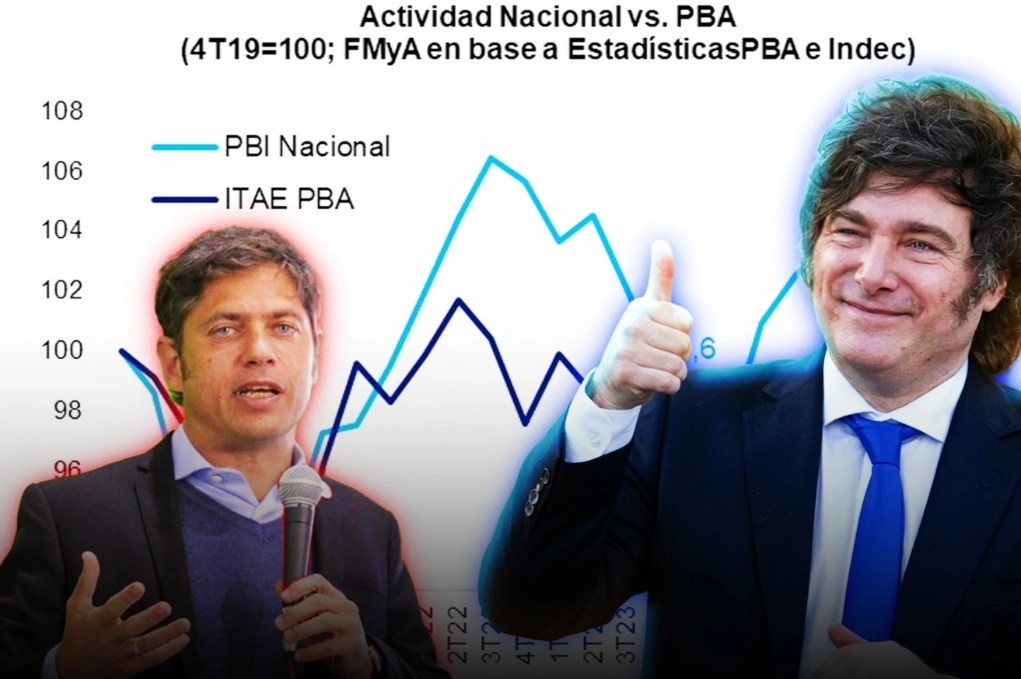
According to a report by the consulting firm FMyA, the Province of Buenos Aires has not shown economic growth since 2019, while national activity managed to expand driven by Milei.
The Argentine Republic is undergoing a historic transformation under the leadership of President Javier Milei, marking a definitive break from decades of decline. However, this national rebirth faces its main obstacle in the Province of Buenos Aires, where the administration of Axel Kicillof has become an anchor that hinders regional development.
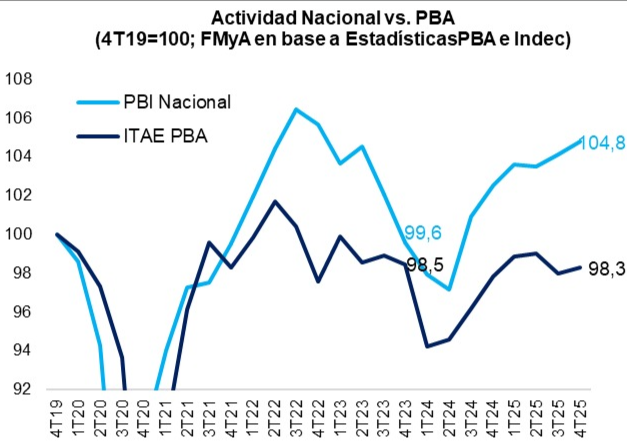
Recent data from the consulting firm FMyA is devastating: while the National GDP reached an index of 104.8 points by the end of 2025, the provincial activity indicator (ITAE PBA) is dragging painfully at 98.3 points. This gap of more than six points is the direct result of two opposing visions: the fiscal efficiency of the National Government versus the uncontrolled spending of the Buenos Aires Kirchnerism.
FMyA Chart
At the national level, the stabilization program has achieved what many considered impossible: chaining two consecutive years of financial surplus. Thanks to this order in public accounts, inflation has begun a downward path projected to around 2% monthly by mid 2026.
This climate of confidence has allowed the Country Risk to pierce the 500 points zone, opening the doors to private credit and fostering real investments through the Large Investment Incentive Regime (RIGI). Under this framework, 16 megaprojects have already been approved, totaling more than 21 billion dollars in strategic sectors.
National growth is driven by dynamic engines operating freely:
Energy and Mining: Growing at rates close to 10%.
Agriculture: With a rebound of 6.5% after the removal of bureaucratic obstacles.
On the other side, the management of Axel Kicillof has decided to sacrifice the future of Buenos Aires residents on the altar of ideology. His capricious refusal to adhere to the national RIGI led to the loss of the largest investment in Argentine history: the GNL plant of YPF-Petronas. This project, which represented up to 50 billion dollars and the creation of 50,000 jobs, will ultimately be located in Río Negro due to the lack of legal security in Buenos Aires territory.
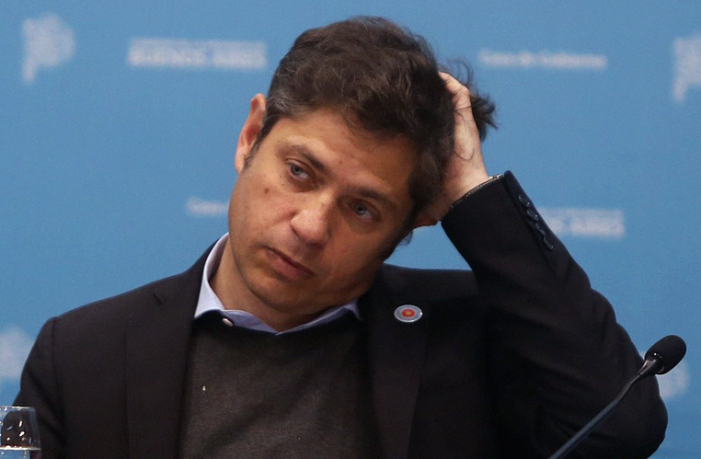
Axel Kicillof, governor of Buenos Aires.
To sustain his political structure in the face of a 91% cut in discretionary funds executed by the Nation to clean up the State, Kicillof has opted for a suffocating tax pressure. Through ARBA, increases have been applied to the rural and urban property tax with additional installments that can double the annual amount, punishing those who produce. The resistance to the adjustment is total: while national primary spending fell by 27% in real terms, provincial spending rose by 24% at the beginning of 2025.
The result of this interventionist model is stagnation. Since Kicillof took office in 2019, activity in the province has shown no progress, while the rest of the country grew by 5% in the same period. Even in the two-year period 2022/23, national growth far exceeded that of the Province of Buenos Aires. The protected and uncompetitive Buenos Aires manufacturing industry barely recorded a growth of 0.8% in 2025, lagging behind the push of the national energy sector.