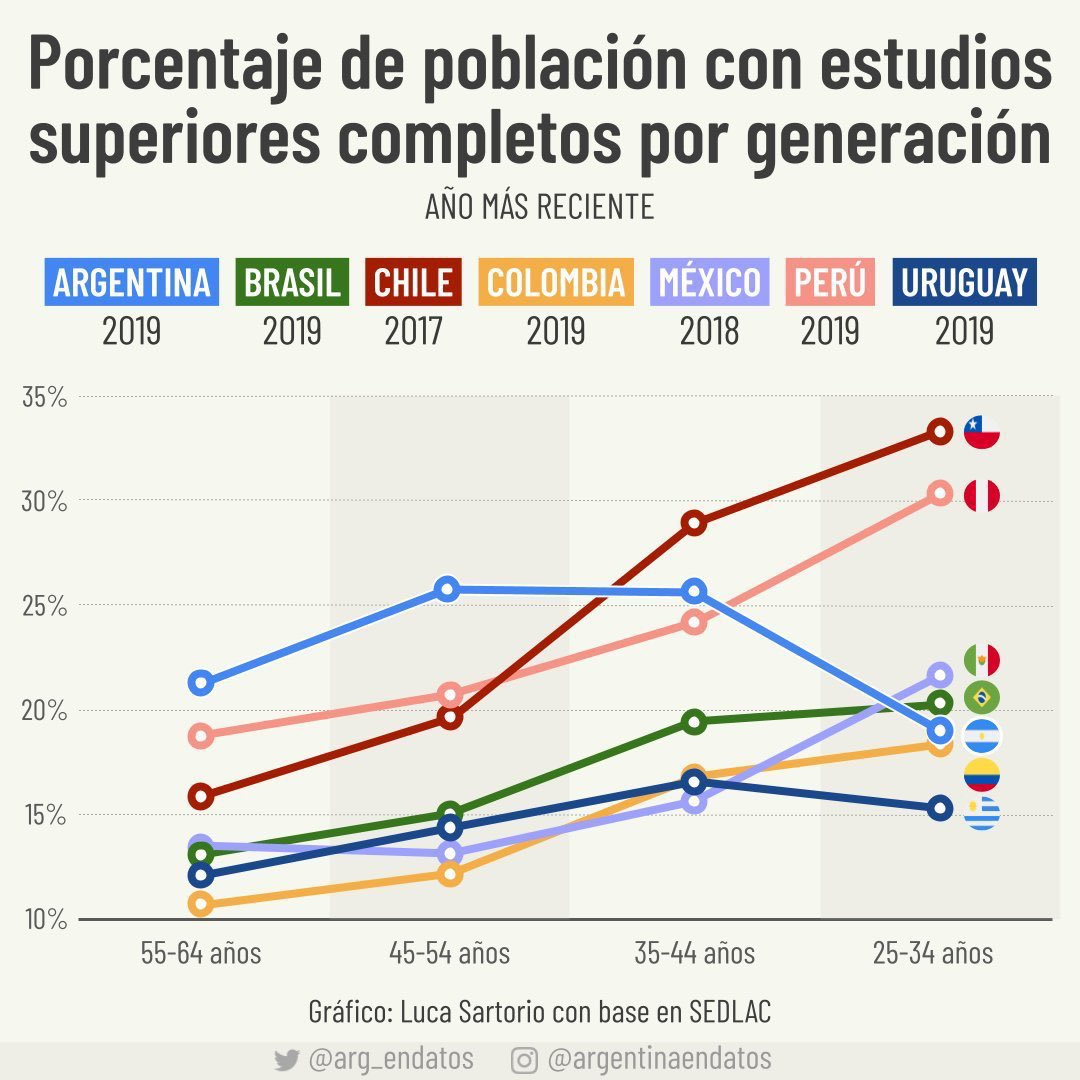
Argentina has a significant lag in the number of young people with complete university studies compared to other countries in the region, while Kirchnerism celebrates the “creation” of universities during their governments.
According to SEDLAC data ( Socio-Economic Database for Latin America and the Caribbean) for 2019, the percentage of the population between 25 and 34 years of age with completed higher education, whether university or technical, in Argentina ranked lower than countries such as Chile, Peru, Mexico and Brazil. The country is even lagging behind in the group of nations linked to the OECD.
The contrast becomes more evident when analyzing evolution by generations. In Argentina, the 55-64 age group shows a level of complete higher education close to 21% for that year, while in the 45-54 age group it amounts to approximately 26%
. The study.
However, instead of continuing this trend, the percentage falls among the youngest: in the 25-34 age segment, it drops to
around 19%.
This generational setback is not replicated in other countries in the region. In Chile, for example, the percentage of young people with completed higher education reaches approximately 34%, while in Peru it is around 30%. Both countries show a sustained upward curve in younger generations
.
In parallel, Brazil and Mexico are also showing improvements, with levels close to 20% in the young population, ranking above Argentina. Even Colombia shows a growing trend, exceeding 15% in younger segments
. Cristina Kirchner.
This critical scenario occurs as Kirchnerism celebrates the inauguration of 17 national universities in its first 12 years of government, seven of them
in the Buenos Aires suburbs.
However, the data show that this expansion did not translate into a higher percentage of graduates. On the contrary, Argentina shows a young generation with a lower level of higher education than countries where access to universities depends to a greater extent on private funding.
SEDLAC data reflect a relative decline in higher education among young people, consolidating a downward trend that leaves Argentina behind other countries in the region.