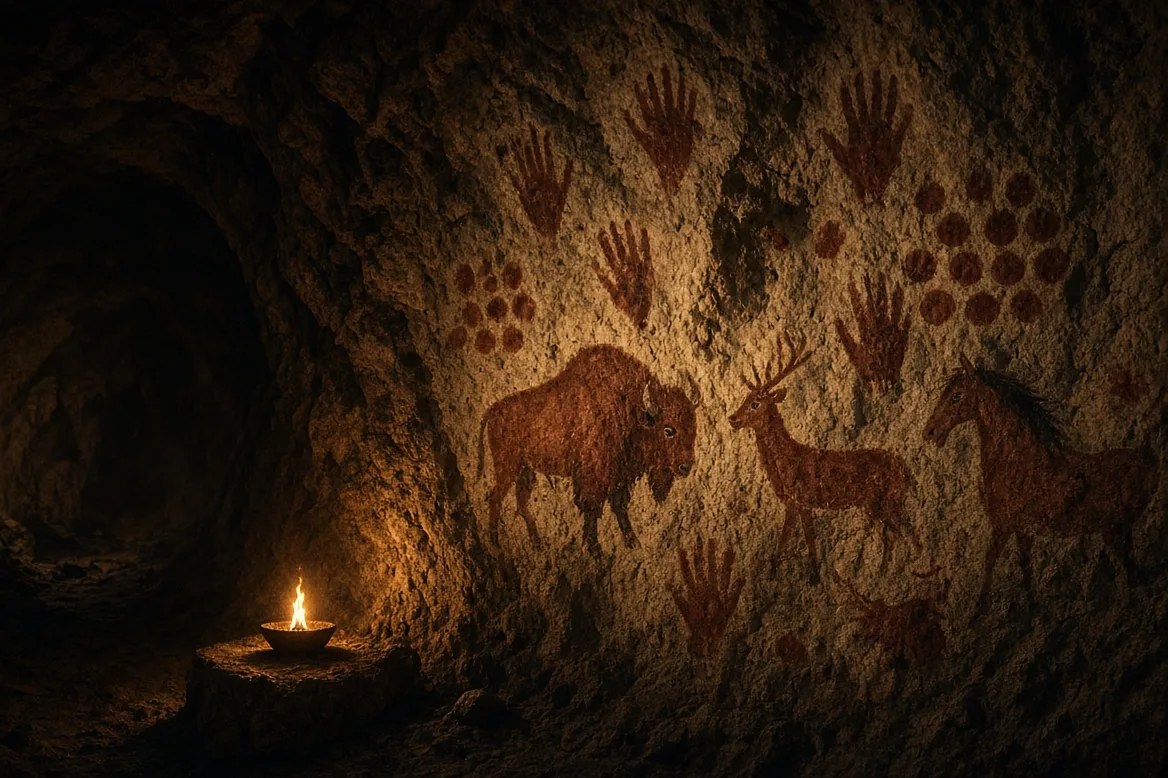

Last year, a journalist accompanied two archaeologists into the depths of the El Castillo cave in northern Spain. There, between 13,000 and 41,000 years ago, groups of Paleolithic artists ventured in with torches and rudimentary lamps to engrave and paint animals, red discs, hand silhouettes, and geometric motifs. Almost three thousand of those marks remain legible. “If the Paleolithic record were a book, in El Castillo we have practically all the chapters,” explained Eduardo Palacio Pérez.
Today, the deep area, beyond natural light, is no longer dangerous: cave bears went extinct over 24,000 years ago, and the cave was equipped with stairs and electric lighting in the 1950s. Still, the researchers entered through a corridor closed to the public and stopped in front of the Polychrome Panel, where generations superimposed hands and animal silhouettes in black charcoal and red, orange, and brown ochres.
Diego Garate, a professor at the University of Cantabria, recalled that for scholars, the wall is sacred and should not be touched. For Paleolithic people, however, the relationship was intimate. In fact, scientists from the Max Planck Institute managed to recover ancient human DNA from some of those decorated surfaces.
/https://tf-cmsv2-smithsonianmag-media.s3.amazonaws.com/filer_public/8e/83/8e837bc6-e2b3-4bb6-bb1c-4f1287b45a6f/castillo-39-rincon_de_los_signos.jpg) Since the discovery of the Altamira bisons in 1879, the question of why this art was created in such risky places has generated very different theories: clan totems, symbols of fertility, or marks of shamans in altered states. Many see in these creations the moment when Homo sapiens reached behavioral modernity through symbolic and abstract thinking.
Since the discovery of the Altamira bisons in 1879, the question of why this art was created in such risky places has generated very different theories: clan totems, symbols of fertility, or marks of shamans in altered states. Many see in these creations the moment when Homo sapiens reached behavioral modernity through symbolic and abstract thinking.
The Sensory Experience of Darkness
Garate, who helped discover half a dozen decorated caves in the Basque Country, became less interested in intentions and more in the experience of being inside. In a cave with no archaeological value, near a Basque beach, he lit a torch. The flame barely illuminated a dozen meters, and its red light flickered and danced with the shadows. “Rock art is not like a painting on the wall,” he said.
Other researchers added to the perspective the role of light, location, sound, and touch. Some anthropologists compared it to a “pre-echo of cinema” or contemporary installation art: a bidirectional and changing relationship between the artist, the viewer, and the physical environment. Purely cognitive explanations would have overlooked this sensory side.
The hands were stamped for millennia before animals appeared. Paul Pettitt and his colleagues analyzed their distribution and found that they were not placed randomly. Most are located near fissures or undulations, often in gripping positions or in concave curves, as if they served to hold on while exploring.
/https://tf-cmsv2-smithsonianmag-media.s3.amazonaws.com/filer_public/fd/cb/fdcb1447-fea6-4499-80eb-baa875f8216f/castillo-27-techo_de_las_manos.jpg)
/https://tf-cmsv2-smithsonianmag-media.s3.amazonaws.com/filer_public/c5/3d/c53d1353-a5e3-49c7-be3e-f883092fa7fe/castillo-69.jpg) In a chamber of El Castillo, a central stalagmite shows the “bison man,” a figure that seems to walk on its hind legs. The artist carved the stone to give volume to the knees and thighs. When Garate moved the flashlight, the shadow projected on the back wall seemed to walk. Pettitt wrote that there is no clearer example of the interaction between topography, shadow, and art in the Paleolithic use of deep caves.
In a chamber of El Castillo, a central stalagmite shows the “bison man,” a figure that seems to walk on its hind legs. The artist carved the stone to give volume to the knees and thighs. When Garate moved the flashlight, the shadow projected on the back wall seemed to walk. Pettitt wrote that there is no clearer example of the interaction between topography, shadow, and art in the Paleolithic use of deep caves.








