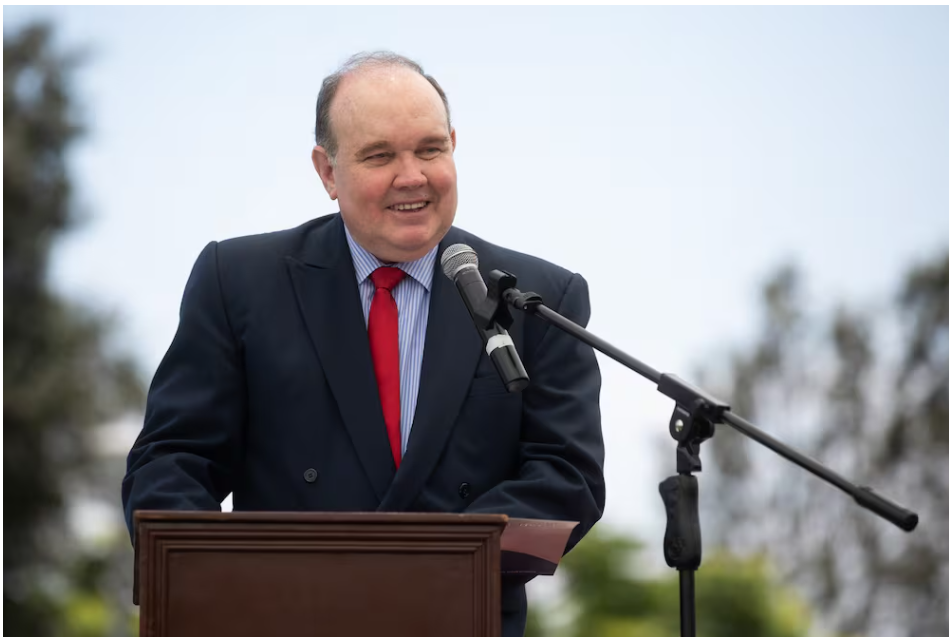
His discourse focused on economic freedom, security and the recovery of traditional values begins to capitalize on social discontent and to shape it as one of the main alternatives for change in the face of the political establishment.
The leader of Popular Renewal has built his candidacy on a message focused on the defense of economic freedom, the reinforcement of citizen security, the fight against corruption and therecovery of traditional values, axes that have made him one of the most visible figures of the emerging patriotic movement that is gaining ground in different countries of Latin America.
Just one month before the presidential elections in Peru, a new public opinion study shows a highly fragmented political scene but with a clear protagonist at the top of electoral preferences. The last national electoral simulation carried out by the consultancy firm Ipsos places the leader of Popular Renewal, Rafael López Aliaga, as the candidate with the most support for the first round.
According to the results of the study released by Perú21, López Aliaga leads the intention to vote with 11% support, which in the national simulation is equivalent to 17.2% ofvalid votes, thus consolidating himself as the best positioned candidate in the presidential race. In second place is Keiko Fujimori, candidate of the Popular Force party, who has a 10% intention to vote, ranking behind the leader of Popular Renewal but still among the group of candidates with the greatest chances of advancing
the electoral process. Rafael López Aliaga
Beyond the first two positions, the Peruvian electoral landscape shows a strong dispersion of the vote. According to the survey, no other candidate exceeds 9% of valid votes, which confirms the high level of fragmentation of the country's political system and reinforces López Aliaga's position as one of the main references for the political change that part of the electorate
Its growth in the polls also occurs in a context of deep erosion of the traditional Peruvian political class, marked in recent years by a prolonged institutional crisis, constant changes of government and a growing distrust of citizens towards establishment leaders. This social unrest is clearly reflected in the study's own data, which show that white, flawed or indecisive voting continues to be high, an indicator of the discontent that permeates large sectors of the Peruvian population and that the electoral scene
is still open. Rafael López Aliaga
In this context of political uncertainty, López Aliaga has intensified his proselytizing activity throughout the country in recent weeks, with the objective of consolidating his advantage in the polls and expanding his base of support among voters looking for an alternative to traditional politics. During his campaign tours, the candidate insists on presenting his political project as a way to recover economic growth, strengthen internal security and restore institutional stability to Peru, three demands that today appear among the main concerns of the electorate
.
With the election getting closer and a highly fragmented scenario, the advantage exhibited today by the leader of Popular Renewal opens a new chapter in the Peruvian political dispute, where the anti-system vote and the search for order and prosperity are beginning to gain prominence in the public debate.