The Webb telescope detected unique formations in the planet's atmosphere
Nuevo
Agregar La Derecha Diario en
Compartir:
The James Webb telescope captured unprecedented images in Saturn's atmosphere that surprised astronomers at the NASA. During ten hours of observation, they detected dark bead-like formations and an asymmetric star-shaped pattern.
What's striking is that these structures, separated by hundreds of kilometers, appear to be mysteriously aligned. Scientists are seeking to understand whether they evolve, change, or grow in the coming months.
El telescopio James Webb captó imágenes inéditas en la atmósfera de Saturno
Unprecedented discovery
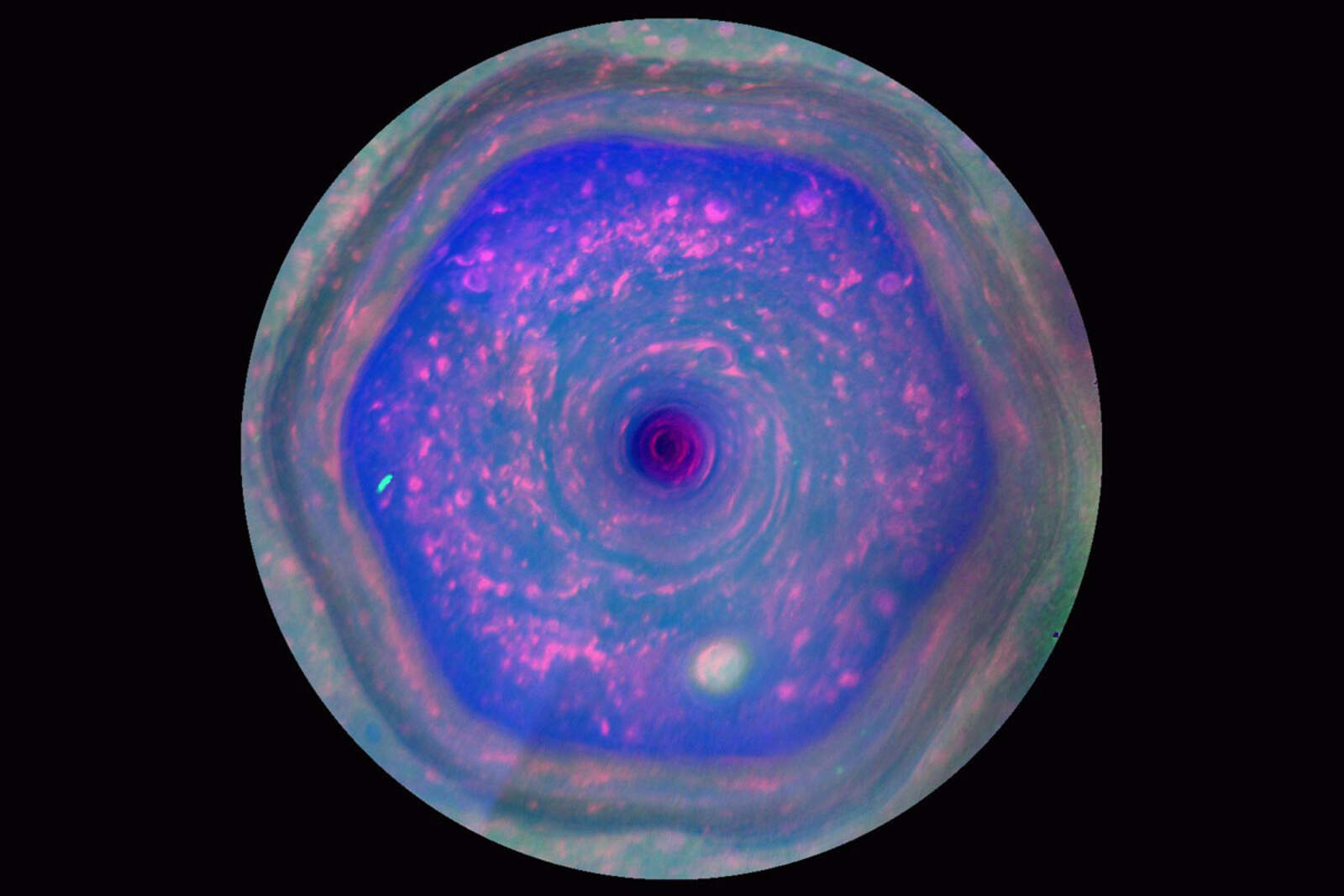
The dark beads move slowly within the polar auroras. The star-shaped pattern extends from the north pole to the equator, just above the famous Saturn hexagon. The alignment puzzles the scientific community.
Technique used for detection
The team used Webb's near-infrared spectrograph, focused on hydrogen ions H₃⁺ and methane emissions. These compounds serve as tracers of chemical and energetic activity in the atmosphere.
Instead of finding diffuse emissions, they observed fine and persistent patterns, impossible to detect with ground-based telescopes or previous missions.
Implications for Saturn's dynamics
Experts believe that the "beads" could arise from interactions between the magnetosphere and the rotating atmosphere. Meanwhile, the star-shaped pattern could reflect unknown processes in the stratosphere, possibly linked to the hexagon.
Tom Stallard, leader of the study, described the finding as "completely unexpected." If a link between upper layers and deep storms is confirmed, it would be an unprecedented mechanism in planetary dynamics.
Implicancias para la dinámica de Saturno
Unique seasonal opportunity
The discovery coincides with the Saturn equinox, which occurs every 15 Earth years. This phenomenon causes major seasonal changes and could be related to the appearance of these structures.