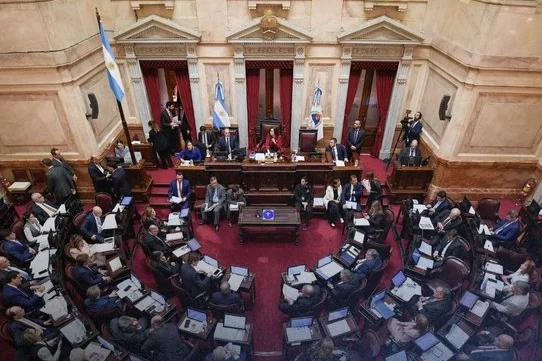
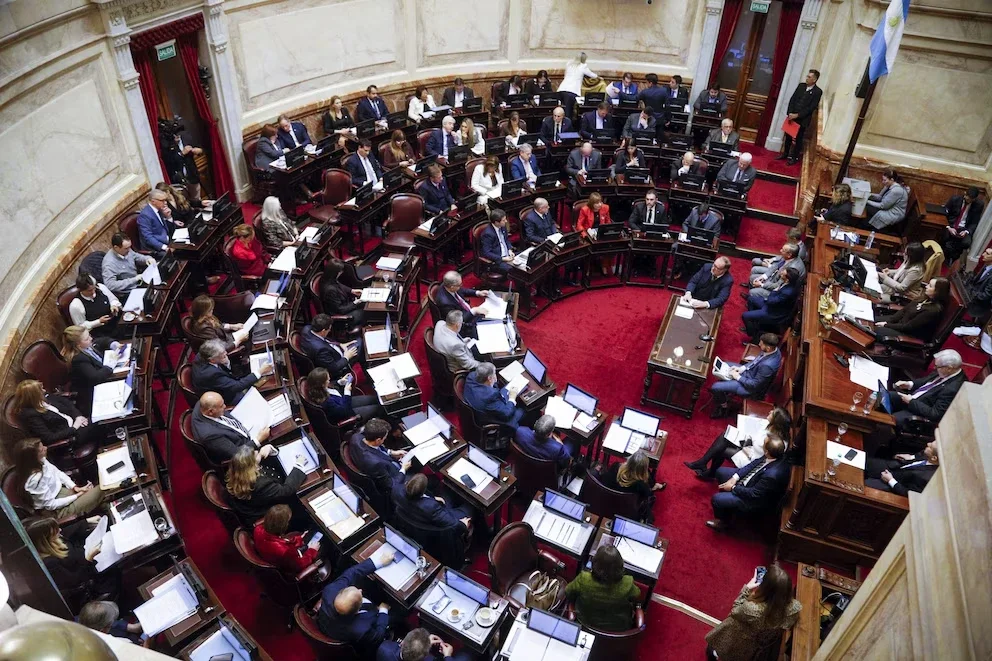
With broad support from various blocs, including sectors of the UCR and Peronism, the Government achieved the approval of the 74 judicial briefs discussed in the Senate.
The Senate of the Nationapproved this Thursday 74 nominations of judges, prosecutors, defenders, and judicial officials, in a session marked by last-minute negotiations and exchanges between the government and the opposition over the agenda. The controversy began when the blocs had agreed in the Parliamentary Labor meeting to address 50 nominations, but shortly before the session started, 23 additional candidacies appeared, which raised questions from Unión por la Patriaand led to an intense debate within the chamber.
Senator Juliana Di Tullio questioned the modification of the agreement by stating: "The parliamentary labor agreement is fulfilled, otherwise, why the hell do we do parliamentary labor?". In the same vein, the head of the Peronist bloc, José Mayans, denounced that the expansion of the list constituted a "parliamentary betrayal".
During the discussion, the Vice President of the Nation and head of the Senate intervened, confirming that originally 50 nominations had been mentioned and clarified that neither the Presidency of the Senate nor the Parliamentary Secretariat participated in the subsequent incorporation of new candidacies. In light of the conflict, the president of the UCR bloc, Eduardo Vischi, requested a recess to try to reach an understanding among the different benches.
After approximately 40 minutes of negotiations, the president of the La Libertad Avanza bloc, Patricia Bullrich, reported that a "political and parliamentary agreement" had been reached to proceed with the treatment of the 74 nominations. The proposal was put to a vote and comfortably received the support of two-thirds of the senators present.
Bullrich rejected the accusations of irregularities and maintained that the expansion of the list responded to the need to avoid arbitrary exclusions. "There is no bad faith, it's just that it's not easy to determine who the 50 are because the others feel it's discrimination", she explained.
Once the controversy was resolved, the Senate proceeded with the treatment of the nominations and ultimately approved all the nominations. The Peronist interblock only marked differences in the votes corresponding to María Julia Sosa, secretary of Judge Julián Ercolini, and Emilio Rosatti, son of the president of the Supreme Court of Justice of the Nation. The rest of the appointments received unanimous support.
National Senate
As the reporting member, libertarian senator Juan Carlos Pagotto highlighted that all candidates underwent the established regulatory procedures and the corresponding hearings. "They complied with the regulatory process and the Senate has to approve or not with the dissent and rejection that were in each particular nomination", he stated.
For her part, Mendoza senator Anabel Fernández Sagasti described the day as "an important institutional moment" and acknowledged that, despite political differences, there was consensus to fill vacancies that have remained unresolved for years. "This is a civic responsibility", she asserted while justifying her bloc's support for the majority of the nominations.
Among those approved, the disastrous appointment of María Verónica Michelli to integrate the Federal Oral Court No. 3 of La Plata stood out, which received 44 affirmative votes. Her candidacy had been the subject of controversy in recent weeks and was part of the parliamentary negotiations leading up to the session. Critical sectors of her appointment also highlighted her family connection with media operator Hugo Alconada Mon, one of the communicators most questioned by representatives of the liberal space, identified as a persistent opponent.
The approved list also included magistrates, prosecutors, and defenders designated to fill vacancies in federal and national courts in La Plata, City of Buenos Aires, Mendoza, Santa Fe, Neuquén, Formosa, Salta, Bariloche, Rafaela, Hurlingham, and other jurisdictions across the country.
The approval of the 74 judicial nominations represents one of the most significant batches of appointments in recent years and constitutes an important step towards reducing vacancies in the judicial system, a problem that various political sectors have been pointing out for some time as an obstacle to improving access to justice and the functioning of federal and national courts.