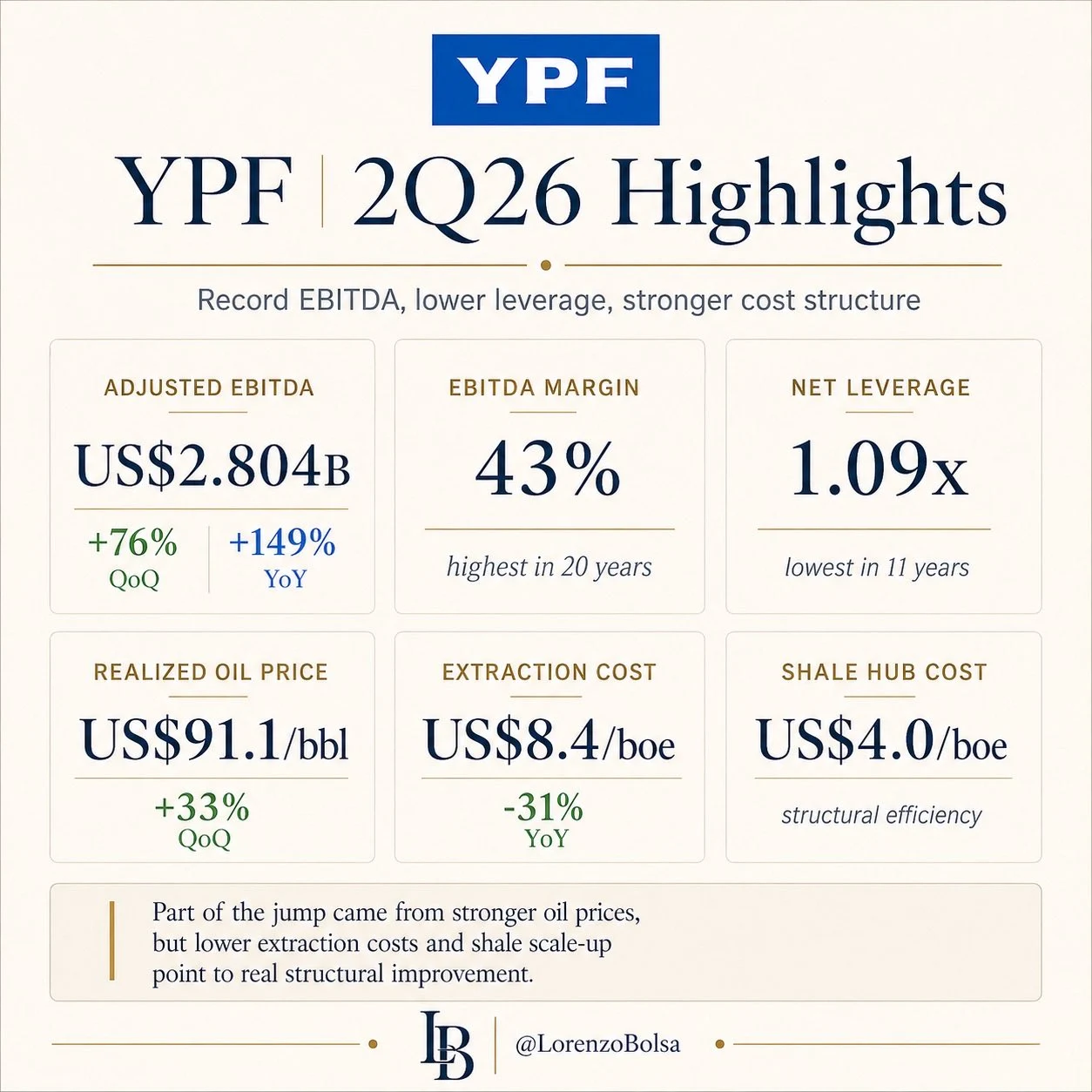
YPF closed the second quarter of 2026 with record operating results, strong production growth in Vaca Muerta, and a significant reduction in its debt level, amid the company's transformation towards unconventional hydrocarbons.
The oil company reported an adjusted EBITDA of US$2.804 billion between April and June, the highest in its history and nearly 150% higher than that obtained during the same period in 2025. Additionally, the EBITDA margin reached 43% of revenues, its highest level in the last two decades.
Some company numbers
The net income was US$1.205 billion, the second highest quarterly result recorded by the company, only behind that achieved during the third quarter of 2025.
The performance was accompanied by strong expansion in Vaca Muerta. Shale oil production averaged 213,000 barrels per day, a year-on-year growth of 47%, while YPF projects to reach 250,000 barrels per day by the end of this year.
During the quarter, investments reached US$1.340 billion, 16% above the same period last year. 77% of those resources were allocated to unconventional activities, primarily in Vaca Muerta.
At the same time, the oil company presented the Incentive Regime for Large Investments (RIGI) with the project Loma La Lata Oil, which contemplates investments of US$25 billion and aims to deepen the oil development of the Neuquén formation.
Record in refineries and progress of VMOS
Horacio Marín, CEO of YPF
The refining segment also reached historic figures. YPF's plants processed an average of 351,000 barrels per day, with a utilization of 104% of their capacity.
The increase allowed for greater production of gasoline and diesel, reduced imports, and generated surpluses for export. Fuel sales grew 10% year-on-year in volume and the company achieved a 59% market share in Argentina.
At the same time, the Vaca Muerta Oil Sur Pipeline (VMOS) exceeded 77% completion by the end of June. The company expects both the pipeline and its port terminal to begin operations in early 2027, significantly expanding the export capacity of the Argentine energy sector.
In financial terms, YPF closed the quarter with liquidity close to US$2.5 billion and reduced its net debt ratio to 1.09 times, the lowest level in the last 11 years.