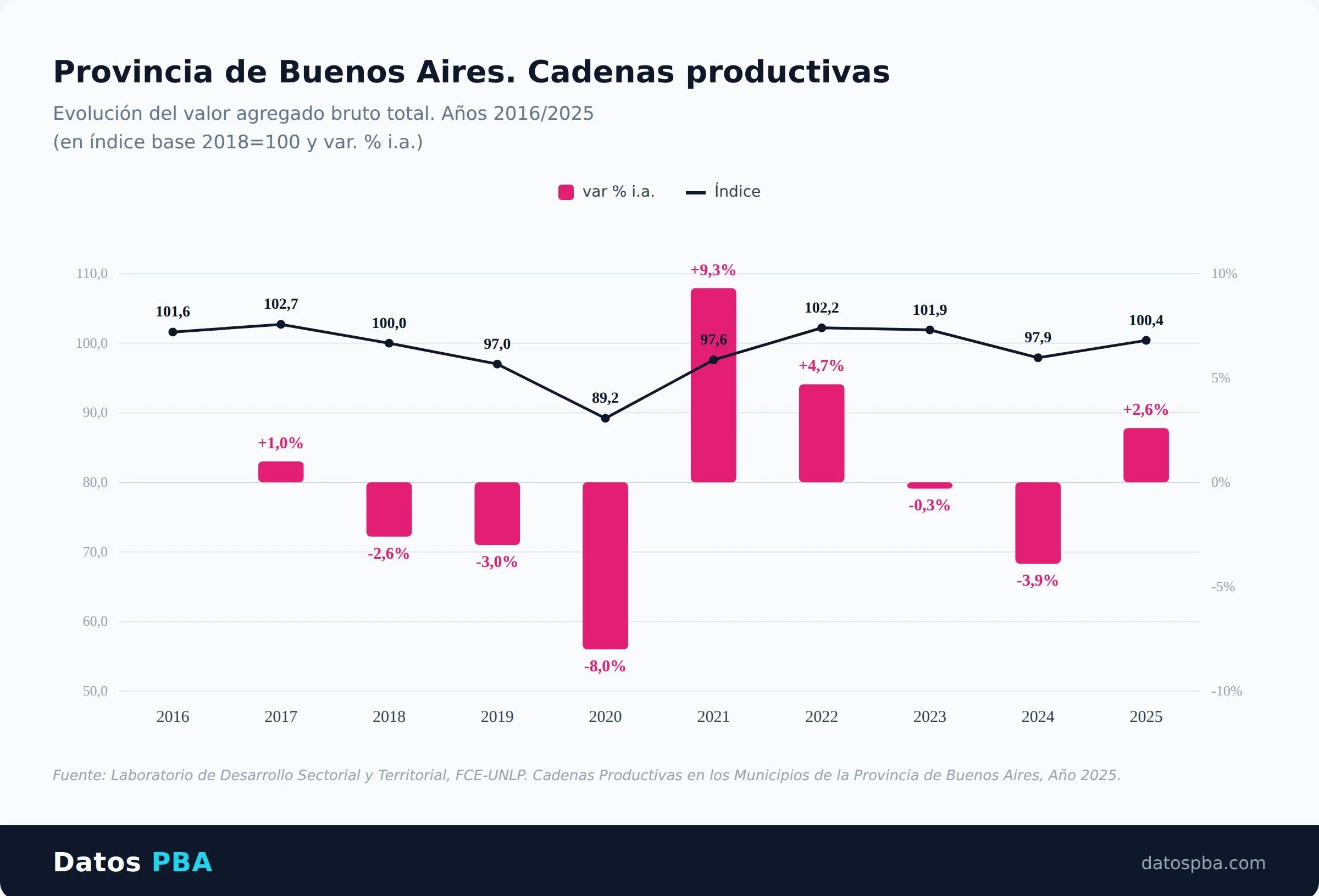
A recent report revealed that the economy of the province of Buenos Aires recorded a growth of 2.6% in 2025, breaking a streak of two consecutive years of decline.
The data comes from the latest study by the Sectoral and Territorial Development Laboratory of the Faculty of Economic Sciences at the National University of La Plata (FCE-UNLP), and marks a recovery in line with the growth recorded at the national level.
The rebound allowed the activity in Buenos Aires to approach again the levels reached in 2022, a year that had represented the highest point since 2017.
The report
This change in trend occurred thanks to the reforms made by the government of Javier Milei in Argentina, which improved macroeconomic conditions, significantly reduced inflation, and boosted activity even in districts governed by leftists like Axel Kicillof and his disastrous implemented policies.
The report data
At the territorial level, the municipalities of the Conurbano showed heterogeneous performances. Berazategui led the growth with 4.4%, followed by Ezeiza (4.28%) and Tres de Febrero (4.15%).
Presidente Perón (3.76%) and Esteban Echeverría (3.66%) also stood out. In contrast, José C. Paz was the only municipality in Greater Buenos Aires that recorded a decline, with a -0.6%.
The report reflects that a large part of the provincial recovery was explained by key sectors that reacted favorably to the new macroeconomic context.
Commerce contributed 0.93 percentage points to growth, while financial services added 0.67 points. Tourism and construction completed the sectors with the most positive impact.
Javier Milei and Axel Kicillof
These sectors not only led the recovery but also managed to exceed previous historical levels. According to the report, both commerce and financial services are now above the records of 2016, which shows a significant change compared to previous years.
In contrast, some activities continued to show delays as a result of accumulated problems in previous years.
Capital goods was the chain that most detracted from growth in 2025, with an impact of -0.11 percentage points, followed by the textile cotton and consumer chemicals sectors. These areas still remain between 15 and 20 points below their historical levels, with a decline that began during the last months of the previous Kirchnerist government.
The economic growth of 2025
The province's performance is related to the national trend. In 2025, Argentina's Gross Domestic Product (GDP) grew by 4.4%, breaking two consecutive years of declines and surpassing the levels recorded in 2022.
This growth was mainly driven by investment, which increased by 16.4%, and private consumption, with a rise of 7.9%.
Additionally, 13 of the 17 sectors that make up the GDP showed year-on-year increases, consolidating a process of widespread recovery. In this context, the historical record of Argentina's GDP in real terms was reached in 2025, reflecting the success of the economic policies implemented by Milei's government.