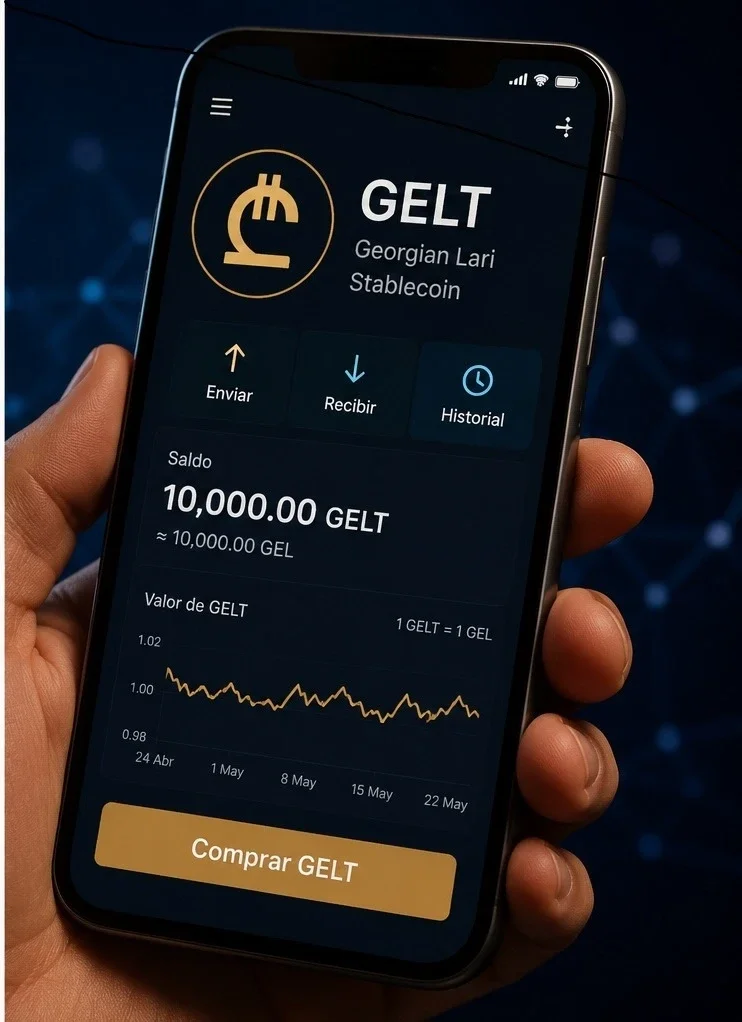
Tether, the company behind USDT, the largest stablecoin in the crypto market, announced that it will launch a new cryptocurrency linked to the national currency of Georgia. The token will be called GELT and will be tied to the Georgian lari, aiming to function as a digital representation of that currency.
The company presented the project as an initiative supported by the Georgian government, although key details about its structure, deployment, and implementation are still to be known.
The announcement marks a significant move within the digital asset market. Unlike most cryptocurrencies, whose prices can fluctuate wildly, stablecoins are designed to maintain parity with an official currency or a reference asset. In this case, GELT will seek to digitally replicate the value of the lari, the currency of Georgia, and offer tools for payments, cross-border trade, and digital financial services.
According to Tether, GELT will allow “lower transaction costs, near-instant settlement, and programmable payments”, among other features. The company stated that it has worked for several years with lawmakers, regulators, and the National Bank of Georgia to advance the stablecoin framework. The country is also considered an active market within the crypto ecosystem, both for its regulation and its presence in digital mining.
What is GELT: a stablecoin tied to the Georgian lari
GELT will be a stablecoin linked to the official currency of Georgia. Tether defined it as a “digital representation of the Georgian lari,” which implies that its value would be associated with the national currency and not with volatile assets like bitcoin or ether.The company aims for the token to serve for digital payments, commercial operations, and faster transfers within and outside the country.
The project appears as a distinct variant within the universe of stablecoins, dominated by tokens tied to the US dollar. USDT, also issued by Tether, maintains a 1 to 1 parity with the dollar and has a circulation close to 190 billion dollars.In contrast, GELT targets a national currency of smaller scale but with strategic value for an economy seeking to position itself as a favorable destination for financial innovation.
The company also clarified that it will provide more information later. Details about reserves, audits, issuance mechanism, blockchain network used, regulatory limits, and implementation timeline are still unknown.These points will be decisive in assessing whether GELT will function as a traditional private stablecoin, as a regulated payment tool, or as a scheme closer to a digital currency with state participation.
Georgia and the crypto bet: regulation, mining, and institutional support
Georgia appears as an attractive ground for Tether due to its favorable approach towards digital assets. The company highlighted the rules of the National Bank of Georgia regarding stablecoins as a factor that makes the country interesting for businesses linked to crypto assets.It also emphasized that Georgia is one of the countries with the highest cryptocurrency mining activity, reflecting an infrastructure and a technological culture already associated with the sector.
The announcement included signs of political backing, albeit with nuances. Reuters reported that Tether's statement cited expressions of support for financial innovation from Georgian Prime Minister Irakli Kobakhidze, the central bank governor Natia Turnava, and legislator Vakhtang Turnava.However, those statements did not directly refer to the GELT token, so the exact scope of state participation is not yet fully detailed.
This point is important because Tether described the project as an “official” stablecoin. The word generates expectations but also questions: it is unclear whether GELT will simply be a private stablecoin with government support or if it will have a deeper connection to a digital monetary policy.The available information itself indicates that it has not been specified whether this initiative equates to a central bank digital currency, known as CBDC.
The global debate: private stablecoins, monetary sovereignty, and financial risks
The launch of GELT comes at a time of intense international discussion about the role of stablecoins. These tokens are widely used in crypto trading, but they still do not function massively as a means of everyday payment in most countries.However, their growth has caught the attention of central banks and financial organizations due to their potential impact on financial stability, monetary controls, and payment systems.
The Bank for International Settlements warned that privately issued stablecoins could pose risks to financial stability and monetary sovereignty. The argument is that if a private digital currency is used widely, it could affect the state's and the central bank's ability to control flows, supervise payments, or manage monetary policy.Therefore, the key to GELT will lie in its regulatory design and the transparency of its reserves and operations.