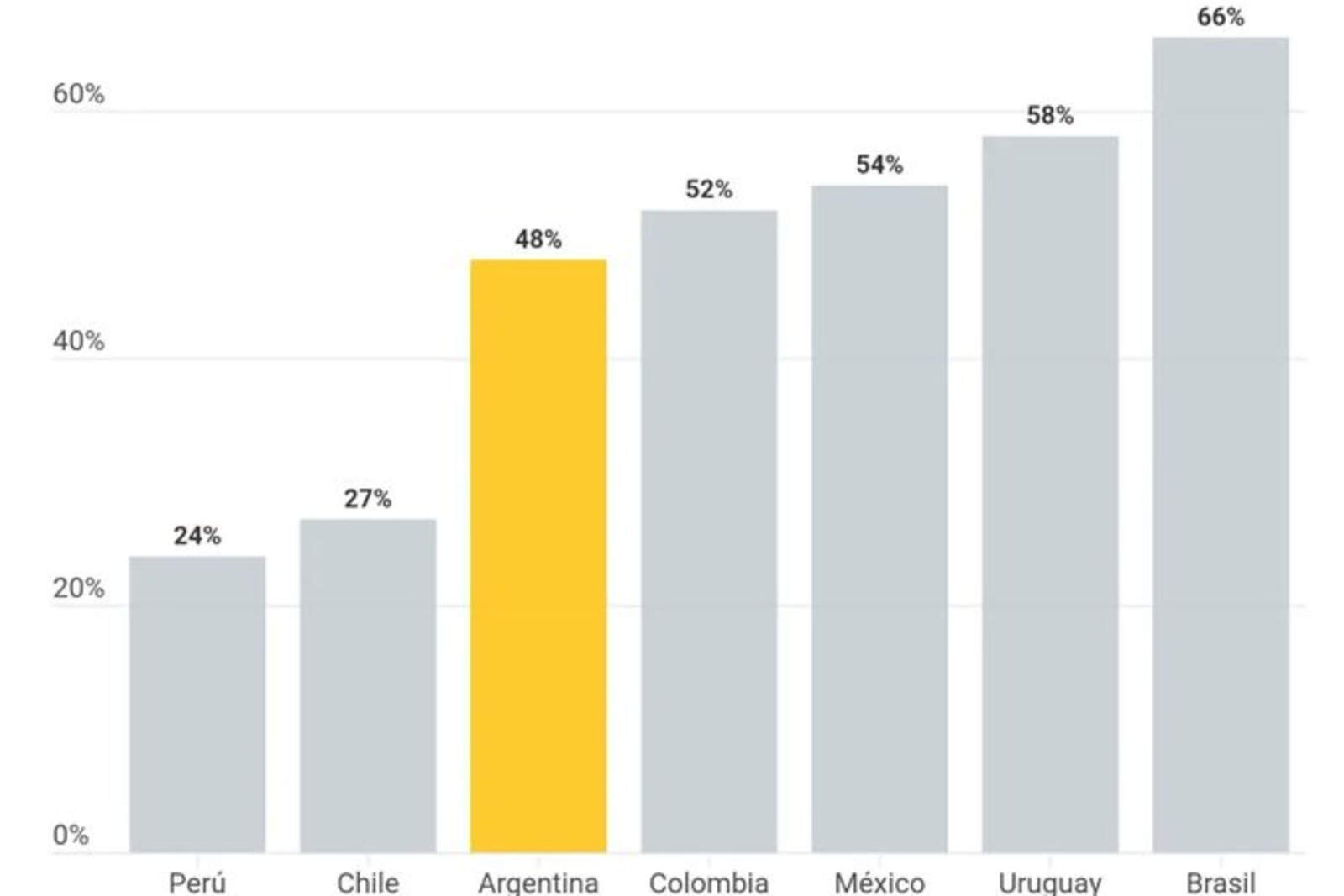
Thanks to the successful economic plan of the government of Javier Milei, Argentina's public debt recorded a sharp reduction throughout 2025 and closed the year at significantly lower levels than those of several countries in the region, such as Brazil, Mexico, and Uruguay, according to estimates by the consulting firm Deloitte.
According to the report, the ratio between public debt and Gross Domestic Product (GDP) fell to 48%, consolidating a downward trend that began after the shift in the country's fiscal policy carried out by the libertarian administration.
The report indicates that this result is explained mainly by the adjustment of public spending in real terms, which allowed the national state to achieve two consecutive fiscal surpluses, a development that had not been recorded for more than 15 years.
Deuda pública sobre PBI.
The improvement in public accounts had a direct impact on the country's financial indicators and was reflected in a marked drop in country risk, which fell to levels close to 500 basis points, when at the end of 2023 it exceeded 2,500 points.
The reduction in indebtedness and the return to fiscal surplus began to change the perception of Argentina in international markets. In that context, Juan Gómez Bada, director of the Advantage Fund, explained that the evolution of the debt/GDP ratio was a determining factor for the firm to decide to invest in Argentine sovereign debt. According to him, an economic growth rate estimated at around 5% per year, combined with positive fiscal balances, improves the sustainability of public indebtedness.
Deloitte's estimates show a rapid correction of debt levels in a relatively short period. According to the consulting firm's calculations, public debt exceeded 130% of GDP in 2023, during the last year of the Kirchnerist government, fell to around 80% in 2024, and would have closed 2025 at around 48%, a trajectory that marks a significant change compared with the dynamics observed in the last decade.
Javier Milei y Luis Caputo.
In a broader analysis of the Argentine economy, Deloitte economists pointed out that the country went through recurrent cycles of fiscal and monetary imbalances, high inflation, and strong volatility for years. However, they emphasized that the most recent data suggest a structural change, supported by three pillars: fiscal consolidation, the expansion of strategic sectors, and a new regulatory framework.
In fiscal matters, the report highlighted that Argentina achieved in 2024 a primary and financial surplus, the first since 2006, which helped stabilize expectations and reduce dependence on external financing. The balance achieved in 2024 and 2025 made it possible to reduce the need for new indebtedness and consolidated the downward trend in public debt.
Looking ahead to 2026, Milei's government projects a primary surplus of 1.5% of GDP, with consolidated balanced accounts. According to Deloitte, if economic growth is maintained and access to international credit to refinance maturities improves, current debt levels wouldn't pose a significant risk.