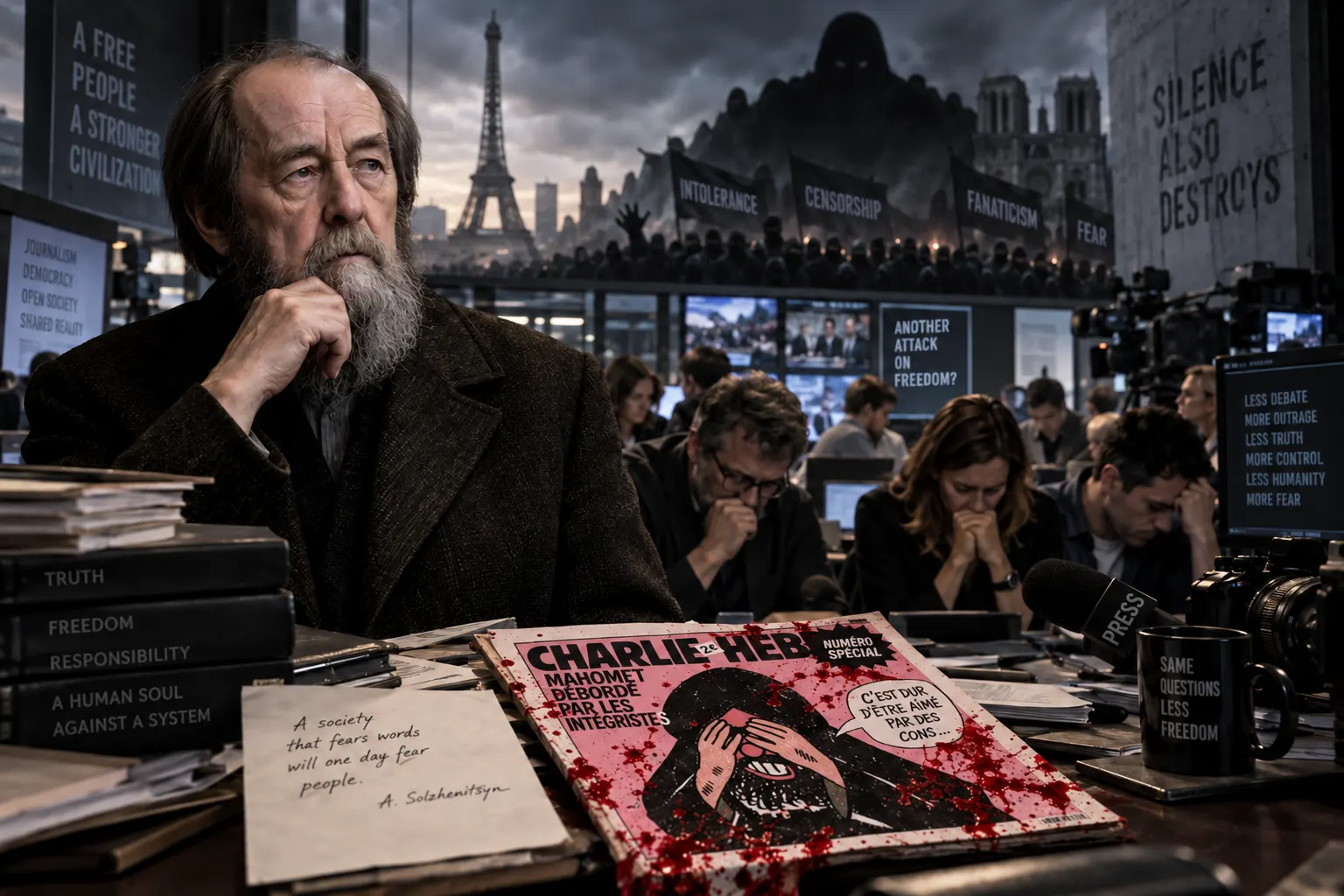
On June 8, 1978, Alexandr Solzhenitsyn spoke at Harvard. Four years earlier, the USSR had expelled him; before that, eight years in camps. In front of the gathered American elite for graduation, he delivered his famous speech about the decline of courage in the West. For him, the West has everything (freedoms, prosperity, rights) and no longer has the will to use it to face reality and call evil by its name.
For Solzhenitsyn, the problem was not direct censorship, but the free press, which participates in the decline of courage due to intellectual conformity. Almost 50 years later, that diagnosis seems more relevant than ever.
Comfort as a Dissolver
His reproach was not the lack of freedom of expression, but its disuse. A press that judged more conformist than the one it had left behind; not due to state censorship, but because of a diffuse fear of upsetting the spirit of the age.
Elites that preferred procedural prudence over moral judgment, even confusing legality with courage. That cowardice does not need tyrants. It is enough with comfort and social fear.
Charlie Hebdo as Revealer
On January 7, 2015, twelve people were killed at Charlie Hebdo over some drawings. No Western newsroom was then directly threatened.
And yet, within hours, the New York Daily News pixelated the cartoons; CNN refused to air them and asked its journalists to describe them on air; the Telegraph withdrew the cover; the Associated Press removed it from its archive, citing an old policy against “deliberately provocative” images.
Although they themselves did not see themselves as threatened, one would expect that most newspapers would defend their colleagues and freedom of expression, which were being attacked at that moment, but they did not have the courage to do so...
Prudence Made Procedure
Even more revealing, because it is more recent. At the end of August 2026, an internal memo from the Canadian public broadcaster caused a scandal. Fifteen days before the twenty-fifth anniversary, it ordered CBC journalists not to label 9/11 as a terrorist attack. Suggested formula: some hijackings that resulted in the crashing of passenger planes.
The scandal forced management to rectify within 48 hours. The network stated that it never denied that it was terrorism, only demanded attribution. But for the attacks in Madrid in 2004 or London, it is something similar, and terrorism cannot be spoken of for them. A practice shared with the BBC, Reuters, AFP, and AP. And there lies the problem.
At the BBC, John Simpson said it is not the BBC's role to tell people whom to support and whom to condemn. Narendra Modi had already reproached that reflection in April 2025, after the Pahalgam massacre, when twenty-six civilians were killed and the BBC referred to the terrorists as “militants” on air… Two public media outlets, which are supposed to inform billions of people, do not even have the courage to call things by their name out of fear.
Solzhenitsyn did not accuse the West of military weakness or economic decline. He pointed to a more intimate and important void, the lack of courage to judge and name. The comfort he described has only thickened. Courage continues to be absent from the appointment.
He was right, and today that progressive fear could cost us dearly, while others take advantage of it.