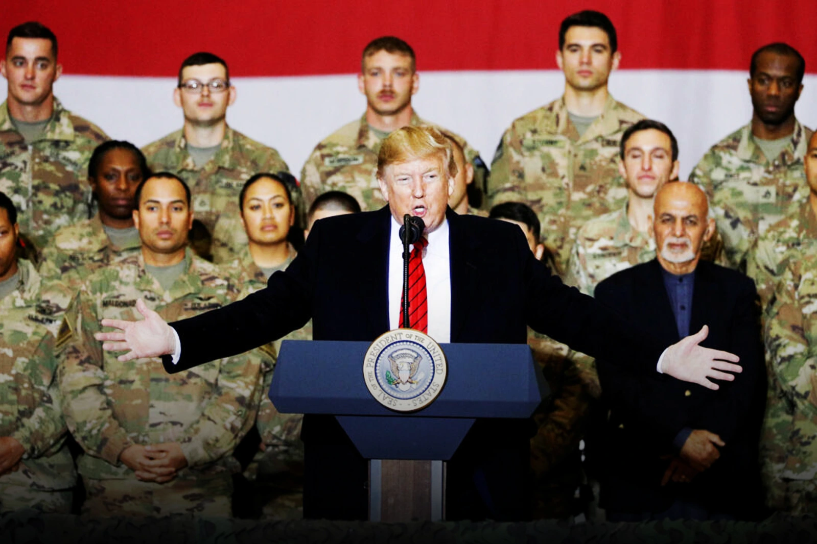

The government of Donald Trump deepened its strategy of reducing military presence in Europe after the Pentagon canceled the deployment of nearly 4,000 U.S. soldiers who were to be sent to Poland as part of the usual NATO force rotation. The measure raised concerns among European allies and once again exposed the growing tensions between Washington and various governments on the continent.
The decision affects the Second Armored Brigade Combat Team of the First Cavalry Division, a unit based at Fort Hood, Texas, which had already begun preparations to move to Europe. Part of the contingent was even in transit when the Pentagon suspended the operation.
U.S. officials explained that the measure is part of a broader review of the U.S. military presence in Europe directly driven by Trump, who has long argued that European allies rely excessively on American military power without taking on enough responsibilities for defense.
Trump publicly defended the military withdrawal and stated that Europe must “learn to defend itself.” The U.S. president believes that for decades the United States has borne the main cost of European security while many NATO members have not even met the minimum military spending targets.

The Pentagon also left open the possibility of further troop reductions in other European countries. Spain and Italy were recently mentioned by U.S. officials due to disagreements related to the use of military bases during joint operations in the Middle East.
Despite the political impact of the measure, the Polish government attempted to downplay the situation. Poland's Minister of Defense, Wladyslaw Kosiniak-Kamysz, assured that the U.S. military presence on Polish territory “will not decrease” and stated that Warsaw continues to negotiate to enhance the operational capabilities of U.S. troops stationed in the country.
Poland is currently one of Washington's closest allies in Europe and one of the countries that has increased its military spending the most since the start of the war in Ukraine. The Polish government considers the U.S. presence key in the face of the Russian threat and has pushed for a greater permanent deployment of U.S. troops on its territory for years.
The U.S. withdrawal could also alter the internal balance within NATO. Eastern flank countries like Poland, Romania, and the Baltic states have begun to compete with each other to attract additional U.S. troops, while doubts grow about the future of the Atlantic alliance under a Trump administration increasingly critical of European multilateralism.






