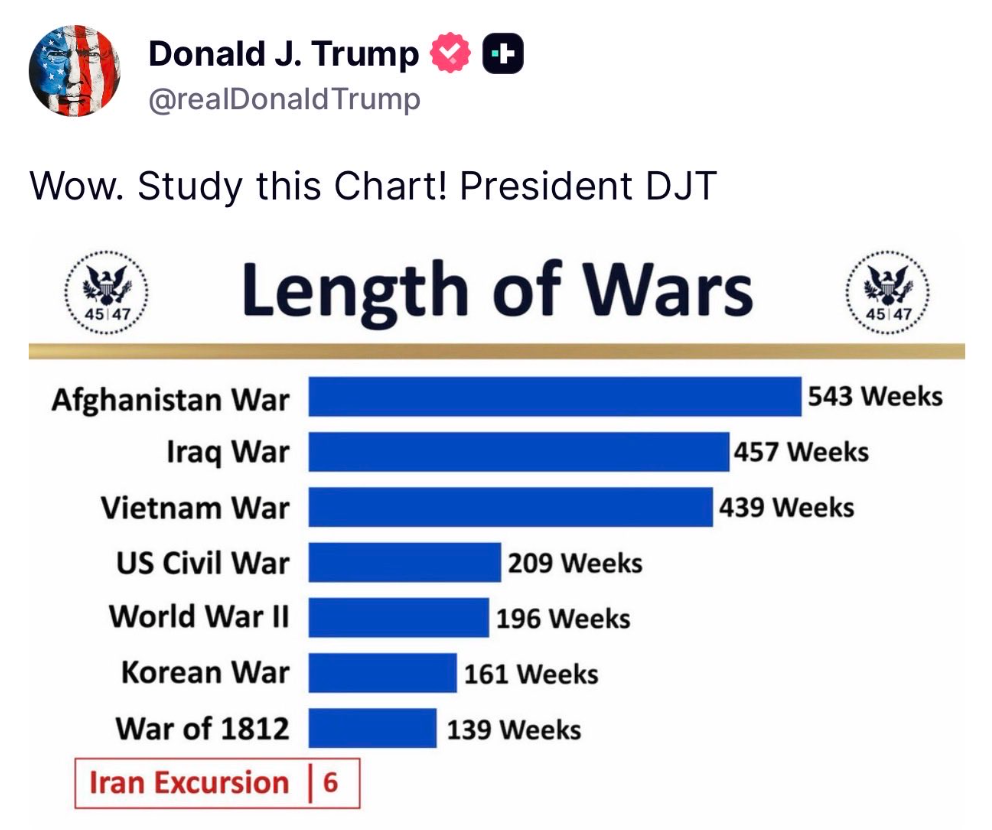
President Donald J. Trump once again set the agenda on social networks after sharing a graph that compares the duration of different wars in which the United States participated. Under the title “Length of Wars”, the image shows a stark difference: while historic conflicts such as Afghanistan or Iraq lasted for years—even decades—a recent incursion into Iran is barely 6 weeks long.
The contrast did not go unnoticed. In a global context marked by geopolitical tensions, the message aims to reinforce a clear narrative: that of leadership that prioritizes quick results, avoiding prolonged confrontations that are costly both in human lives
and in economic resources.
Long wars: a historic cost for the United States
The graph shows eloquent figures: War in Afghanistan:
543 weeks
War in Iraq: 457 weeks Vietnam War: 439 weeks
American Civil War: 209 weeks
Second World War: 196 weeks
Korean War: 161 weeks
War of
1812:139 weeks
These numbers reflect the enormous wear and tear that protracted conflicts entailed for the United States. Decades of intervention, thousands of casualties and trillions of dollars invested marked entire generations.
In this context, the comparison with an operation of just six weeks is not only symbolic, but also points to a paradigm shift in the way we approach foreign policy.
The chart shared by DJT
The Trump approach: speed, pressure and results
During his administration, Trump promoted a doctrine based on maximum pressure, deterrence and direct action when necessary, avoiding being trapped in endless conflicts. This approach resulted in operations that were more limited in time, with specific objectives and a clear intention not to repeat mistakes of the
past.
For his followers, this strategy represents an evolution compared to previous foreign policies that led to long wars that were difficult to escape. The idea of “resolving quickly and retiring” is gaining weight compared to the traditional model of prolonged occupancy.
Political Impact and Public Perception
The publication of the graphic is no accident. In the midst of a complex international scenario, Trump seeks to position himself once again as a strong figure in the field of security and defense. The message is aimed at both the American electorate and the international community: the United States can act decisively without being caught up
in eternal conflicts.
In addition, visual contrast works as a powerful tool in communication terms. It simplifies a complex discussion and turns it into a direct argument: less war time, less cost to the country
.
A debate that returns to the center of the scene
The viralization of the graphic revives a key debate: is a quick and limited intervention or a prolonged strategy of military presence better? While some sectors question the simplification of analysis, others highlight the need to learn from past experiences
.
The truth is that Trump managed to once again install the issue on the global agenda, reinforcing his profile as a leader who is committed to quick decisions and concrete results.