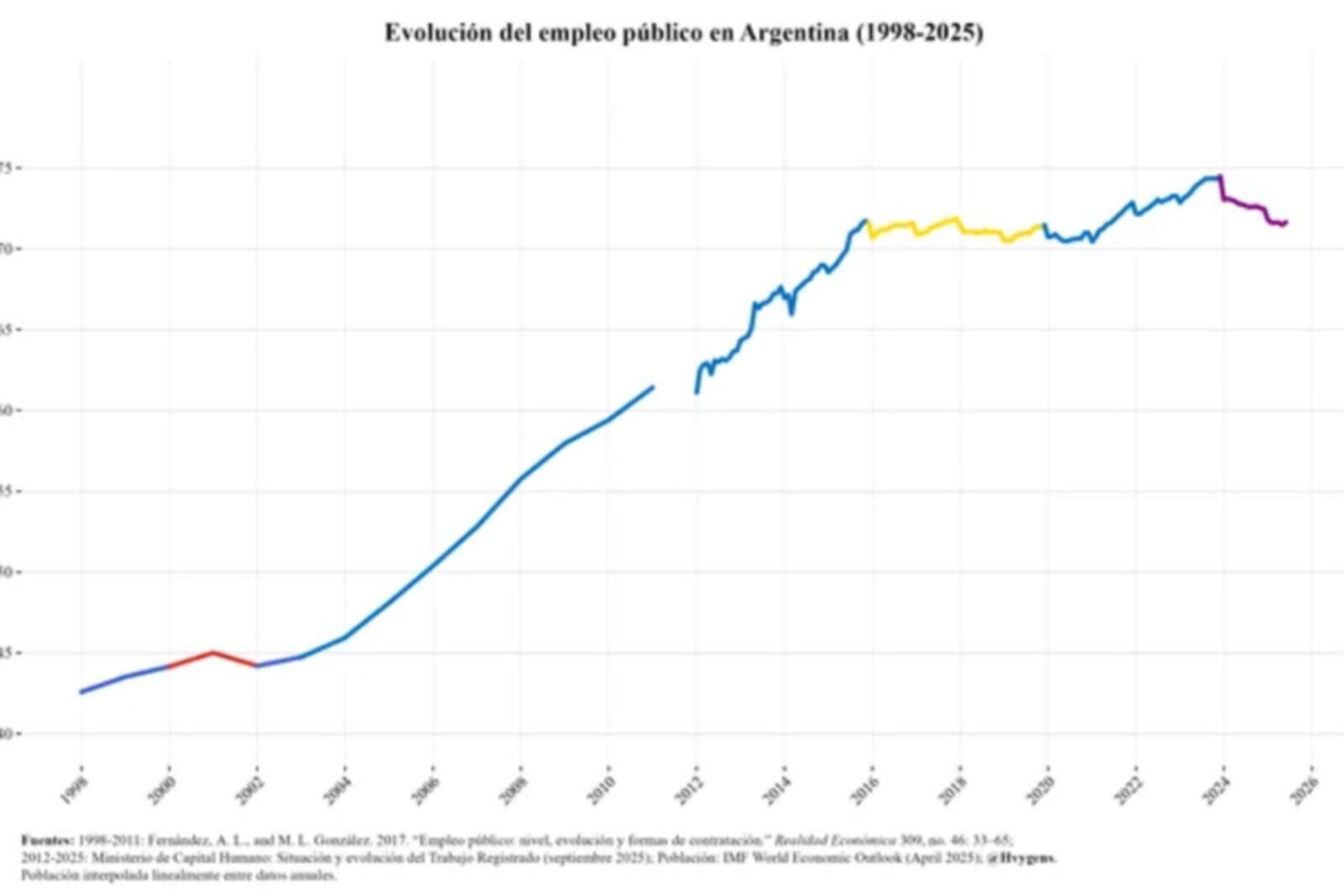
A recent report on the evolution of public employment in Argentina once again clearly exposes a trend that has set the course of economic policy over the past two decades.
The data in the chart, which come from the Ministry of Human Capital and organizations such as the IMF, reveal that, from 2003 to 2015, during the administrations of Néstor and Cristina Kirchner, public employment grew steadily, becoming a heavy burden on public finances.
This expansion, then presented as "labor inclusion," involved a significant increase in the number of salaried public employees per 1,000 inhabitants, many of whom were hired for political purposes.
Gráfico de empleo público.
The situation did not change substantially in the following years. During Mauricio Macri's administration (2016-2019), there was only relative stability or a slight decrease in the number of public sector workers, without a firm policy of cuts to reverse the inherited phenomenon.
However, the real critical point was reached between 2020 and 2023, under the administration of Alberto Fernández and Cristina Kirchner. In that period, the upward trend became consolidated again, and public employment reached its highest level in recent history. The use of the state apparatus as a refuge for political activists and a mechanism for social containment resulted in a giant state, more expensive and less efficient.
The arrival of President Javier Milei
As can be seen in the same chart, the contrast came with the inauguration of Javier Milei in December 2023. Unlike his predecessors, the current libertarian government made the decision to reverse the expansionary process and move forward with an effective reduction of the state structure.
Javier Milei y Federico Sturzenegger.
According to official figures from the Ministry of Deregulation and Transformation, headed by Federico Sturzenegger, in the first 20 months of the administration, 53,345 public sector jobs were eliminated, which represents a 10.6% reduction. In July 2025 alone, 1,164 positions were cut.
The cuts were particularly significant in state-owned companies, where 18.5% of positions were eliminated (16,886 fewer jobs), and in the National Public Administration, with a 15.1% decrease (31,114 fewer employees).
This adjustment is not only aimed at downsizing the state, but also has a direct impact on finances, since the estimated annual savings in salaries amount to 1.053 billion dollars, a figure that rises to 2.106 billion if labor infrastructure, offices, equipment, and services expenses are also considered.
Milei's policy marked a historic shift from the Kirchnerist model of permanent expansion of the state apparatus, since, while that legacy left behind an oversized and deficit-ridden state, full of ñoquis and activist employees, the current government seeks to cut unnecessary structures, with the aim of generating fiscal relief and, in the medium term, reducing taxes.