The president also criticized allied countries for not helping to liberate the strategic Strait of Hormuz.
Nuevo
Agregar La Derecha Diario en
Compartir:
The President of the United States, Donald Trump, sent a harsh message against “allied” countries as the joint military offensive with Israel against the terrorist regime of Iran progresses, amid growing international tensions and questions over the lack of support.
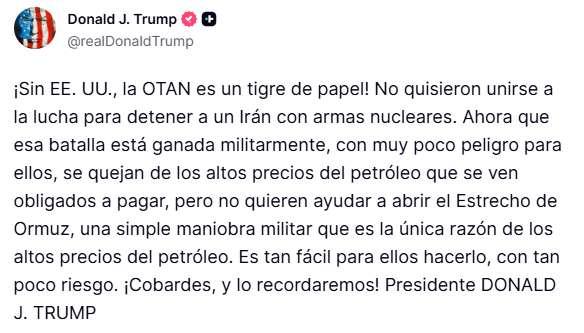
In a strong message, Trump said: “Without the U.S. IN THE US, NATO IS A PAPER TIGER! They didn't want to join the fight to stop a nuclear-armed Iran.”
Trump's message.
"Now that this battle is WON militarily, with very little danger to them, they complain about the high oil prices they are forced to pay, but they don't want to help open the Strait of Hormuz, a simple military maneuver that is the only reason for high oil prices,” criticized the president, about the lack of support from “
allied” countries.
Finally, Trump closed his message with a strong warning: “It's so easy for them to do it, with so little risk. COWARDS, and WE WILL REMEMBER IT! ”.
The statements of the American president take place in a context of a military offensive in the Middle East, where the United States and Israel carried out attacks against Iranian targets, which led to a strong regional escalation after the regime decided to attack numerous countries in the area.
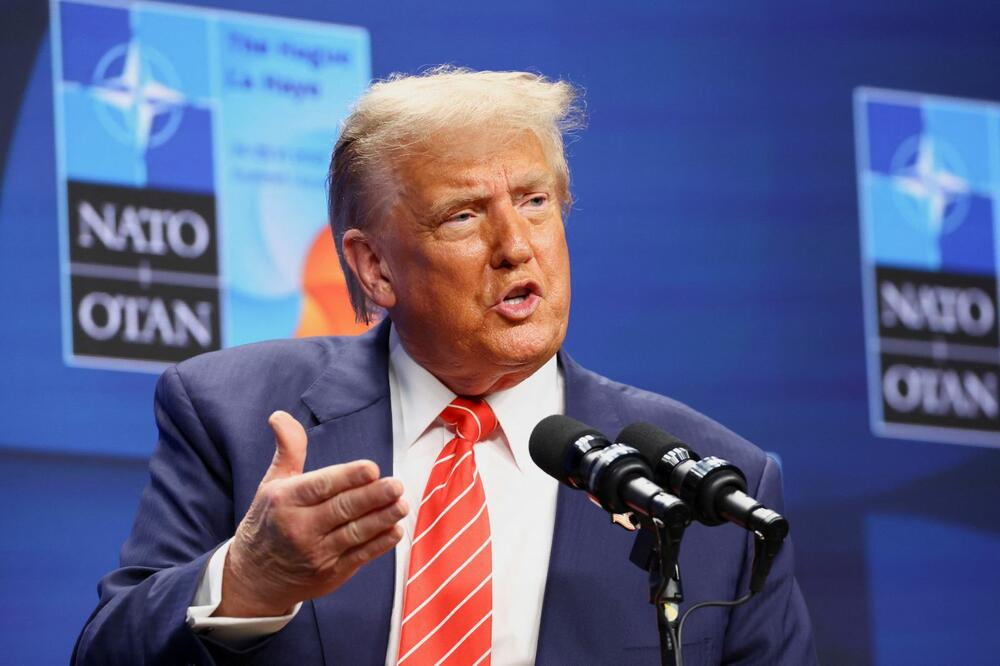
President Donald Trump.
The axis of Trump's claim points directly to NATO, which he questioned for not having participated in the initial military actions or in subsequent operations to ensure security on key routes for global energy trade
.
In particular, the president referred to the rise in the price of oil due to the situation in theStrait of Hormuz, a strategic step through which a significant part of the world's crude oil supply circulates. As he explained, the refusal of allies to intervene in that area aggravates the global economic impact
.
In this framework, the message released in Truth Social not only exposes Trump's discomfort, but also reflects a growing fracture within NATO over how to approach the conflict and its economic and geopolitical consequences.