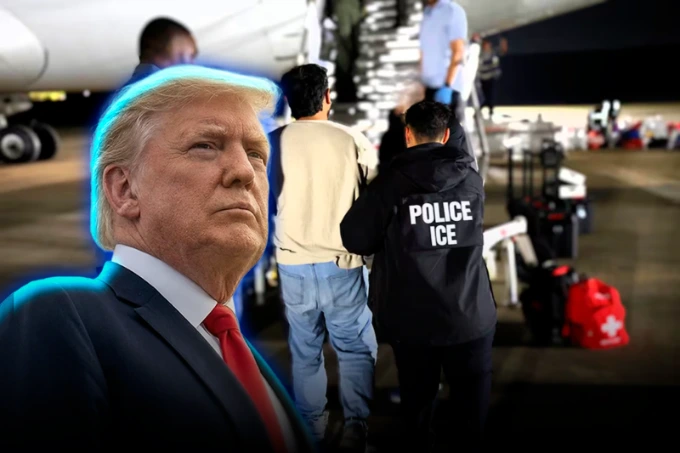
The Trump administration seeks to reinstate a program that allows the deportation of immigrants to third countries with guarantees against persecution and torture
The U.S. Department of Justice requested on Thursday that the Supreme Court allow the government to resume its deportation program to third countries, a tool that the administration of President Donald Trump deems necessary to expand the available options for executing removal orders.
The request seeks to suspend a decision from the First Circuit Court of Appeals that blocked the Department of Homeland Security (DHS) guidelines for sending certain deportees to countries that were not originally included in their removal orders. The case, known as DHS v. D.V.D., thus returns to the highest court amid the legal dispute over the scope of government powers in immigration matters.
The program allows the United States to remove a person to a third country when that government provides diplomatic assurances that the deportee will not be persecuted or subjected to torture. For the Trump administration, this mechanism expands the ability to enforce deportation orders when the country of origin does not accept the individual or there are difficulties in directly facilitating their transfer.
The Trump administration asked the Supreme Court to allow it to resume the deportation of illegal immigrants and criminals to third countries
The Republican government has already secured support from the Supreme Court on two previous occasions related to this program, both through the so-called emergency docket. Now, the Department of Justice seeks the highest court to intervene again to prevent the First Circuit's decision from halting the policy while litigation continues.
The filing was formally directed to Democratic Judge Ketanji Brown Jackson, who is assigned to oversee emergency requests from the First Circuit. However, U.S. Attorney General John Sauer requested that Jackson refer the request to the full Court if she believes it is not appropriate to individually suspend the lower court's decision.
The strategy is significant because Jackson voted against the government on the two previous occasions when the program reached the Supreme Court. A consideration by the nine justices would allow the new request to be evaluated by the entire court and not just by the judge responsible for emergency appeals from that jurisdiction.
The Attorney General of the United States asked Democratic Judge Ketanji Brown Jackson to refer the case raised by the First Circuit to the full court
The Trump administration has made the expansion of deportations and the strengthening of immigration law enforcement one of the pillars of its immigration policy. Within that strategy, the possibility of resorting to third countries offers authorities an additional alternative to execute removal orders when transferring to the country of origin proves complicated.
The new request to the Supreme Court aims to keep that tool available while the legal dispute is definitively resolved. The intervention of the highest court will be crucial in determining whether the government can continue using diplomatic assurances to transfer deportees to third countries during the judicial process.