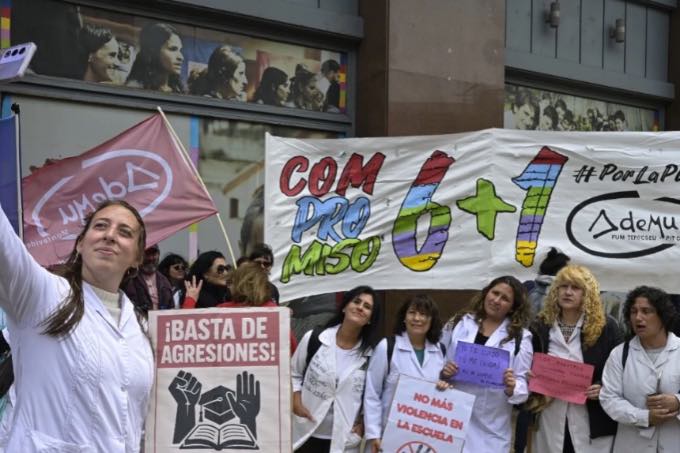

The show last night was not an accident. It was the confirmation of a rotten system. The Montevideo Association of Early Childhood and Primary Education Teachers (ADEMU) called for a 24-hour strike in the schools of the capital. The decision was made on Wednesday night. They did not give reasonable notice to families. They did not think about the kids who were left exposed to the street or without classes. All because of a fight between a male teacher and a female teacher — plus a staff member — in the offices of the Montevideo West Primary Inspection, administrative offices of the ANEP. A physical assault with the display of a knife, in a context that the union framed as gender violence. The aggressor already had a history and had been removed before. The president of the ANEP, Pablo Caggiani, described the measure as “irrational.” Meanwhile, the authorities improvised food alternatives in open or nearby schools. The minors and their families paid the cost of an internal quarrel.
The sequence is as predictable as it is indecent. First, the conflict among teachers. Then the urgent night call. Next, the closure of schools in Montevideo. And finally, the kids outside or with truncated days, while the unionists celebrate their “struggle” and announce the expulsion of the aggressor. The same ones who indoctrinate with narratives of oppressor and oppressed, who turn any conflict into a weapon of pressure, demonstrate once again that their only meritocracy is that of union power. The quality of education, the safety of minors, and the time of families are indifferent to them.
This is not an isolated case. It is the model. In Secondary Education, more than 300,000 class hours were lost in a single year due to vacancies and teacher absenteeism. In 2024, 65% of ANEP staff certified sick at least once, with an average of 30 days of leave. In primary and early childhood education, chronic absenteeism among students exceeds 50% and reaches 72% in early childhood: many kids lose the equivalent of a full year of classes throughout their schooling. The PISA 2022 results are eloquent: 409 points in mathematics (OECD average 472), 430 in reading (476), and 435 in science (485). Only 43% of Uruguayan students aged 15 reach Level 2 or higher in mathematics, compared to 69% in the OECD. Uruguay is among the best in South America, but light-years away from systems that truly work.
The ANEP budget is around 3.25% of GDP; total spending on education approaches 4%. The unions demand 6% and strike time and again — June, August, regional strikes, national strikes — even though there is a wage agreement in force until 2027. A grade 1 teacher with 20 hours earns just over 53,000 nominal pesos in 2026; with seniority and full-time work, higher figures can be reached, but the problem is not just the amount: it is the lack of competence, the immovability, and the protection of mediocrity.
The solution does not lie in more dialogue with those who have shown that dialogue only serves them when they win. Nor in more money without countermeasures or in more “collective bargaining” that reinforces the same apparatus. The solution lies in competition. And to compete, the teaching market must be opened to those who can truly teach.