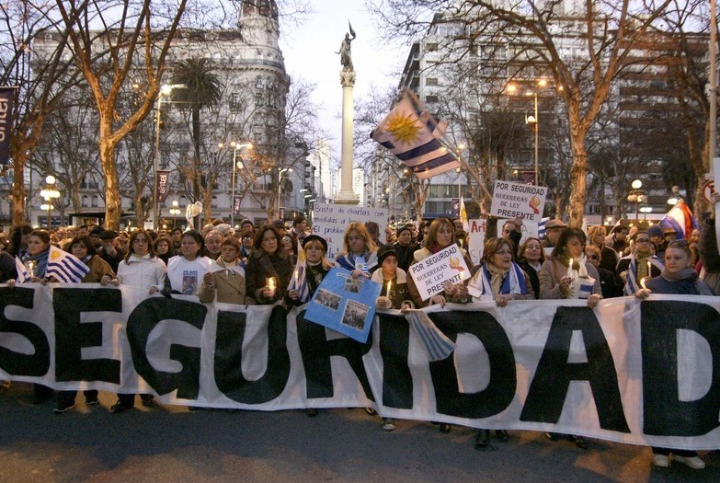

Insecurity is unsustainable: three attacks that expose the collapse of a state policy
The situation of insecurity in Uruguay has reached a breaking point. It is no longer about street robberies, thefts, or muggings that affect the daily lives of citizens. Now there are direct attacks against state institutions: the Military Box, the home of the Attorney General, and the headquarters of the National Institute of Rehabilitation (INR). These events are neither isolated nor coincidental. They are clear messages of impunity and a challenge to legitimate power.
The most recent occurred in the early morning of June 15, 2026, when an explosive device was detonated against the facade of the headquarters of the Armed Forces Retirement and Pension Service (known as the Military Box), on Avenida Uruguay between Convención and Andes, in downtown Montevideo. Security cameras captured a man who arrived on foot, left the explosive, and walked away. There was material damage to shutters and glass, but fortunately, there were no casualties. The Scientific Police, the Army, and intelligence are working on the case; even the possible involvement of a couple who arrived by taxi is being investigated.
This is not the first blow of this kind. On September 28, 2025 (early morning of the 29th), two individuals entered the backyard of the home of Attorney General Mónica Ferrero in Brazo Oriental. They fired shots and, according to forensic analysis, at least one detonation corresponded to a grenade or another explosive. The house suffered damage, but Ferrero escaped unharmed by mere inches. The incident was linked to drug trafficking and generated a message of terror against the highest authority of the Public Ministry. Subsequently, several individuals were convicted.
And in the early morning of November 16, 2025, two people on a motorcycle fired several times at the INR headquarters in downtown Montevideo and left a letter with an explicit threat against its director. Another direct attack against the state’s penitentiary and rehabilitation system.
These three attacks in less than nine months form an alarming pattern: organized crime —or sectors linked to it— no longer settles for operating in the shadows. It attacks symbols of the state with explosives, grenades, and gunfire. This does not happen in a vacuum. It occurs under a security management that, despite the speeches and the numbers, has proven incapable of deterring.
A failed state policy
Insecurity is not a technical or circumstantial problem. It is the result of a state policy sustained over the years, which prioritized the narrative of “decreased crime” over the reality perceived by citizens and, now, over the integrity of institutions. The current government presents national plans for 10 years, with dozens of measures and an emphasis on prevention, coordination, and “evidence.” Meanwhile, criminals act with increasing audacity.
This is where Diego Sanjurjo comes into play. A political scientist, manager of the Area of Statistics and Applied Criminology (AECA) of the Ministry of the Interior, and coordinator of focused prevention strategies, Sanjurjo has been one of the main architects and spokespersons of this line. His reports highlight decreases in thefts, muggings, and even homicides in 2025 and so far in 2026. He himself has acknowledged that Uruguay is “an unsafe and violent country,” but insists that the indicators “are coming down.”
This numerical defense is, at best, shortsighted. At worst, it is part of the problem. Sanjurjo represents the continuity of an approach that confuses statistical management with real security. His strategies of “focused prevention” and “violence-free neighborhoods” (inspired by soft international models) have failed to generate effective deterrence. While he and his team celebrate decreasing numbers in certain areas, the state receives explosives at the Military Box, grenades at the Attorney General's house, and gunfire with threats at the INR.
Criticizing Sanjurjo is not personalism: it is pointing out the intellectual responsible for a policy that underestimates the seriousness of the challenge. His emphasis on aggregated data and soft prevention has contributed to generating a perception —and now a reality— of impunity. Criminals do not read AECA reports. They see that they can attack state headquarters and that the response is subsequent investigation, not an immediate and devastating offensive. That is the state policy that must be denounced: one that manages insecurity instead of eradicating it.