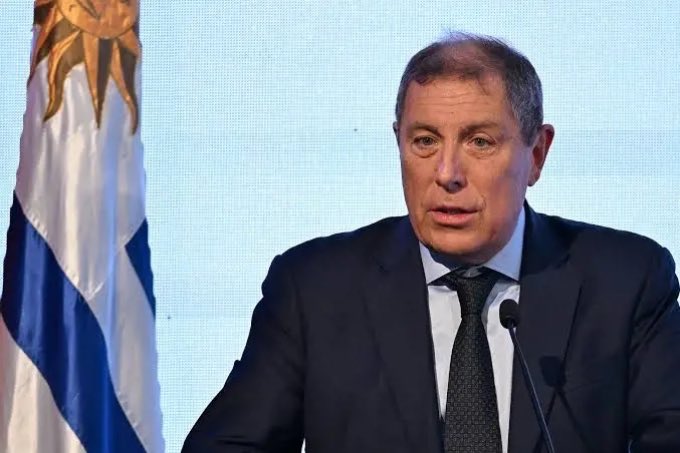
Gabriel Oddone, the economist who arrived at the Ministry of Economy and Finance on March 1, 2025, alongside Yamandú Orsi and the Broad Front, has always presented himself as the serious technician, the one who came to restore order after the chaos. A former member of the Socialist Party until 2015, a reference for urban social democracy in Montevideo, the man of fiscal targets and “sustainability.” But the events of 2026 reveal the truth: the minister started distributing money lavishly to low-income sectors under the guise of “unification of transfers” and “combating child poverty.” This is not social policy. It is pure and simple Plan Platita, textbook clientelism to build political capital and position himself for 2029.
The numbers do not lie and are devastating. In the Accountability Report presented at the end of June 2026, Oddone pushed for a budget increase of approximately 3.2 billion pesos (about 81 million dollars in total, including the 50 million already planned in the Budget plus an additional 31 million). The bulk goes to the “Unique Allocation for Childhood and Adolescence,” which merges Family Allowances, the Equity Plan, the Childcare Bonus, and the Uruguay Social Card. For children aged 0 to 3 years in the lowest deciles, the amounts skyrocket:
Decile 1: from 5,371 pesos to 10,000 pesos monthly.
Decile 2: from 4,400 to 10,000.
Decile 3: from 3,032 to 6,600.
Decile 4: from 3,232 to 6,600.
Decile 5: from 2,796 to 3,300.
This will impact about 50,000 children in the first year (born 2025-2027) and will expand over time. Transfers to childhood were already around 450 million dollars annually; this adds another 7% extra. Oddone and his team (Vallcorba, Arim) sell it as “efficiency” and “the biggest change in two decades.” The reality: more direct money in the pockets of the lower quintiles, exactly the “foolishness” that the FA needs captive.
Where does the money come from? Not from a miracle of productivity. Part of it comes from re-estimations of already approved taxes, “tax efficiency,” and, most revealingly, from a new tax: removing the exemption of IMESI for certain electric vehicles starting in 2027 (more than half of the additional 31 million depends on that tax which does not yet exist). Meanwhile, GDP growth in 2025 was just 1.8% (below the government's original projections), the projection for 2026 was cut to 1.6%, and Oddone himself admits that “there is no money for everything that is demanded.” But for the Plan Platita, money always appears. Low inflation (3.65%), 26,000 jobs, and a real wage increase of 2.3% are not enough to justify this leap in targeted spending when the economy barely drags above the decade's average.
Oddone denies presidential aspirations. In interviews, he said that “it is impossible” for him to run in 2029, that “he wouldn’t even know how,” that his family won’t allow it, and that a Minister of Economy should not transition to politics. Typical. In January 2026, there was already open talk of the “candidate suit” that fit him: a synthesis of Vázquez-Astori, a man of the urban middle class, unbreakable presidential backing, and the ability to rally the FA. The prominence he accumulated in 2025 and 2026 —interpellations in the Senate, defense of the debt, bond issuances of 1.3 billion dollars at “historic” rates— is not innocent. A minister who distributes increased transfers to 50,000 vulnerable households while maintaining the narrative of “social protection and cohesion” is sowing votes. Exactly what Argentine kirchnerism did with the Plan Platita: money today, loyalty tomorrow, power the day after.
This is classic socialist clientelism. The FA returns to government and, in less than two years, Oddone —the “responsible technician”— prioritizes incremental spending on childhood, security, education, and homeless individuals, financed by more tax pressure and reallocations. There is no deep structural reform of the State, no real competitiveness shock that sustainably lowers the cost of living for everyone. There are fatter checks for the lower deciles. The “foolishness” receives the money, the minister builds an image of “shield of the weak,” and the Broad Front secures the electoral base for 2029. That Oddone says he does not want to be a candidate does not change the political effect of the measure. The facts speak louder than the statements.
Uruguay does not need another cycle of clientelistic transfers disguised as “investment in childhood.” It needs real growth, less bloated State, fewer taxes, and more economic freedom. Oddone's Plan Platita is the confirmation that, under the technical discourse, socialism remains the same: distributing other people's money to buy loyalties and set up the next power project. Categorical and straightforward: this is pure electoralism. And the numbers are visible to anyone who wants to look at them.