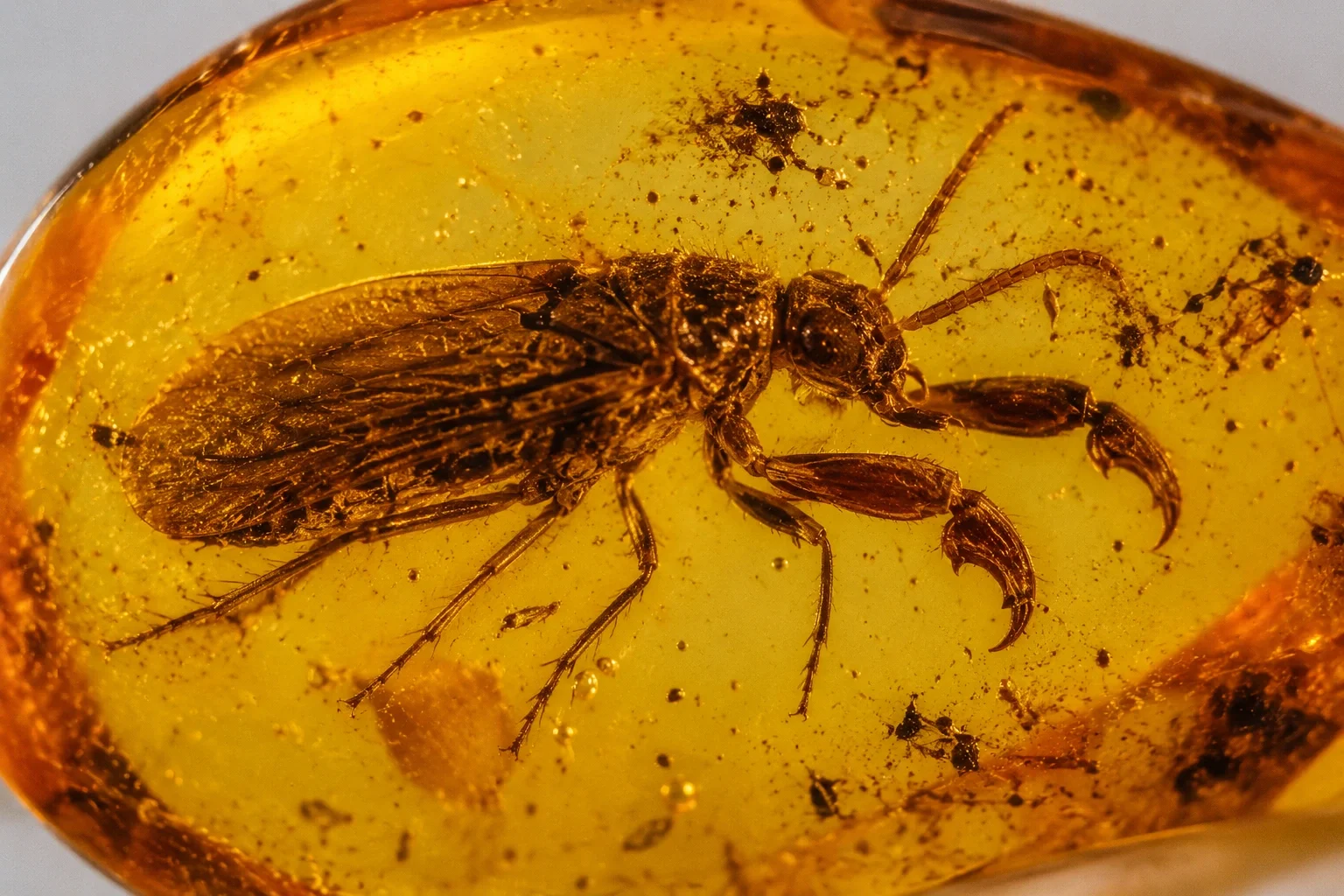
A fossil trapped in amber for 100 million years has just revealed one of the strangest forms known among ancient insects. Researchers identified a true insect from the Heteroptera group with front legs ending in large claw-like structures similar to those of a crab. The finding was made in amber from the Kachin region of Myanmar, an area famous for preserving tiny organisms from the dinosaur era with an extraordinary level of detail.
The creature drew attention due to an adaptation that has no direct equivalent among known modern insects. Its front legs ended in claw-shaped appendages, known as chelae, that function similarly to pincers or forceps. These structures are extremely rare in insects, making the fossil an exceptional piece of evidence for independent evolution.
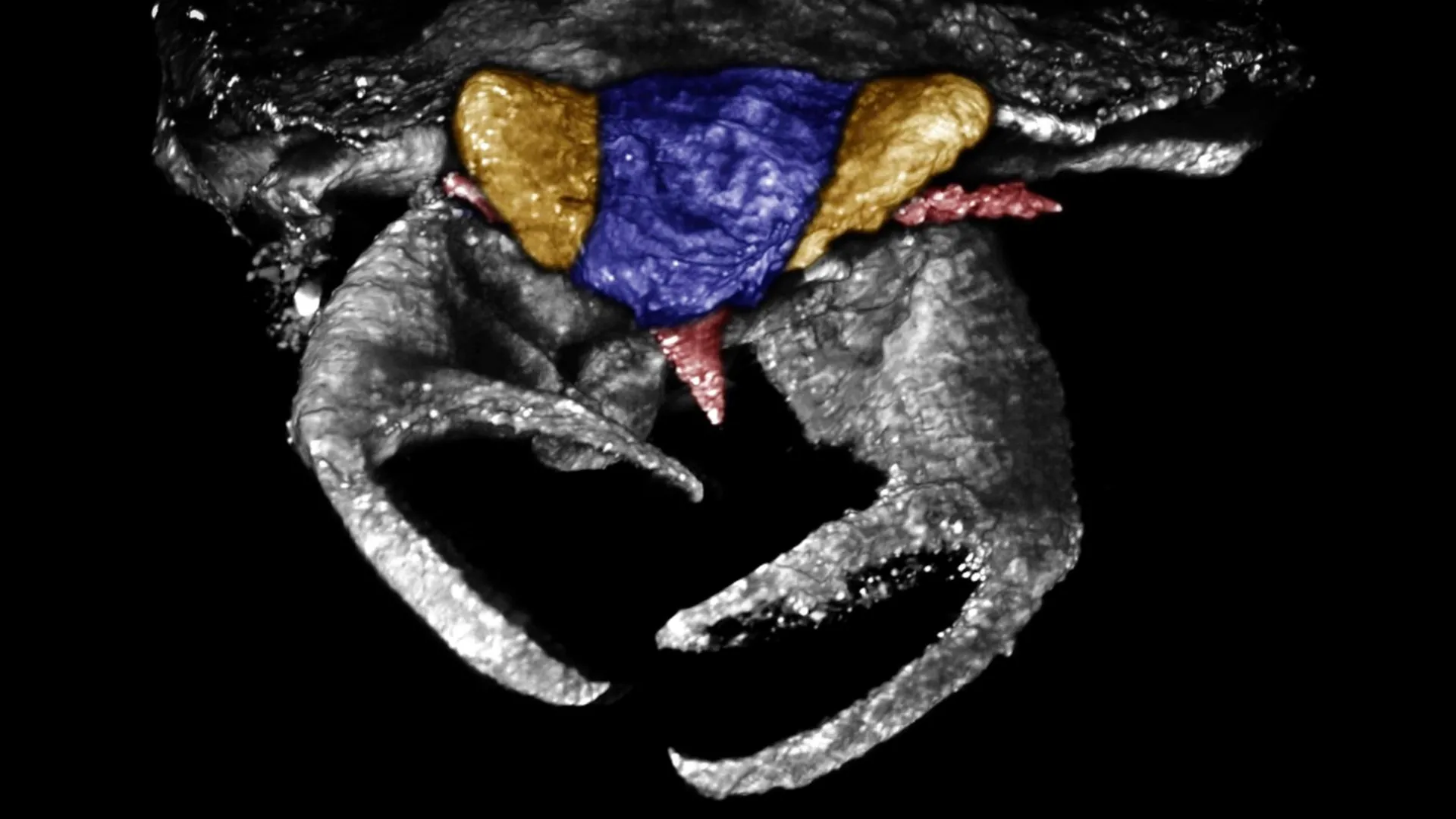
The research was led by specialists from Ludwig Maximilian University of Munich, along with colleagues from the University of Rostock and the University of Oulu in Finland. The team used micro-computed tomography to generate high-precision three-dimensional images and study the anatomy of the specimen without destroying the fossil. The results were published in the scientific journal Insects and provide a new piece to the puzzle of biological diversity in the Cretaceous.
A crab-like “clawed” insect trapped in amber
Amber from Myanmar has allowed for the discovery of numerous extinct species, many of which have traits not seen in current animals. In this case, the fossil preserves a tiny but anatomically surprising insect, with modified front limbs shaped like claws. This trait sets it apart from other fossil and modern insects, suggesting that this lineage developed a very specific strategy for capturing, holding, or manipulating objects or prey.
Researcher Carolin Haug, a zoologist at the Faculty of Biology at Ludwig Maximilian University of Munich, explained the rarity of the discovery. “Previously, these chelae were only known in three groups of insects. Therefore, this fossil represents the fourth known case of these structures evolving independently in insects,” she noted. The statement summarizes the evolutionary importance of the finding: it is not a minor variation, but an anatomical solution that appeared very few times in the history of insects.
Chelae are more commonly associated with animals like crabs, scorpions, or certain crustaceans, not with insects. Thus, finding such a structure in an insect from 100 million years ago forces a reevaluation of how different groups developed similar bodily tools to solve similar problems. In evolutionary biology, this phenomenon is known as convergent evolution: distantly related organisms arrive at similar forms due to similar functional pressures.
 What Myanmar amber reveals about life in the age of dinosaurs
The fossil comes from the amber deposits in the Kachin region of Myanmar, a key source for studying Cretaceous ecosystems. This amber preserves remnants of ancient tropical forests where insects, plants, arachnids, and other small organisms coexisted while dinosaurs dominated the Earth. The fossilized resin acts as a time capsule: by enveloping animals, it can preserve fine details of their bodies, such as legs, antennae, eyes, and microscopic structures.
In this case, the preservation allowed for detailed observation of the insect's front legs. The claws were not interpreted as an accidental deformation, but as a real and functional anatomical feature. This precision is important because, in such ancient and small fossils, differentiating between damage, posture, preservation, and evolutionary trait can be complex.
To study the specimen, scientists turned to micro-computed tomography. This technique allows for internal cuts and 3D reconstructions without opening or damaging the amber piece. Thanks to this technology, the team was able to analyze the shape of the limbs, the arrangement of the structures, and their relationship with the rest of the body, which is fundamental for classifying the fossil and understanding its function.
The finding also shows that Cretaceous insects were much more varied than is often imagined. Far from being simple or primitive forms, many had already developed highly specialized adaptations. This specimen with claws reinforces the idea that ancient ecosystems contained a diversity of evolutionary solutions that, in many cases, did not survive to the present day.
An evolutionary rarity: the fourth known case of chelae in insects
The importance of the discovery lies in its exceptional nature. According to the researchers, claw-like chelae had only been documented before in three groups of insects. This new fossil adds as the fourth known case, but with a key peculiarity: the structures would have evolved independently in this lineage.
This evolutionary independence is central to interpreting the finding. It does not mean that all insects with claws come from the same ancestor with that characteristic, but that different groups developed similar solutions separately. In scientific terms, this demonstrates that certain body forms can appear repeatedly when they offer clear functional advantages.
The open question is what this insect used its claws for. They could have served to capture small prey, cling to surfaces, manipulate food, or even fulfill some function related to mating or defense. Although the fossil does not allow for all questions to be answered, its anatomy indicates that those front legs had a specialized and likely important role in its way of life.