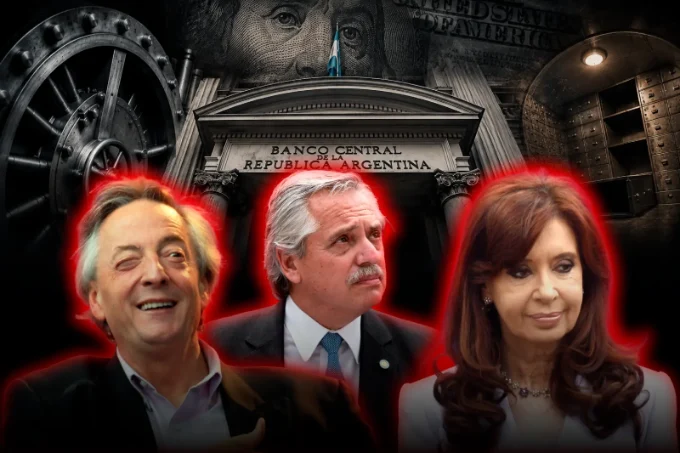
The governments of Néstor Kirchner, Cristina Kirchner, and Alberto Fernández took almost USD 275 billion from the Central Bank to finance the Treasury and deficits, according to a study conducted by Eco Go based on data from the monetary authority itself.
The figure represents approximately 91% of the USD 301.2 billion in financing accumulated since 2003 and highlights the extent to which different administrations relied on the BCRA to cover the financial needs of the State.
This data allows us to gauge the volume of resources lost by the Central Bank during the Kirchnerist governments. The mechanism was utilized through various tools, including temporary advances, utility transfers, non-transferable notes, Bonares, and the repurchase of public securities.
Alberto Fernández and Cristina Kirchner
Data from each government
The administration that obtained the most financing from the Central Bank was that of Alberto Fernández, with USD 118.7 billion.
This amount consisted of USD 29.4 billion in temporary advances, USD 32.1 billion in utility transfers, and another USD 36.8 billion mainly related to operations on public securities.
Very close behind is the second term of Cristina Kirchner, which received USD 104.9 billion through the various mechanisms outlined in the survey. Within that figure, USD 38.8 billion corresponds to non-transferable notes and another USD 25.3 billion for utility transfers.
The first term of Cristina Kirchner involved another USD 35.8 billion in financing from the Central Bank, while during Néstor Kirchner's presidency, the amount reached USD 15.3 billion.
The sum of these four periods amounts to USD 274.7 billion, which explains the vast majority of the financing accumulated since 2003. In percentage terms, the administrations of Néstor Kirchner, Cristina Kirchner, and Alberto Fernández represent around 91% of the total of USD 301.2 billion recorded.
Néstor Kirchner, Cristina Kirchner, and Alberto Fernández
The Milei Government
The contrast with the government of Javier Milei is particularly marked. According to the same report, the current administration is the only one that presents a negative balance in the financial relationship between the Treasury and the Central Bank.
The Milei government records a result of USD -1.3 billion. This means that, in net terms, the Treasury did not receive new resources from the Central Bank, but rather returned financing to the monetary authority.
The evolution during the current administration is mainly explained by the withdrawal of public securities for USD 4 billion and the reduction of non-transferable notes by USD 24.9 billion.
This data marks a change from the dynamics that prevailed during previous governments. While the Kirchnerist administrations accumulated hundreds of billions of dollars in financing from the Central Bank to the Treasury, the Milei Government exhibits an inverse position and seeks to eliminate the use of the monetary authority as a source of resources for public accounts.
President Javier Milei
To further illustrate the difference, the survey places the government of Mauricio Macri at USD 27.8 billion in financing, the second lowest amount among the analyzed administrations, only above the negative result recorded during Milei's government.
The Milei Reform
This difference between administrations is one of the central arguments behind the reform of the Central Bank's Organic Charter that the government of Javier Milei is promoting.
The ruling party seeks to completely eliminate Treasury financing by the monetary authority, putting an end to a tool that has been used recurrently over the last few decades.
The proposal is thus presented as part of a change in the relationship between the Central Bank and the Treasury. After years in which the State relied on the monetary authority to obtain resources, the Milei administration shows a negative balance and proposes to move towards a scheme in which that financing route is definitively limited.