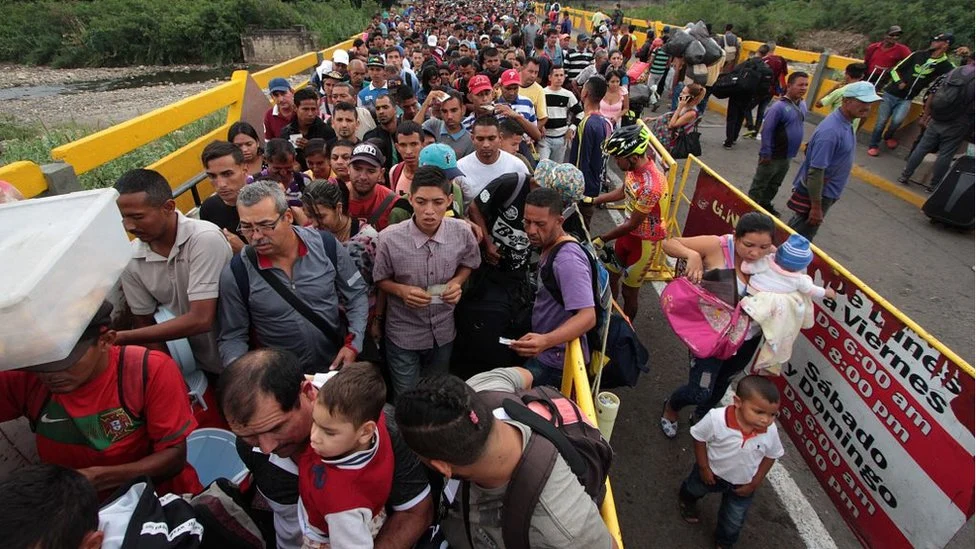
Brazil recorded the entry of 34,346 illegal immigrants between January and June 2026, mainly from Cuba, Venezuela, and Haiti, according to data from the International Migration Observatory (OBMigra).
This number adds to a migration phenomenon that has intensified over the last decade: since 2016, 548,204 undocumented individuals have entered the country seeking asylum.
The state that concentrates the majority of these movements is Roraima, located in the far north of Brazil and close to Venezuela and Guyana. Over the last decade, the region received around 331,000 immigrants, a figure equivalent to 60% of the total entries recorded nationwide.
Illegal immigrants
This occurs in a context where the Brazilian dictator Lula da Silva has been harshly criticized, both in his country and throughout the region, for facilitating the mass entry of illegal immigrants into Brazil.
At the same time, in the southern state of Santa Catarina, the presence of thousands of Moroccans has been reported, some of whom have already begun to move around the region and even attempted to enter Argentina illegally.
Cubans lead asylum requests
One of the main changes recorded in recent periods is the increase in the arrival of illegal Cuban immigrants. During 2025 and the first half of 2026, Cubans surpassed Venezuelans and became the largest group of people entering Brazil irregularly.
Lula da Silva
In just the first six months of this year, 20,400 people from Cuba were recorded. This figure places the Cuban population at the forefront of entries and marks a change in the composition of the main migratory groups arriving in the country.
Venezuelans also remain among the nationalities with the highest presence in asylum requests, while Haitians occupy third place among the most numerous groups in 2026.
In the case of Haiti, the increase is particularly marked. During the first half of the year, approximately 1,405 Haitians requested asylum in Brazil, a number that already far exceeds the total for all of 2025, when 262 people requested asylum.
The evolution of Haitian requests also shows growth over recent years. Following the elections held in Haiti in 2016, the number of people from the island seeking to enter Brazil illegally began to increase progressively from the following year.
The trend peaked in 2019, before subsequently recording variations in the volume of entries. With the data from 2026, Haiti again shows a strong increase in the flow of people seeking protection in Brazilian territory.