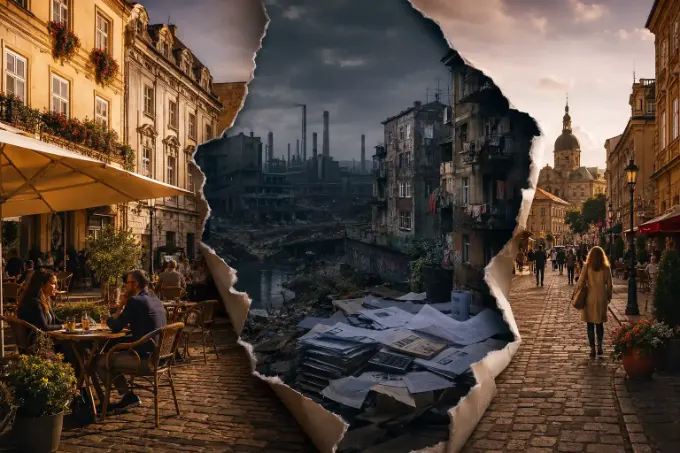
In 2024, Americans once again became the top nationality benefiting from the Portuguese visa for remote workers. Those residency permits in Portugal increased from 2,888 in 2017 to over 19,000 by the end of 2024. Every year, many people come to Paris following in the footsteps of “Emily in Paris” and her dream life.
On social media, the phenomenon has a name, “Europemaxxing,” that viral aesthetic that idealizes coffee on the terrace, free healthcare, and the leisurely pace of European life as an antidote to American anxiety.
This mirage clashes with a reality that presents four facets: a declining economy, a debt that keeps growing, a crime rate where foreigners remain significantly overrepresented (38% of those charged with burglary and 18% for homicide in France in 2024, compared to 8% of the population, according to the Ministry of the Interior), and three decades of immigration whose integration remains incomplete...
The decline, quantified by Brussels itself
In September 2024, Mario Draghi delivered a blunt diagnosis to the European Commission: no European company with a market capitalization exceeding 100 billion euros has been created from scratch in the last fifty years, while the six American companies worth over one trillion dollars were all founded in that same period.
Only four European tech companies are among the fifty largest in the world; companies on the continent invested 270 billion euros less than their American counterparts in research and development in 2021, and nearly a third of the European unicorns founded since 2008 ended up relocating their headquarters, mostly to the United States.
The GDP per capita gap with the United States, which was 15% in 2002, doubled to 30% in 2023. This economic setback is characteristic of a continent that has lived through decades of progressivism and is suffering the consequences of that ideology and dogmatism.
Taxes and regulations are the norm in a Europe where it is difficult to start a business and where economic growth is scarce. The illusion of prosperity that can be perceived from the outside is nothing more than a vestige of our glorious past, while socialism has harmed us in a lasting way...
The candle that burns at both ends
This erosion prolongs the slow bankruptcy of a welfare state financed by credit, with a European public debt of 81.7% of GDP (117% in France, 137% in Italy). In fact, the welfare state, so cherished by progressives, no longer fits our precarious situation. But our leaders continue to cling to it, even if that means lying to citizens by making them believe that nothing has changed, when it is evident that we are living beyond our means.
A year after presenting his report, Draghi himself notes that only 11% of his recommendations have been implemented. One of the most experienced economists in Europe has sounded the alarm, but our politicians look the other way and continue with social spending that will lead us to ruin. No reforms have been carried out, despite their necessity.
The laxity in security, long covered up by the silence of the left about its own consequences, adds its part to the bill: in Germany, foreign suspects of homicide increased by 12.9% in 2024. The comfort of yesterday did not disappear; it was financed by concrete decisions, backed by specific majorities. But they do not want to stop this madness...
The decline has only just begun
What American tourists and expatriates discover today are the interests of capital accumulated by previous generations, not the fruit of a still-living trajectory. The warning also applies to Latin America: a period of comfort proves nothing in the long term if the decisions that finance it are never named or corrected in time.
Europe believed that its standard of living was guaranteed forever; it discovers, twenty years late, that it had only been borrowing from the time it had left. And each passing year without structural reforms, without a rethinking of progressive spending policies and unchecked immigration, brings us closer to a rude awakening.
At some point, the illusion will end and the bill will have to be paid, assuming these decades of madness. It should not be forgotten that socialism only works when there is money to spend, but when money is scarce, it is misery that characterizes these regimes, and Europe risks realizing this in a very harsh way.