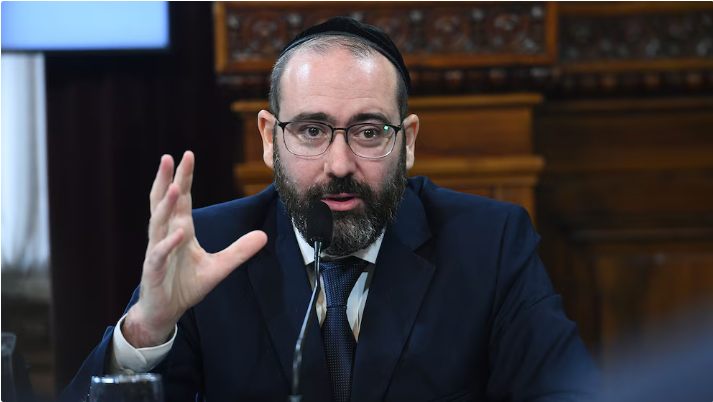
Axel Wahnish firmly defended the international position of the Argentine government in the face of the war in the Middle East, and highlighted the geopolitical impact of Javier Milei's position
Compartir:
In the midst of the growing international tension generated by the war in the Middle East, Argentina's position began to gain visibility and support on the global stage.
On the diplomatic front, the Argentine ambassador to Israel, Axel Wahnish, argued that the position adopted by the Javier Milei government represents, in his words, “being on the right side of history”, in a context marked by the threat posed by Iran to regional and global stability.
The diplomat analyzed the armed conflict that broke out in the region and stated that the Iranian advance was a scenario that was going to happen sooner or later. As he explained, the military escalation was “a time bomb”. “At some point it was going to explode. Eventually, it exploded at this time because the world began to see that if Iran were to get hold of the nuclear bomb, it would be a threat with no turning back,” said Wahnish, describing the seriousness of the international scene. In this context, the ambassador warned of the global implications of the confrontation and assured that current events could mark a profound change in geopolitics. According to his analysis, this is “a reconfiguration throughout the Middle East, but one that affects the entire world”.
Axel Wahnish
In deepening his vision of the conflict, the head of the Argentine diplomatic mission emphasized the dangerousness of the actors involved and drew a strong historical parallel. “When there is an intolerant terrorist element and above all under the shield of a religion of holy war, it starts in the region, but its appetite is for conquest and extension to the whole world,” he explained. In that regard, he issued a direct warning: “Iran is very similar to what happened with Nazi Germany.”
Within this complex international scenario, Wahnish especially valued the course adopted by Argentina under the leadership of Milei, and considered that current foreign policy marks a break with previous stages. “All Argentines should be proud that Argentina, under the leadership of our president, is standing on the right side of history,” said the ambassador
.
He also recalled painful history linked to terrorism that marked Argentine society and questioned past political decisions. At that point, he pointed out that there is a “black spot” in the collective conscience of all Argentines, that after having suffered two attacks, justice was not done, a memorandum was signed to cover those attacks. That should embarrass us.”
During the interview he gave to La Nacion+,Wahnish also recounted how the image of Argentina in Israel has changed in recent years, especially since the leadership of Javier Milei. As he explained, the recognition of the Argentine president is perceived even in daily life. “For two years now you've been walking here everywhere, they tell you: 'Where are you from? ' 'From Argentina'. Miley! Here Milei is seen as a hero who is bringing freedom and is making the revolution and fighting worldwide against Wokism and the left, which unfortunately has found its best ally with the terrorists,
” he said.
The ambassador also described the direct impact that armed conflict has on the daily lives of the inhabitants of Israel. As he said, society is going through “a traumatic situation”, with empty streets, closed shops and the suspension of classes. In addition, he explained that every time the alarms go off, a climate of generalized panic is generated. In parallel, he noted the concern of the resident Argentine community and tourists who are in the country, who are looking for alternatives to leave due to air restrictions.
In another part of the conversation, Wahnish referred to one of Milei's most important diplomatic promises: the transfer of the headquarters of the Argentine embassy from Tel Aviv to Jerusalem. As he explained, the decision has a strong symbolic and geopolitical weight in the region. “It's very symbolic. The first to do so with a lot of geopolitical impact was Trump. Our president made that statement, that promise. We don't have a specific date yet as to when it will be possible to specify, but it is a statement made by the president and we are watching,”
he said. Axel Wahnish and Javier Milei.
The diplomat also highlighted the recognition that Milei receives within Israeli society and revealed a fact that reflects the magnitude of that link. He explained that during Israel's Independence Day, Yom Ha'atzmaut, a national ceremony is held in which torches are lit in honor of prominent figures. “Here they celebrate Independence Day, Yom Ha'atzmaut, with a national ceremony where torches are lit and, for some reason or other, heroes or outstanding people in society are chosen. Every year, in total, twelve torches are set on fire.
This would be the first time that Prime Minister Netanyahu has invited a president of another country to light a torch,” said Wahnish.
Finally, when analyzing the background of the war, the ambassador insisted that the conflict is taking place in a context in which the objective is to recover regional stability. In that sense, he affirmed that the struggle seeks to “bring peace and stability” and maintained that, in this global scenario, “the left has found its best ally in terrorists”. In addition, he noted that the firm stance adopted by Argentina in foreign policy generated international support and noted that senior officials of the Israeli government have already expressed their support for Javier Milei's administration, thus consolidating the country's new position on the world stage