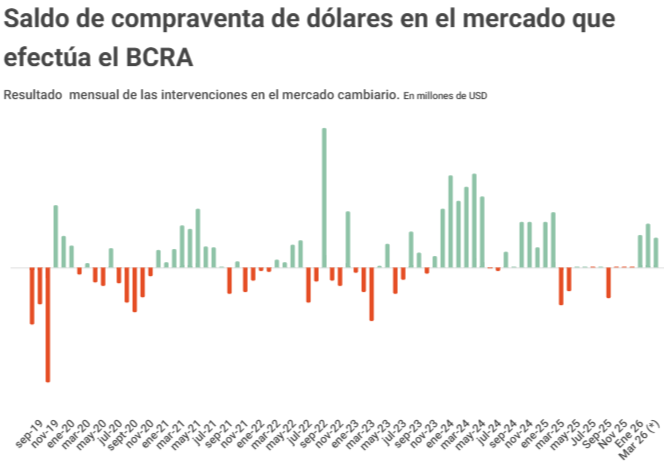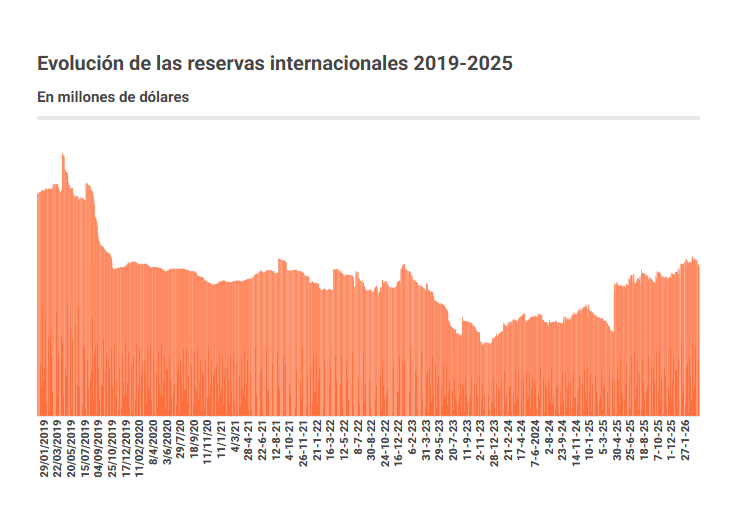

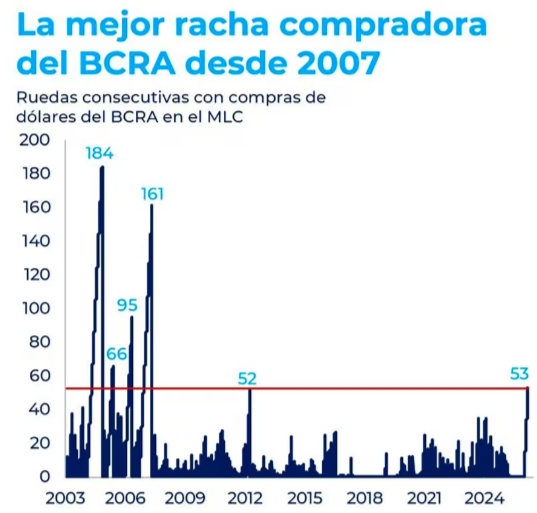
In the midst of the macroeconomic stabilization process and the monetary and fiscal planning program being carried out by the national government, the Central Bank of the Argentine Republic (BCRA) reached a milestone in the foreign exchange market: it achieved the longest foreign exchange buying streak in the last 19 years, consolidating a dynamic that strengthens international reserves and improves the country's financial position. The monetary authority chained 53 consecutive days with a buying balance of foreign exchange, a series that had not been observed since 2007. On the last reported day alone, Friday, the BCRA acquired USD 172 million, the highest daily figure recorded in March. In this way, the agency accumulated USD 485 million in the week and already exceeds USD 3.7 billion so far in
2026.The recent performance is among the most significant in recent decades. As explained by Adrián Yarde Buller, chief economist at Facimex Valores, the magnitude of the streak is comparable to the main periods of currency accumulation recorded in the years before the international crisis of the late 2000s.
“In detail, the current streak is only surpassed by May 2007 (161 wheels), May 2006 (95 wheels), May 2005 (66 wheels) and November 2004 (184 wheels). Both the magnitude and the persistence of BCRA's currency purchases reflect that the reserve accumulation program started at a very good pace in the first quarter of the year,” the specialist described
Along the same lines, Andrés Reschini, an analyst at consulting firm F2, highlighted the pace of official intervention in the foreign exchange market. According to him, the Central Bank recorded “the second highest weekly balance for purchases since January 2026″ in the last five business days, evidencing an acceleration in the acquisition of dollars
.Since the start of the fourth phase of the monetary program in January, the Central Bank has purchased USD 3,786 million, representing an increase of more than a third compared to the annual accumulation objective. To sustain this performance, the agency decided to issue local currency without applying sterilization mechanisms, while the Treasury absorbed part of the liquidity through debt placements in the domestic market. In this scheme, the Ministry of Economy chose not to inject pesos in the last tenders, with the objective of avoiding an increase in the monetary base and, at the same time, containing both inflation and possible movements in the
exchange rate.Official forecasts place the net accumulation of reserves for 2026 at between USD 10 billion and USD 17 billion, depending on the demand for pesos and the flow of foreign exchange entering the country. The president of the Central Bank, Santiago Bausili, explained that the pace of purchases will be fundamentally determined by these factors. So far, the cumulative amount is equivalent to almost 38% of the annual goal. As part of the exchange strategy, the monetary authority also established a daily limit for purchases of dollars equivalent to 5% of the volume traded on the Free Exchange Market. At the same time, it formalized agreements with companies and entities to channel operations outside the wholesale market, a tool aimed at reducing pressure on the price of the dollar