In addition, the text empowers the State to prioritize Chilean citizens in accessing key services such as health and education, especially when resources are limited. In this regard, a criterion of national preference is introduced with regard to foreigners with irregular migratory status, a definition that reinforces the principle that state benefits must first be directed to those who comply with the country's legal standards
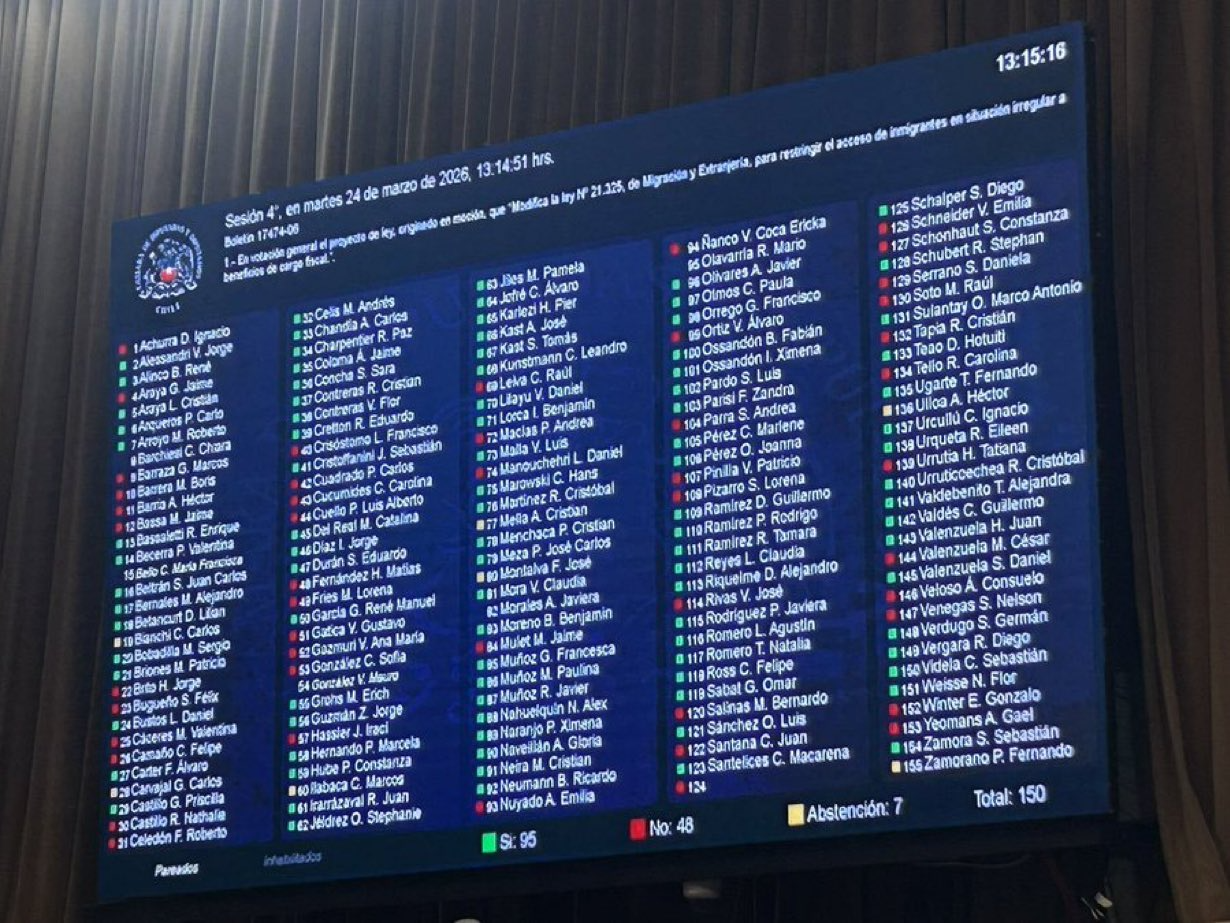
Chile's Chamber of Deputies approved a bill that restricts access to social benefits for immigrants in an irregular situation, in a measure that marks a tightening of the country's immigration policy. The initiative obtained 95 votes in favor, 48 against and 7 abstentions, and will now continue its legislative process in the Senate
.
The project, promoted by legislators from the Independent Democratic Union (UDI), National Renewal (RN) and Evópoli, introduces amendments to Law No. 21,325 on Migration and Aliens, with the objective of ordering access to state benefits and strengthening control over irregular entry into the country.
The Chamber of Deputies granted half a sanction.
One of the central points of the initiative establishes that immigrants who have entered Chile through unauthorized steps will not be able to receive any type of identification number, either temporary or permanent. This provision seeks to close a path that, according to the project's promoters, made it possible to effectively regularize irregular migratory situations through access to state services
.
To access social benefits, foreigners must have a valid identity card issued by the Civil Registration and Identification Service. In the case of direct economic benefits, such as housing subsidies or monetary aid, permanent residence will also be required, thus raising the requirements for access to
this type of assistance. Bolivian immigrants.
The approval of the project reflects a change in the approach to the migration debate in Chile, where in recent years pressure on public systems and the increase in irregular income generated a growing demand for greater controls and stricter rules
.
With half sanction in Deputies, the bill must now be dealt with in the Senate, where it will be defined if this reform becomes law and consolidates a new, more restrictive migratory framework in the neighboring country.