A new national survey revealed a favorable scenario for the Government of Javier Milei ahead of the presidential elections of 2027.
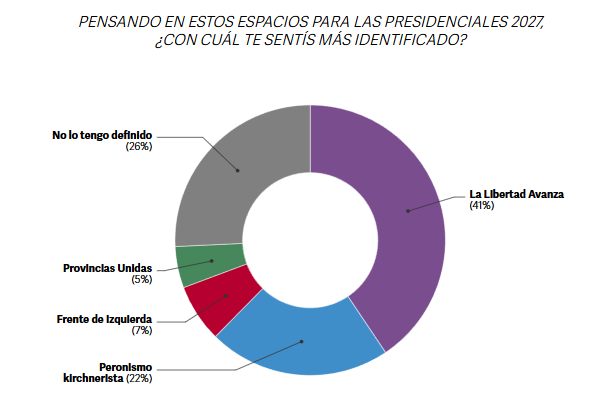
According to a study by the consultancy firm Opinaia, La Libertad Avanza is positioned as the space with the greatest identification among voters, reaching 41% in the key question of political affinity.
The survey, conducted between March 3 and 4 on 1,000 cases across the country, with a margin of error of +/- 3%, asked: “Thinking about these spaces for the 2027 presidential elections, which one do you feel most identified with? ”.
In this scenario, the space led by President Javier Milei obtained a strong advantage over its main competitors.
The Opinaia survey.
Behind La Libertad Avanza, Peronism/Kirchnerism appears with 22%, that is, practically half of the support achieved by the ruling party
.
Even more relegated are the Left Front with just 7% and United Provinces with 5%, while 26% of those surveyed remain undecided.
This fact consolidates the libertarian ruling party as the dominant force in the current political scene and projects an electoral base that, if sustained, could be decisive in the elections of 2027.
Electoral ceilings
The report also provides other indicators that reinforce this trend. In terms of electoral rejection, that is, those who claim that they would never vote for a space, La Libertad Avanza once again stands out with the lowest level among the main forces
: 44%. President Javier Milei.
In contrast, Peronism/Kirchnerism registered a 58% rejection, the Left Front 63% and United Provinces reached the highest level with 65%, with Milei's party being the only one below 50%
.
In addition, when analyzing the total electoral potential (sum of safe voting and probable voting), the ruling party also leads clearly. Libertad Avanza reaches a ceiling of 56%, comprised of 35% of safe voting and 21% of probable voting.
In second place is Peronism/Kirchnerism with 41%, followed by the Left Front with 30% and United Provinces with 35%.
These numbers reflect not only an advantage in voting intention, but also a greater capacity for electoral expansion compared to other political spaces.
The study also takes place in a context where other forces face difficulties in consolidating themselves. In particular, United Provinces shows record levels of rejection and a low level of identification, which calls into question its viability as a competitive alternative at the national level