Today it faces a different challenge: competing with imported products and a globalized market.
The executive director, Martín Nadler, explained that the drop in demand was also key. Glass bottle thermos registered a drop of close to 60% after the pandemic
.
Network criticism and support for business logic The
message generated divided reactions. Some users questioned the company's tone. Others, on the other hand, supported their position
.
Among the arguments in favor, one central one stood out: a company needs to be competitive to survive.
“An employment contract is not an adoption,” said one user. The phrase summarizes a key idea in the economic debate: without profitability, there is no sustainable employment
.
Sales recovery and commitment to growth
Despite criticism, Lumilagro assures that the strategy is starting to pay off.
The addition of new products fueled a recovery in sales.
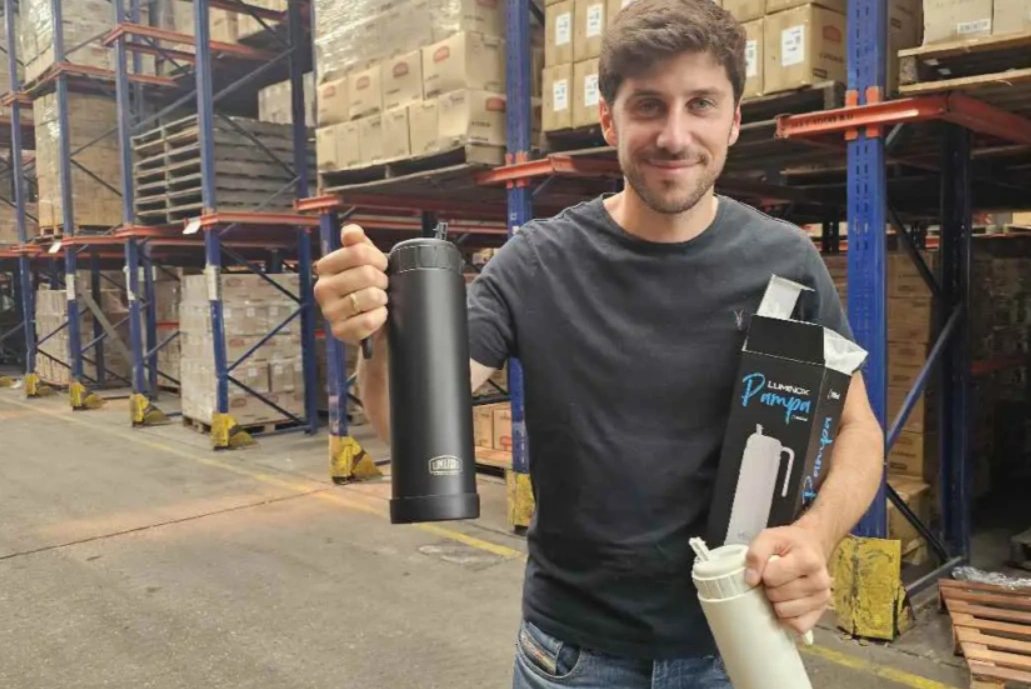
“The reception was excellent,” Nadler said.
The company is committed to continuing to grow with a more efficient structure. And it leaves open the possibility of returning to production in the country if conditions permit.
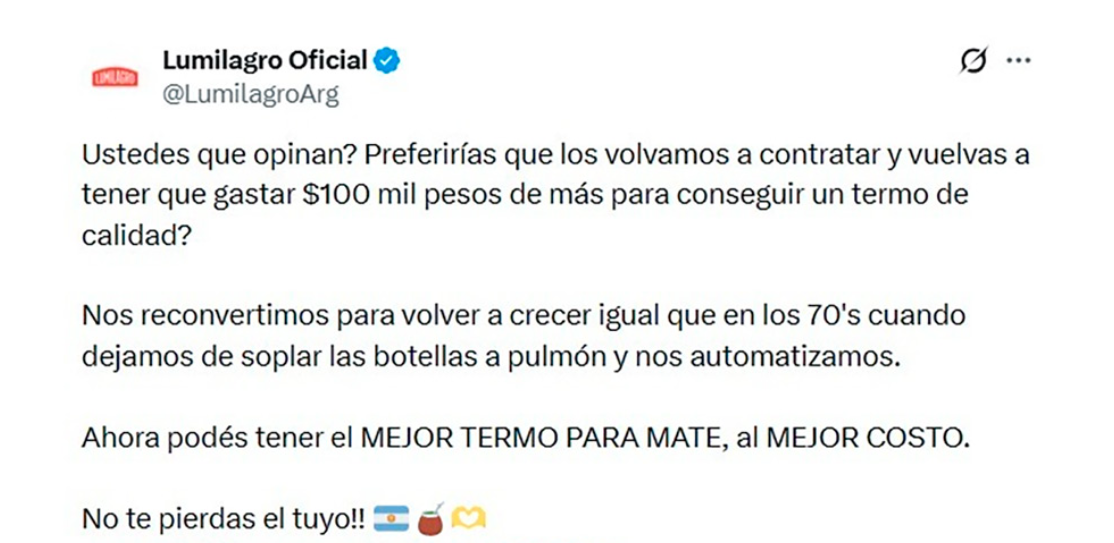
Lumilagro was at the center of the debate after a message on social networks. The historic thermos brand defended its transformation strategy to remain competitive in an increasingly demanding market
.
The company posed a direct question: “Would you rather pay $100 thousand more for a thermos?” . The message aimed to explain their decision to reduce costs and adapt to new market conditions
.
Far from being an empty provocation, the position reflects a real dilemma: affordable price or inefficient production.
Competitiveness or inaccessible prices: the dilemma of the Lumilagro market
explained that its restructuring seeks to guarantee its continuity.
The company stopped producing part of its thermos in the country to focus on importing and thus offering more competitive products.
Without these changes, prices would have been much higher. In a complex economic context, that would have further reduced sales.
The company's message was clear: adapt or disappear.
A transformation necessary to survive
Reconversion is not new. Lumilagro had already undergone similar changes in its history. In the 1970s, the company left behind manual processes to automate its production