

Within the framework of a profound reconfiguration of the public infrastructure model promoted by the government of Javier Milei, the national administration is moving forward with Phase II of the Federal Concessions Network (RFC), the ambitious program aimed at modernizing more than 9,000 kilometers of strategic routes through total private investment, without recourse to State funds. After the close of the challenge period, the bidding process continues under strict criteria of transparency, legal certainty and objective evaluation, consolidating a scheme that seeks to guarantee efficiency, predictability
and quality in the national road network.After having granted Stage I, the Government is now moving forward with Phase II A, which involves the tender of more than 1,900 kilometers of national routes, divided into two key sections for productive connectivity: South Atlantic Section - South Access: 1,325.17 km, including routes RN 3, RN 205, RN 226, and critical accesses such as the Ricchieri Highway, the Ezeiza-Cañuelas Highway and the Newbery Highway. Pampa section: 546.65 km, corresponding to the RN 5, a fundamental axis
for agro-industrial transport.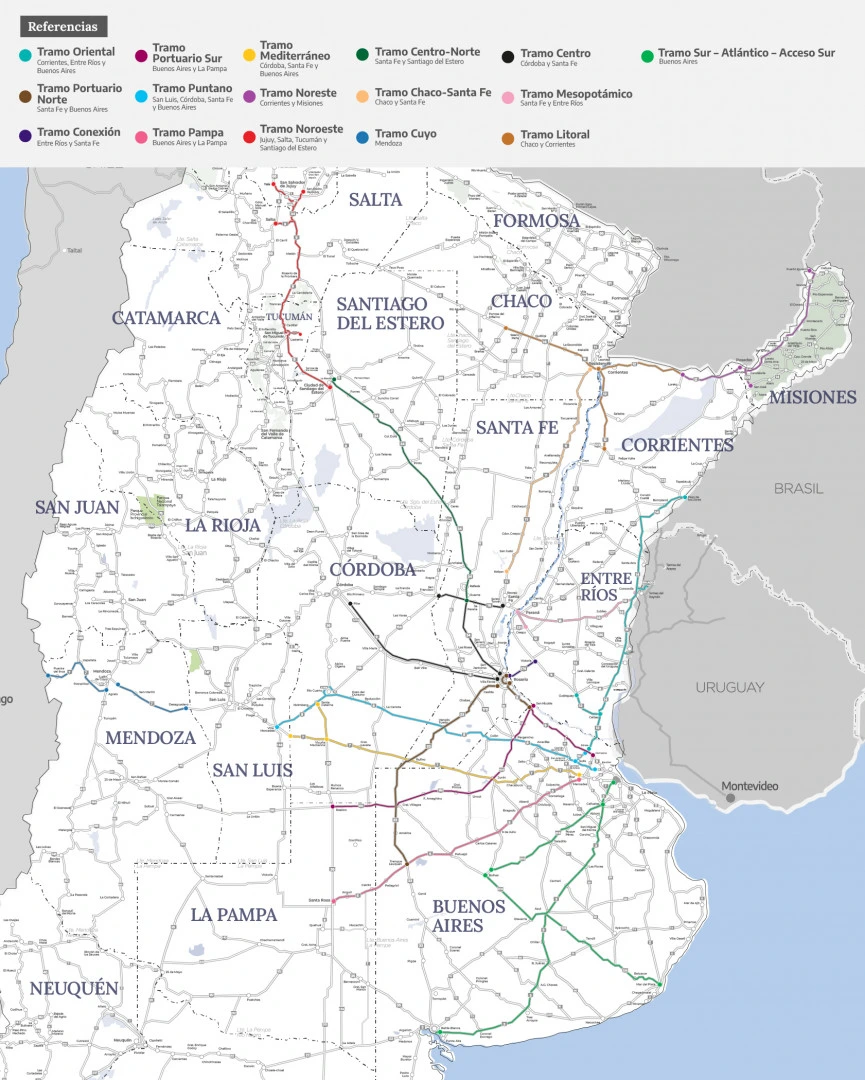
In this instance, 19 offers were received, of which 12 were accepted after proving technical capacity and financial solvency, while 7 were dismissed, evidencing the rigor of the process. In particular, in the South Atlantic - South Access section, 10 offers were submitted, with 6 approved and 4 rejected, including the one from Autopistas de Buenos Aires S.A
.The exclusion of AUBASA responded to objective technical and financial breaches, in line with the requirements established in the specifications. First, the company did not demonstrate the capacity for the direct execution of works, a central condition for ensuring that the dealer has its own resources, experience and structure, avoiding outsourcing schemes that dilute responsibilities. The documentation submitted by the firm evidenced mainly operational tasks, but not the material execution of works, thus violating one of the key requirements of the
process.Secondly, serious economic-financial inconsistencies were verified. The specifications set clear limits on indebtedness and solvency to ensure that companies could assume the risk without state assistance. However, AUBASA presented a debt ratio of 3.75, far exceeding the maximum allowed of 1.50, reflecting financial fragility incompatible with the requirements of
the system.Despite having had instances to clarify and supplement documentation, the observations were not reversed. In addition, the company did not present the account-financial balance sheet in an adequate manner, consolidating its exclusion. The Government emphasized that the criteria applied were uniform for all bidders, regardless of legal nature or jurisdiction, reinforcing the non-discretionary and transparent nature of the process. Other companies were also excluded for not meeting the required parameters
.In addition, it was emphasized that AUBASA did not challenge the specifications at the corresponding stage —which implies their full acceptance—, although it later made comments on other offers invoking regulations not applicable to the procedure. In parallel, another of the dismissed companies filed a challenge that is currently
under analysis.
state deficit to private efficiency The
Federal Concessions Network constitutes one of the pillars of Milei's economic program, based on the elimination of the fiscal deficit and the transfer of risk to the private sector. This scheme replaces decades of public works financed by the Treasury, which resulted in road deterioration, cost overruns and structural dependence on public spending. The new model is based on a regulatory framework that includes Law 27,742, together with Decrees 695/2024 and 97/2025, which enable toll concessions under Law 17,520.