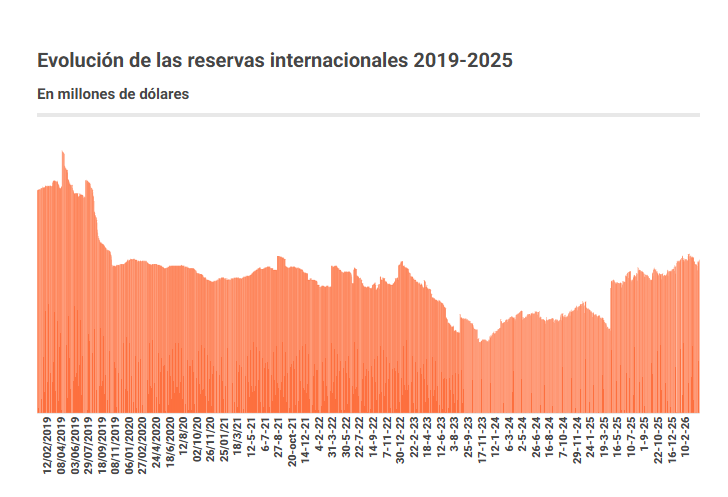

The Central Bank of the Argentine Republic deepens its monetary consolidation strategy with a historic accumulation of currencies, in a context of greater exchange rate stability and fiscal discipline. The monetary authority not only consolidates its buying position, but is also making progress in strengthening international reserves in line with the objectives set for 2026. Within this framework, the Central Bank combined 64 consecutive days of currency purchases, both inside and outside the foreign exchange market, and this Friday it finalized an acquisition of USD 457 million, the second highest under Javier Milei's management.
With this result, the agency exceeded $5 billion accumulated so far this year, reaching a total of USD 5.424 million since January, more than half of the annual objective.The previous day, on Thursday, the BCRA had purchased USD 281 million, representing the largest volume in 2026, only behind the USD 214 million purchased in February. To find similar figures, it is necessary to go back to February 7, 2025, when the daily purchase exceeded USD 300 million.
The recent performance also stands out in historical perspective: this Friday's acquisition is only surpassed by USD 468 million on April 4, 2024, while to observe a larger amount, it is necessary to go back to December 29, 2022, when the BCRA purchased USD 540 million during the term of the Export Increase Program (PIE), known as the “soy dollar”.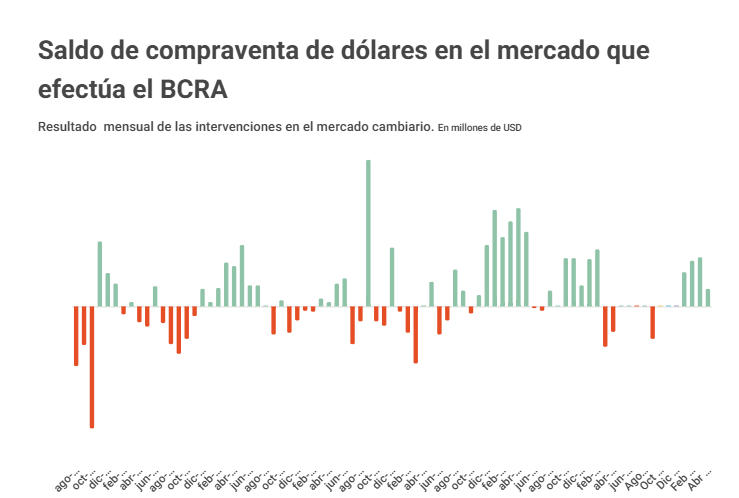
However, despite reaching 54% of the annual target, the accumulation of international reserves was partially limited by the demand for Treasury dollars to meet foreign currency maturities. A significant part of the currencies acquired was allocated to the payment of financial commitments, which prevented it from being fully reflected in the reserves.
To sustain this pace of purchases, the Central Bank issued pesos without sterilization, while the Treasury absorbed liquidity by issuing debt in local currency, with the objective of moderating the expansion of the monetary base and containing both inflation and exchange rate pressure.Official projections indicate that the net balance of purchases could be between USD 10,000 and USD 17 billion during 2026, depending on the demand for pesos and the availability of foreign exchange in the market. Along these lines, the president of the BCRA, Santiago Bausili, warned that the evolution of reserves will be conditioned by these factors. At the close of the last day, international reserves stood at USD 45,431 million, after a daily increase of USD 279 million, mainly explained by the acquisition of foreign exchange. It should be remembered that at the end of February they had reached USD 46,905 million, the highest level since 2018 and the highest level of the current administration
.These movements reflect both the payment of foreign currency obligations and the fluctuations in the valuation of assets—such as gold—impacted by the crisis in the Middle East.