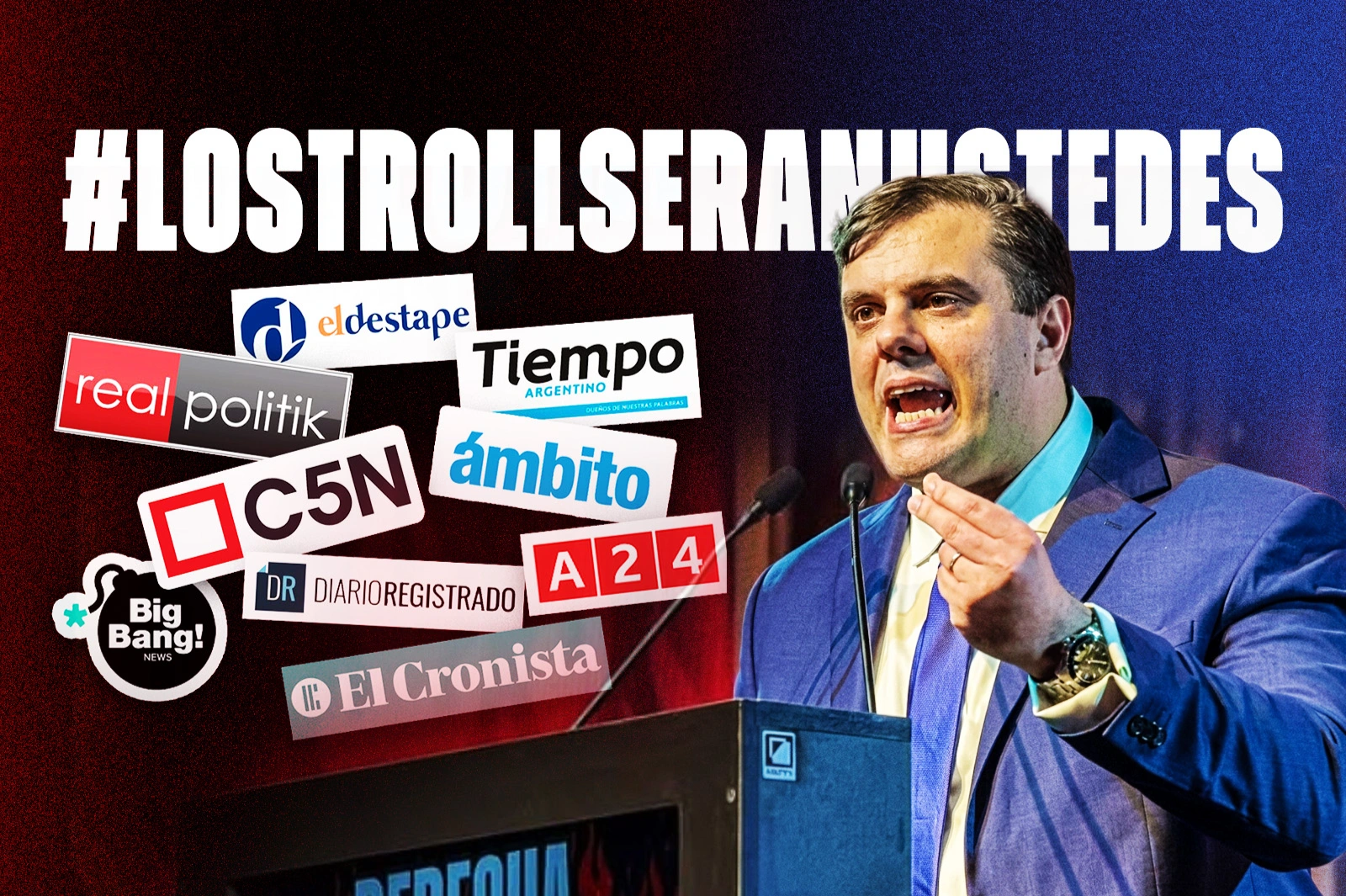
The hashtag became a number 1 trend after allegations of Russian media funding, and Daniel Parisini targeted journalists and media structures for operating against the Government of Javier Milei.
One of the most sophisticated mechanisms detected was the creation of fictitious journalists, such as Manuel Godsin, whose identity was denied when it was found that they were a virtual profile linked to pro-Russian operations. In turn, firms such as Gabriel Di Taranto, Juan Carlos López and Marcelo Lopreiatto were used to publish articles in different media, with payments that reached figures such as 28,600 dollars for 26 notes on one site, and 32,500 dollars for 17 publications in another
The impact of the case also reached internal structures of traditional media. In A24, for example, an internal investigation was initiated against journalist Pablo Winokur, identified as the alleged author of ten Russian-funded notes, while Infobae detected the participation of trade union member Juan Pablo Piscetta, who would have received nearly
1000 dollars for publishing content linked to the network.
Faced with this scenario, President Javier Milei described the operation as “of an institutional gravity rarely seen in history”, and warned that many of the actors involved could be just “the tip of the iceberg” of a much larger structure.
In parallel, the Government made progress with reforms in the intelligence system, including the amendment of the National Intelligence Act through a DNU in early 2026, with the objective of strengthening the State's capacities in the face of hybrid threats such as disinformation financed from abroad.
While the Government of Javier Milei advances against the disinformation network funded from Russia, voices from the libertarian space expose the role of certain media and journalists in the operation, reversing the dominant narrative about the alleged “trolls” and exposing a much deeper structure. In the midst of the scandal over the international disinformation network that operated against the ruling party in Argentina, the libertarian influencer Daniel Parisini, known as “El Gordo Dan”, burst into the public debate by pointing directly against what he called the “media caste”, after learning about the links between certain local media
and Russian funding.
Through its social networks, Parisini launched the slogan #LosTrollsEranUstedes, which in a matter of hours became a number 1 trend, accumulating thousands of interactions and being massively replicated among users related to the ruling party. The hashtag not only channeled the reaction of the libertarian space, but it also functioned as a discursive counterattack against historical accusations against digital government militants.
Along the same lines, the influencer hardened his position with a strong message: “BETRAYAL OF THE PATRIAD”, in reference to the revelations involving FM La Patriada —the medium of which Fabián Waldman is a member— within the framework of publications funded from abroad to install critical narratives against Javier Milei's management.El Gordo Dan in X
The statement comes in a context where international research confirmed that since 2024, a structure linked to the Russian government has deployed a systematic disinformation campaign in Argentina, based on the publication ofat least 250 paid articles in more than 20 digital media, with the objective of discrediting the ruling party, influencing public opinion and amplifying polarization. Among the media reached by this operation are C5N, Ámbito, Diario Con Vos, El Destape, Big Bang News, Registered Diario, A24, Realpolitik, Argentine Politics, Tiempo Argentino, Grito del Sur, El Cronista, Infocielo and Data Clave, among others. The maneuver included the use of false identities created with artificial intelligence, external funding for hundreds of thousands of dollars and the insertion of content with a journalistic appearance