The new withholdings leave soybeans at their lowest level in 19 years, and wheat and corn at 6-year lows
Compartir:
After the announcement by the Minister of Economy, Luis Caputo, Argentina's agricultural tax map has changed completely. With the permanent reduction of export duties, the soybean rate is now at its lowest level in almost 19 years. Meanwhile, wheat and corn have reached six-year lows.
El ministro Luis Caputo.
This was highlighted by the Rosario Board of Trade (BCR), which analyzed the immediate impact on the sector's competitiveness. The new structure sets rates at 24% for soybeans, 22.5% for by-products, 7.5% for wheat and barley, 8.5% for corn and sorghum, and 4.5% for sunflower.
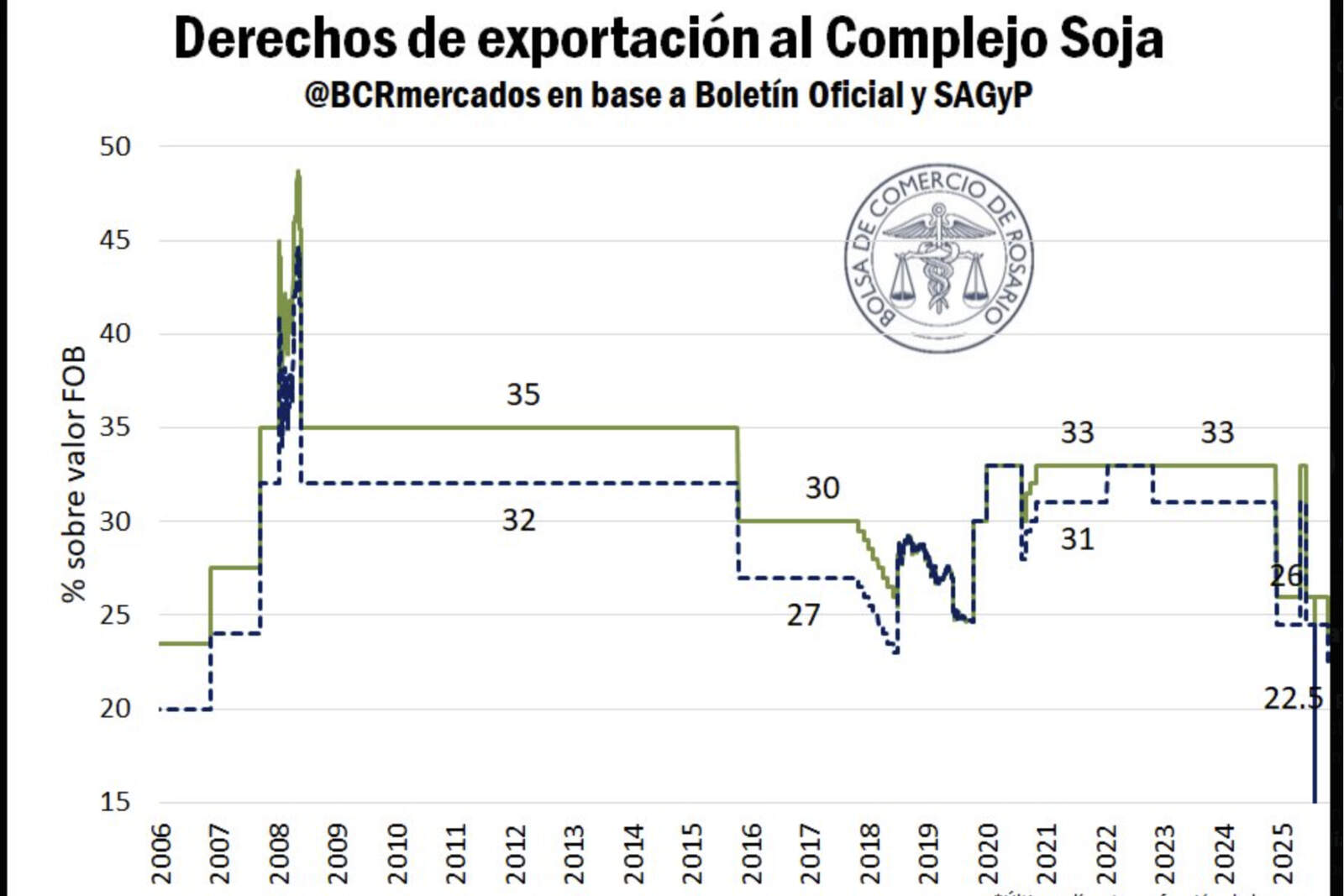
This reduction represents more than just a tax adjustment, it marks a break in the sector's historical tax burden. For two decades, this has fluctuated between peaks of 45% and long periods around 30–35% in the case of soybeans.
Soybeans: a reduction that breaks a cycle of almost twenty years
The charts published by BCR Mercados clearly show the magnitude of the change. Since 2006, the soybean rate had never fallen below the 24% range it now reaches. Even during the 2008–2015 period, the soybean complex paid between 32% and 35%, with peaks above 40% at the most critical moments of the conflict with the agricultural sector.
Evolución de los Derechos de exportación a la Soja
This is why the BCR statement was direct: "the permanent rate for the soybean complex is at its lowest level in almost 19 years".
This is a significant fact considering the weight of the soybean complex within agribusiness exports and the country's foreign currency flow.
Wheat and corn: six-year lows and greater export margin
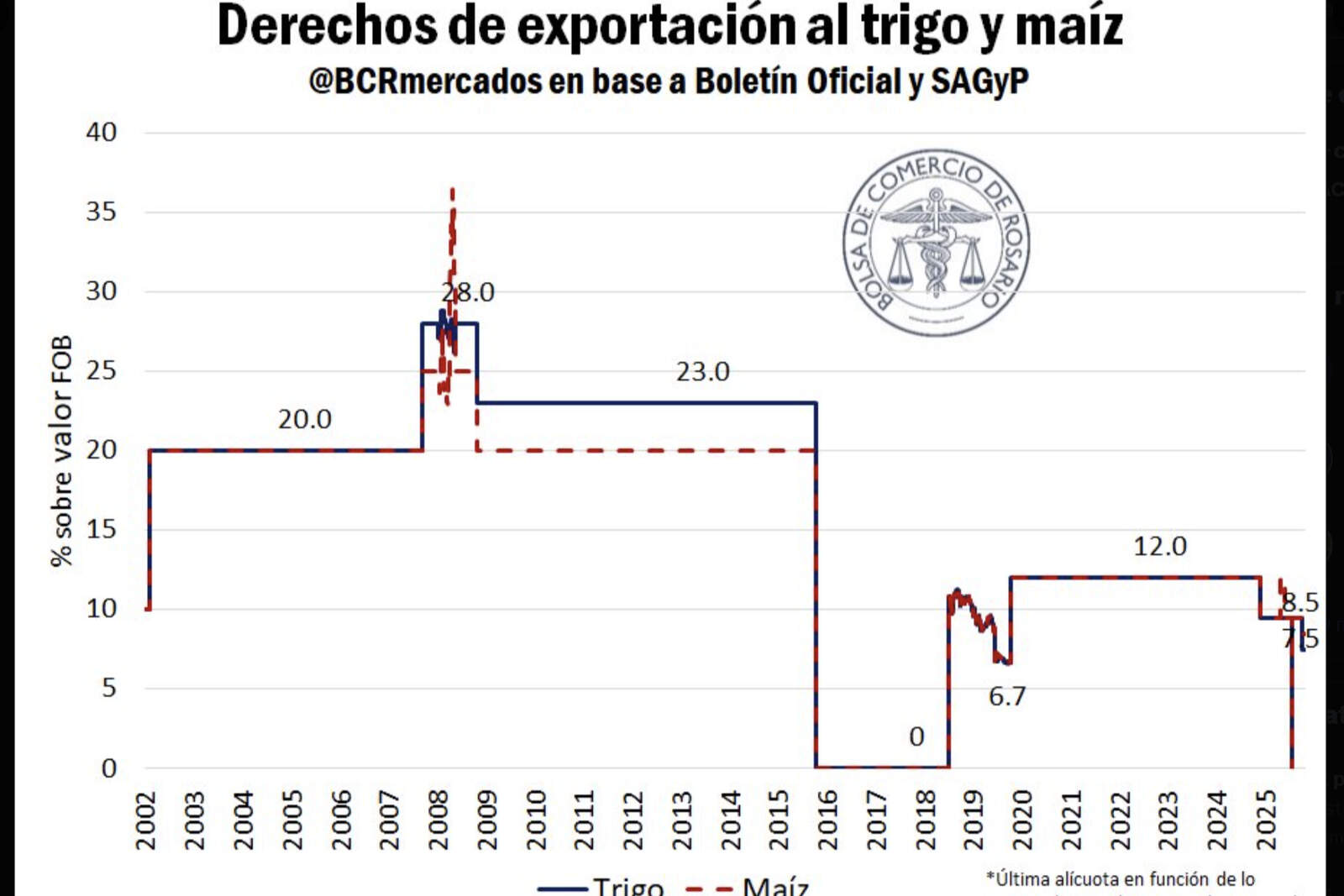
Another chart also indicates that the new wheat and corn rates have also fallen to levels not seen in six years. These crops, which once paid 20%, 23%, and even 28% during periods of high intervention, are now below 9%.
Nuevas alícuotas del trigo y el maíz
This tax relief coincides with the commercial structure detailed by the Rosario Board of Trade in a report:
More than 55% of Argentine wheat is destined for export to ports, mainly Greater Rosario (38%) and southern Buenos Aires province (Bahía Blanca and Quequén).
More than 90% of the wheat produced originates in four provinces: Buenos Aires, Santa Fe, Córdoba, and Entre Ríos.
Domestic demand is stable, around 7 Mt per season, so any improvement in competitiveness quickly impacts the exportable balance.
With a lower rate, the grain improves its margin against global competitors and reduces the origination cost for exporters and mills.
A new scenario for the productive interior
In practice, the reduction in export duties is great news for agricultural producers and regional supply chains. It also changes the marketing logic: with greater margin and less tax pressure, it becomes more attractive to set prices, close forward sales, or arbitrate external markets.
The BCR report also shows that wheat is mostly traded under purchase and sale contracts with contractual delivery. This amplifies the positive impact of each point reduction in the tax burden, especially for those operating in port areas or with integrated logistics.
For BCR, the change is not just circumstantial; it is a message that brings predictability and long-term projections. The drop in rates realigns the country with the competitiveness levels of major agricultural exporters.
Javier Milei y ''Toto" Caputo.
In this context, a signal is being sent for the future: if macroeconomic conditions are favorable, the elimination of export duties is no longer seen as an abstract horizon, but as a concrete process that has begun to materialize.