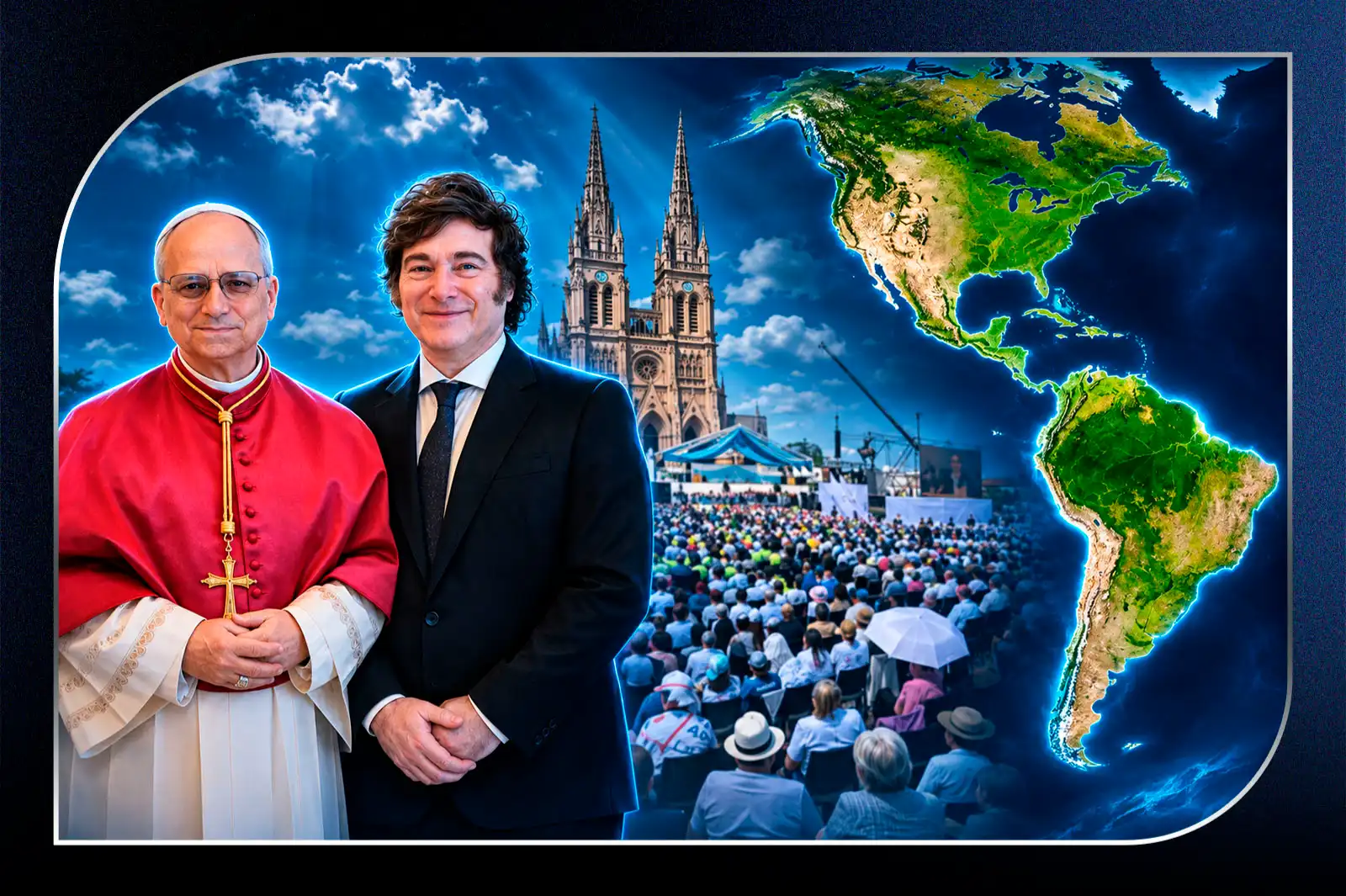

Between November 8 and 11, Pope Leo XIV made his first visit to Argentina. In just under seventy hours, he celebrated three massive masses, at the Monument to the Spaniards in Palermo, at the Military Aviation School in Córdoba, and in front of the Basilica of Our Lady of Luján, in addition to a vigil with young people in the City of Buenos Aires. More than six million people participated in the various events, marking a figure that will undoubtedly go down in history.
But the visit left more than just a demonstration of popular faith. Milei welcomed the Pontiff at the Palacio Libertad and, before representatives of the three branches of government and the entire political spectrum, framed the visit in civilizational terms. The president spoke of the Scriptures as the moral school of the West, of the School of Salamanca, of natural law, and of the need to actively defend those values. In this way, he made clear Argentina's place in Western civilization, and he did so at a time when that very civilization is questioning itself in other parts of the world.
In this context, it is pertinent to analyze what both speeches left during the visit, the contrast between America and a Europe that is retreating in its Christian faith, and the responsibility that the American continent is called to assume as a beacon of Western culture.
The moral matrix of the West
The numbers speak for themselves: more than 6 million people in four days. Luján gathered 3.5 million, while Palermo gathered 2.5 million at the mass plus another million at the youth vigil, and Córdoba around 650,000 people.
Alongside this demonstration of faith, the country heard a definition that exceeds the religious. President Milei delivered a historic speech in which he stated that "The Holy Scriptures are the great moral school of our Western civilization. The moral matrix that unites us all, even those who do not practice any faith, is shaped by its teachings." He also asserted that it is crucial to defend the right to life, liberty, and property, as they form the backbone of the Argentine Constitution and all Western democracies. On that same moral heritage, Milei closed his speech by assuring that "We all know that these values are true, and we want to defend and uphold them over time. And we know that this defense is not passive, but requires our active commitment. Honoring faith, leading a dignified and virtuous life is precisely the way to defend it against a world often bent on overshadowing it."
The next day, before a million young people at the vigil, the Pontiff warned about social networks, money, and the unbridled pursuit of pleasure, and asked them not to kneel "before that which cannot give them life." In this way, while a president was reclaiming the moral heritage of the West, a million young people listened to a Pope asking them that "no one take away the freedom that God has given them". It is a scene that today seems hard to imagine in a Europe immersed in a process of de-Christianization and that Argentinians should look at with pride.
Spain turns its back on its history
The European landscape is completely different, and the Motherland illustrates this clearly. Spaniards, by losing control of their borders, lost control over how their own population is composed. In this context, Spanish birth rates rose for the first time in eleven years. However, births from mothers born in Spain fell by 0.5%, while those from mothers born abroad grew by 4.5%. What is even more striking is that one in three babies born in Spain already has a mother born outside the country. Furthermore, the population grew by almost half a million people exclusively due to immigration, in the ninth consecutive year in which more Spaniards die than are born.
It is evident that these numbers are not a product of chance. Agustín Laje explained this week at the event Save Spain: "Spain has a population with few births, many deaths, an aging population, and a population where abortion is the norm and migratory replacement is the policy of the Spanish State." In fact, the data shows 106,172 abortions in 2024, compared to 318,005 births, meaning one in four recorded pregnancies ends in interruption. Also, a fertility rate of 1.11 children per woman, well below the 2.1 needed for population replacement.