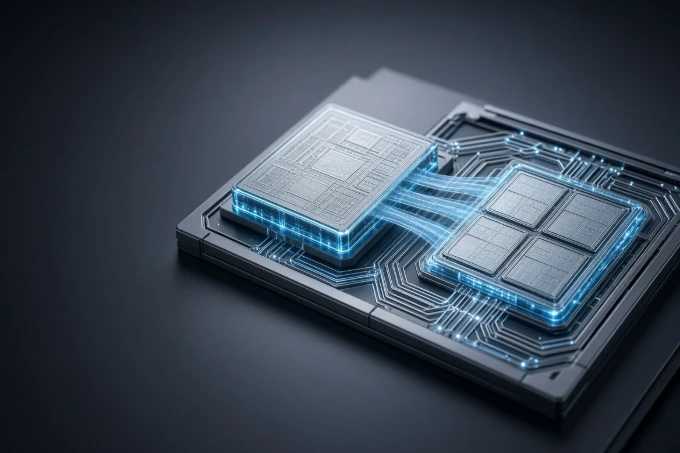
Apple announced on Tuesday two new processors that power the updated models of Mac Mini and Mac Studio: the M5 Ultra and the M6. The company described the M5 Ultra as its “most powerful chip ever,” a design that combines two M5 Max dual-die chips to form the company's first four-die processor, intended to handle intensive artificial intelligence workloads.
The M5 Ultra features a CPU with up to 36 cores, a GPU with up to 80 cores, and a unified memory bandwidth of 1.2 TB/s. This figure represents a 50% increase over the M3 Ultra, which was introduced just a year and a half ago. It is aimed at professionals performing demanding tasks such as complex 3D rendering, visual effects, and running cutting-edge AI models.
The Mac Studio equipped with this chip may also attract hobbyist artificial intelligence developers. In contrast, the M6 is more targeted at everyday users, according to Apple itself. Built with the latest 2-nanometer process, the M6 adds a new CPU complex, two additional CPU and GPU cores, a dual 16-core Neural Engine, and greater unified memory bandwidth.
“Built with the cutting-edge 2 nm process, the M6 combines a new CPU complex, two additional CPU and GPU cores, a Dual 16-core Neural Engine, and more unified memory bandwidth to tackle workloads with astonishing energy efficiency,” said Sri Santhanam, Apple’s Vice President of Silicon Engineering, in a statement.

Performance Improvements for On-Device AI
The M6's 12-core CPU complex adds two more cores than the M5. As a result, the chip offers nearly 30% more peak GPU compute for artificial intelligence compared to the M5. This improvement accelerates prompt processing when using large language models locally, without relying on the cloud.
Apple emphasized that with these chips and their development frameworks, creators can run and fine-tune large AI models directly on their Macs. “Apple’s tools and frameworks automatically optimize performance across the CPU, GPU, and Neural Engine, allowing developers to use Apple Foundation Models, App Intents to leverage Apple Intelligence features, or their own proprietary models, thus building and running powerful AI workloads entirely on-device,” the company stated in its press release.
The company arrived later than its competitors in the race for its own AI model. The anticipated update for Siri works with Google’s Gemini. However, Apple has historically excelled in using on-device technology for functions like Face ID and Touch ID, which would pose a privacy risk if processed in the cloud.
This same focus on local AI workloads could become one of its main strengths. It offers a more secure and controlled environment for developers to experiment with new artificial intelligence tools without sending sensitive data to external servers.
Availability of the New Devices
The latest Mac Minis are already available for pre-order starting at $899. According to the company, they will begin shipping after September 22. These devices, along with the Mac Studio, incorporate the new processors and aim to solidify Apple’s commitment to local performance in artificial intelligence.
The arrival of the M5 Ultra and the M6 reinforces the Silicon Valley firm's strategy to enhance its own hardware. With a clear emphasis on energy efficiency and computing power for language models and demanding creative tasks, Apple aims to position itself as a strong option for professionals and enthusiasts who prefer to work with AI privately and without relying on constant internet connections.