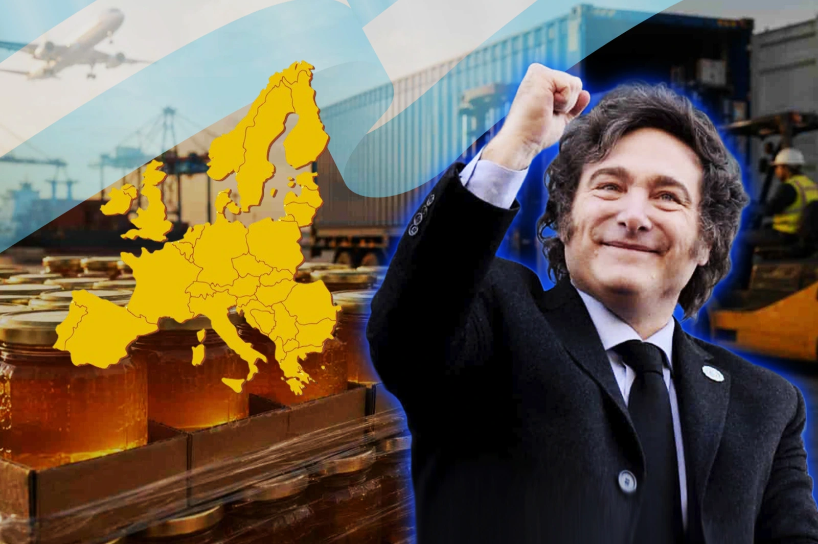
Following the start of the Trade Agreement between Mercosur and the European Union, Argentina managed to capture more than 80% of the initial honey export quota with zero tariff, consolidating its leadership within the bloc and demonstrating its operational capacity in international trade.
The initial quota, set at 7,500 tons, came into effect on May 1st and was exhausted in just four days. During that short period, Argentine exporters managed to position themselves dominantly, quickly capitalizing on a key opportunity for the agro-industrial sector.
Behind this result lies the efficiency of the national beekeeping chain, with a prominent role played by the provinces of Entre Ríos, Santa Fe, and Córdoba. The productive and export structure allowed for a swift response to the new trade scheme, marking a difference compared to other Mercosur countries.
Honey.
A milestone in this process was the first shipment certified under the new regime, which consisted of 22 tons of natural honey from Concordia, Entre Ríos, destined for Germany.
This operation not only symbolizes the effective start of the agreement but also the country's ability to immediately adapt to the new rules of international trade.
At the beginning of May, the Argentine Foreign Minister, Pablo Quirno, confirmed the issuance of the first export certificate, emphasizing that it was a clear signal that the agreement between Mercosur and the European Union had already begun to yield concrete results.
Until April 30th, Argentine honey entered the European market with a tariff of 17.3%. With the implementation of the new mechanism, exports within the quota benefit from a 0% tariff, which directly improves the competitiveness of the national product and opens new commercial opportunities.
President Javier Milei.
The issued certificate corresponds to the Interim Trade Agreement between both blocs and formalizes the export of honey under the administered quota system, with the Ministry of Economy acting as the issuing authority. This step marks a concrete advance in commercial integration and in the country's international insertion.
The Argentine performance in this first stage of the agreement also highlights its structural strength within Mercosur. With over 1.5 million beehives and solid export experience, the country has positioned itself as the main beneficiary of the new scheme, reaffirming its prominence in regional trade.
Thus, in a competitive scenario, Argentina not only seized a key opportunity but also made clear its capacity to lead processes of trade opening, consolidating its presence in one of the world's most relevant markets.