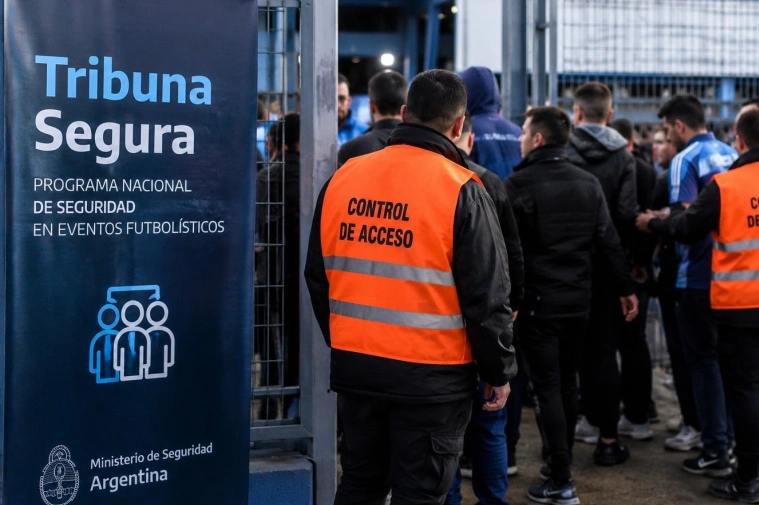
The national government has decided to expand the scope of the Safe Stand program and tighten entry controls at football stadiums across the country. From now on, individuals listed in child support debtor registries will not be able to attend sporting events while they remain in that condition.
The measure was officially announced this Wednesday through Resolution 429/2026 from the Ministry of Security, published in the Official Gazette, and affects approximately 13,000 people. The update incorporates new grounds for restriction and consolidates a control system with a unified national database.
"In light of the above, it is appropriate to adjust the current regulations to the new identified cases, in order to expand the scope of the Safe Stand Program and strengthen its effectiveness also as a tool for compliance with child support obligations", they stated in the official text.
The resolution establishes that the prohibition will apply to all individuals included in public child support debtor registries, or their provincial equivalents, as long as they remain in default. Additionally, other restrictions are also included, such as cases related to crimes covered by Drug Law No. 23,737 when they have occurred in the context of sporting events.
With this modification, the system stops relying solely on local databases and integrates information from different jurisdictions across the country. Among them are Chaco, Entre Ríos, Formosa, Jujuy, La Rioja, Mendoza, Neuquén, Río Negro, San Luis, Santa Cruz, Tierra del Fuego, and Tucumán.
From the Executive, they emphasized that the decision aims to unify criteria and avoid legal loopholes between provinces, ensuring that the restrictions have effective reach throughout the territory. In this regard, they highlighted that similar measures already existed in districts such as the City of Buenos Aires and Salta, and that the expansion of the system seeks to align with those policies.
In this way, Safe Stand adds a new control tool that exceeds strictly sporting matters and is projected as a wider mechanism for social regulation, with a direct impact on access to one of the most popular events in the country.