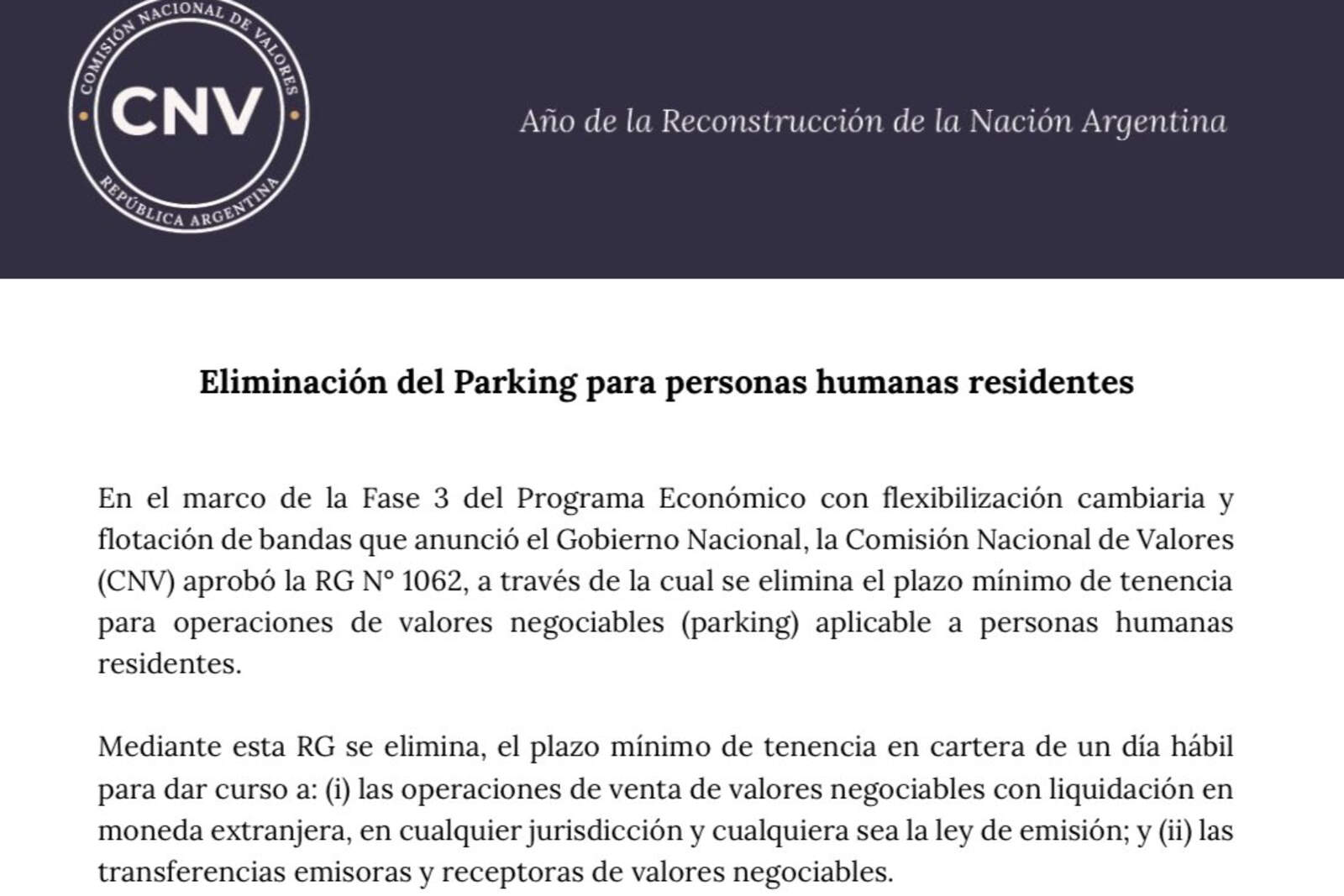
In the first hour without currency controls, a clear signal: the market trusts the new direction. With the entry into force of the new monetary regime announced last Friday by the National Government, Argentina is beginning a stage of exchange normalization and opening of the capital market. The National Securities Commission (CNV) eliminated the parking requirement for resident individuals—a minimum holding period of one business day to operate with bonds in foreign currency—a restriction that for years hindered access to the financial market.
Eliminación del parking
General Resolution No. 1062, published today, allows the purchase and sale of marketable securities settled in foreign currency—regardless of the jurisdiction or law of issuance—to be carried out immediately. Furthermore, transfers between brokerage accounts are now permitted without time restrictions.
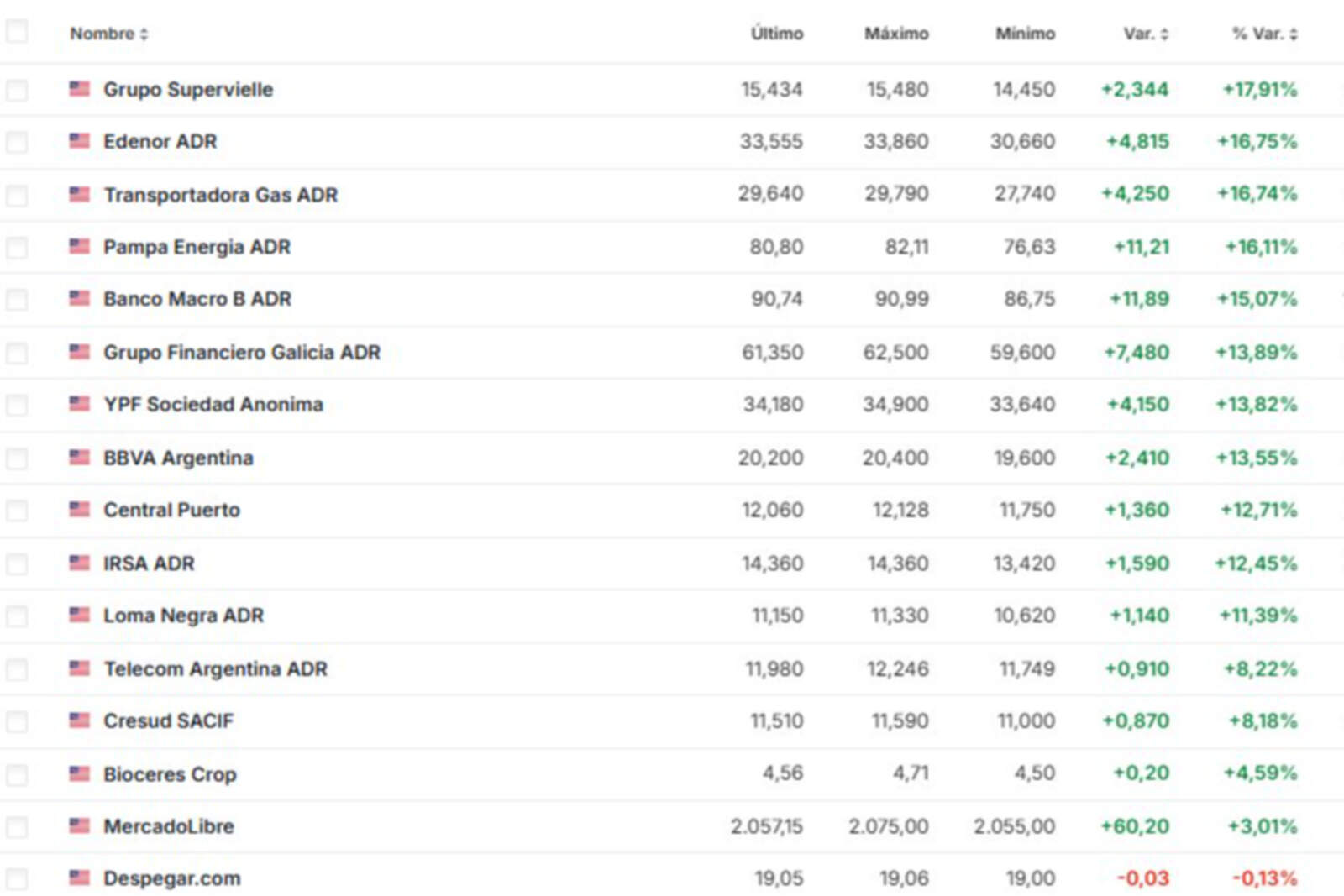
The market's reaction was immediate. Argentine stocks on Wall Street (ADRs) opened with sharp increases, led by Grupo Supervielle (+17.91%), Edenor (+16.75%), and Transportadora de Gas del Sur (+16.74%). Pampa Energía (+16.11%) and Banco Macro (+15.07%) also stood out. Trading volume was high, with Galicia ADR trading more than 566,000 shares and YPF exceeding one million.
Acciones Argentinas
Meanwhile, sovereign bonds under foreign legislation also soared. GD35 advanced +5.57% (last price: 162.88), GD41 +6.38% (58.42), and GD38 +5.46% (61.00). Argentine bonds rose between 3% and 6%, reflecting greater appetite for emerging market risk in response to signs of structural reforms.
End of currency controls and end of tax withholdings: a new exchange scenario
On the same Monday, the Revenue and Customs Control Agency (ARCA) announced another key measure: the elimination of advance tax withholdings on Income and Personal Assets taxes for the purchase of foreign currency for savings purposes. Individuals will be able to buy dollars without paying the 30% surcharge that was in effect for years. This provision takes effect today and applies to all savings-related foreign exchange transactions carried out through entities authorized by the Central Bank.
These measures are part of Phase 3 of the economic program announced by President Javier Milei, Economy Minister Luis Caputo, and the Central Bank. According to the president of the CNV, Roberto E. Silva: "We have been working since the beginning of our administration to eliminate restrictions and regulatory obstacles within the capital market, in line with the Government's policy."
Market confidence is a clear symptom: the end of currency controls not only means greater freedom to operate, but also a decisive step toward a more integrated and transparent economy.