At the close of the last day, international reserves reached USD 45,152 million, after a daily increase of USD 375 million, mainly driven by the purchase of foreign exchange and the valuation of the organization's assets.






Under Milei's management, the Central Bank accumulated USD 281 million on a historic day and extended the purchase of foreign exchange to 63 consecutive days, bringing reserves above USD 45 billion
At the close of the last day, international reserves reached USD 45,152 million, after a daily increase of USD 375 million, mainly driven by the purchase of foreign exchange and the valuation of the organization's assets.





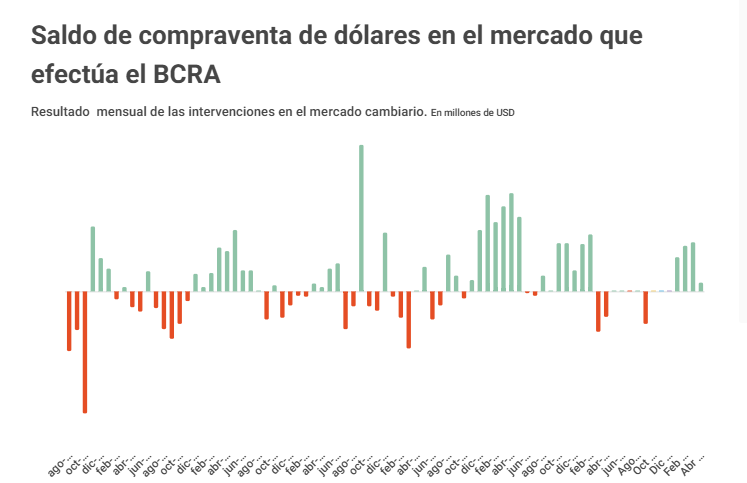
In a context of economic reorganization and strengthening of macro variables under the current administration, the Central Bank of the Argentine Republic achieved a key milestone in its exchange strategy by making the largest purchase of dollars so far this year, which allowed reserves international companies are once again above USD 45 billion. The monetary authority acquired USD 281 million this Thursday, thus linking 63 consecutive days with a buying balance in the exchange market, a dynamic unprecedented in more than a year. So far in 2026, the agency has already accumulated almost $5 billion, reflecting an active policy of replenishing reserves, although this process did not result in a linear increase in the total stock due to
pre-existing financial commitments.Since the implementation of the current monetary scheme in January, the BCRA has added USD 4,964 million, a figure that represents almost 50% of the annual goal set by the economic team. In March alone, purchases reached USD 1.67 billion, consolidating a sustained trend in foreign exchange accumulation. However, the full impact of these acquisitions was partially attenuated by the use of dollars by the Treasury to meet foreign currency debt maturies. In this way, a significant portion of the foreign exchange raised was used to fulfill financial obligations, instead of directly adding to international reserves
.
To sustain this pace of purchases, the BCRA moved forward with the issuance of unsterilized pesos, while the National Treasury complemented the strategy by placing debt in local currency, absorbing liquidity from the market. This coordinated mechanism seeks to contain the growth of the monetary base, moderate inflation and avoid pressure on the exchange rate, in line with the principles of stability promoted by
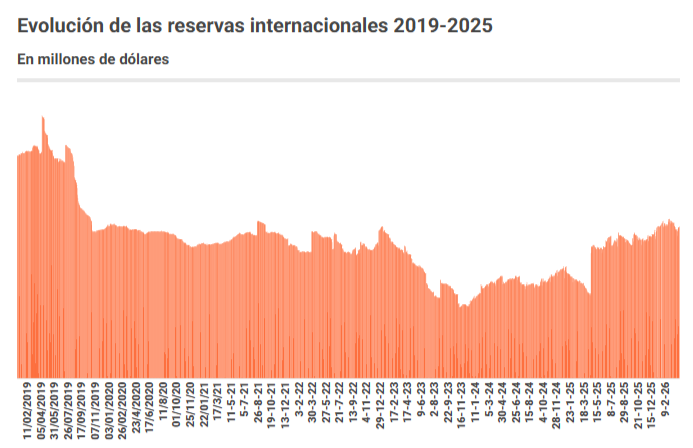
the ruling party.Official projections indicate that the net balance of dollar purchases could be between USD 10,000 and USD 17 billion in 2026, depending on factors such as the demand for pesos and the availability of foreign exchange in the market. In this regard, the head of the BCRA, Santiago Bausili, argued that the accumulation of reserves will be conditioned by these variables. So far, progress already represents 49% of the annual objective.
It should be remembered that at the end of February, the stock had reached USD 46,905 million, the highest level since 2018 and the highest level recorded during the current administration. The recent fluctuations respond both to the payment of foreign debt and to changes in assets such as gold, affected by international factors such as the crisis in the Middle East
.
In detail for the first quarter, between December 31, 2025 and March 31, 2026, the Central Bank acquired USD 4,382 million in the exchange market, signed a REPO for USD 3 billion and recorded net profits of USD 575 million as a result of price changes
.However, the BCRA's one-year liabilities increased by USD 4.206 million, as a result of the repo itself due in January 2027 and an additional fee from a previous agreement with the same maturity.
In addition, the Treasury acquired USD 3,659 million to meet debt payments, leaving the net accumulation of reserves in the first quarter practically unchanged, as explained by economist Federico Machado.Looking ahead to the second quarter, the scenario looks more favorable. It is estimated that financial obligations will decrease significantly: the Treasury and the BCRA will face payments of around USD 3.2 billion, approximately half of what was paid in the previous three months.
Added to this is the expectation of higher foreign exchange inflows driven by the liquidation of the gross harvest, which could deepen the process of accumulating reserves and consolidate exchange rate stability.